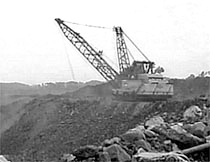
Photo by flickr user nrdc_media used under a Creative Commons license
On Wednesday afternoon, lawmakers in Washington, DC, will finally take up the fate of mountaintop removal mining, a type of surface mining that levels the summits of mountains to expose coal seams. The practice inflicts substantial damage to the surrounding environment and communities, mainly because the removed rock and soil is dumped into nearby rivers and streams, contaminating them and often burying water sources. The Senate Subcommittee on Water and Wildlife will host the first legitimate hearing on mountaintop removal in nearly seven years, titled “The Impacts of Mountaintop Removal Coal Mining on Water Quality in Appalachia.” Witnesses include leading experts on the subject, like Maria Gunnoe, a 2009 Goldman Environmental Prize winner for her organizing against the mining practice; Dr. Margaret Palmer of the University of Maryland’s Center for Environmental Sciences; and Randy Pomponio, the director of the EPA’s Mid-Atlantic region, among others.
An outspoken opponent of mountaintop removal, Sen. Benjamin Cardin (D-Md.) called the hearing to more thoroughly review the effects of the practice, a decision that comes on the back of legislation he introduced in March with Sen. Lamar Alexander (R-Tenn.) to completely ban the mountaintop removal called the Appalachia Restoration Act. The hearing also has supporters and opponents of mountaintop removal fired up: Both coal industry-friendly and environmental groups have chartered buses to Capitol Hill for the hearing, while other organizations will be streaming video of the event. (Not to mention the recent arrests of NASA’s James Hansen and others who were protesting mountaintop removal in Southern West Virginia.)
The hearing on this disastrous form of mining is momentous for several reasons. First, honest, critical scrutiny of mountaintop removal has been a long time coming, given the anti-nature Bush Administration’s support for the practice. “We have essentially been shut out by the prior administration,” says Janet Keating, executive director of the Ohio Valley Environmental Coalition. Now, however, Keating says she hopes Wednesday’s hearing will build momentum among lawmakers that could eventually lead to restrictions or a ban on this kind of mining.
The single most driving force behind that momentum is Sen. Cardin’s legislation to outlaw mountaintop removal. Cardin introduced the two-page Appalachia Restoration Act in March, and he has been forceful in his opposition to the practice, writing in a recent press release that mountaintop removal has “already has destroyed some of America’s most beautiful and ecologically significant regions” and that “We must put an end to this mining method that has buried more than a thousand miles of streams.” Cardin’s bill would remove mountaintop removal waste from the definition of “fill material” allowed to be dumped under the Clean Water Act. (Cardin’s not alone here: A similar bill in the House is also seeking to exclude certain kinds of mining waste from the defintion of “fill material” that can be legally dumped in lakes and rivers under the CWA.) The new administration has had it both ways so far: It approved 42 of 48 permits for mountaintop removal in May, yet took steps toward ending the practice earlier this month.
Not surprisingly, there’s ample opposition among Senate Republicans. Sen. James Inhofe (R-Okla.), the Senate’s resident climate-change denier, and other Republicans point to a Congressional Research Services report that says Cardin’s bill would ban far more kinds of mining than just this one, unfairly hurting the industry. Inhofe said in a statement that the legislation was a “monumental disaster as it effectively bans nearly 70 percent of U.S. coal production.” It’s unclear where Inhofe got that figure (it’s not in the CR report), but it nevertheless goes to show that the interests of the coal industry to keep the practice going will be well represented.