Flickr user In Praise of Sardines
Is the future of agriculture the neglected flower bed on Main Street? The San Francisco Chronicle reports today that Mayor Gavin Newsom has ordered all city departments “to conduct an audit of unused land–including empty lots, rooftops, windowsills and median strips–that could be turned into community gardens or farms.” If the Mayor gets his way, you could just as well get an apple from the corner mart as from a tree growing on the street corner.
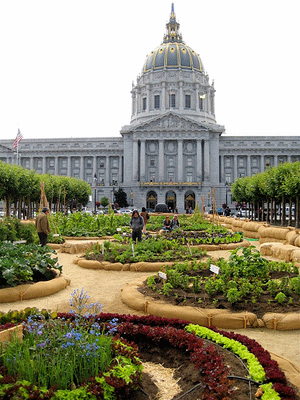
The announcement is the latest fruit from an “urban-rural” roundtable of food experts that Newsom convened last year to look for more ways to get locally-grown foods onto the plates of city residents. The effort began last summer with a quarter-acre “victory garden” in front of city hall–a big hit with locals and tourists; Newsom later announced plans to replicate the effort at 15 sites around the city. He also floated the idea of planting fruit trees on street medians, and experimented with a strawberry patch atop a bus shelter–ideas that could catch on under his new food directive.
Newsom’s move builds upon a vibrant hyperlocal agriculture movement in the Bay Area and along the West Coast. Detailed in “Inside the Green Zone” in our March/April food issue, the movement encompasses everything from professional farmers who’ll sow your backyard to urban fruit foragers who barter blackberries plucked from city parks. The efforts have taken on a timeliness in the midst of the recession as cities look for ways to fill lots that aren’t being developed and provide healthy, inexpensive food. Indeed, the original “victory garden” was planted by Eleanor Roosevelt on the White House lawn in the waning years of the Great Depression to serve as a model for rugged self reliance.
Newsom plans to go a step further by also requiring the city departments serve only high-quality food. Within two months, he’ll send an ordinance to the city’s Board of Supervisors mandating that all food served in city jails, hospitals, homeless shelters, and community centers be safe, healthy, and sustainable. Of course, the switch will be much easier in San Francisco, which consumes a million tons of food a year but has 20 tons available within a 200 mile raidius, than it would in say, New York. Still, there’s no reason an apple tree couldn’t also thrive on a sidewalk in Brooklyn.