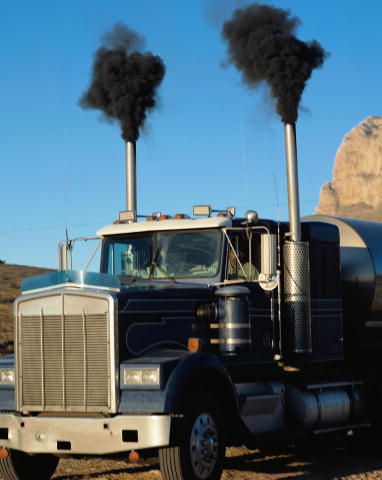
How Diesel Exhaust Grows Cancer

| Wed Sep. 2, 2009 4:19 PM PDT

A link has been found between diesel fumes and cancer and it lies in the ability of diesel exhaust to grow new blood vessels supplying solid tumors.

The new research, forthcoming in Toxicology Letters, found that more new blood vessels sprouted in mice exposed to diesel exhaust than in mice exposed to clean filtered air. The growth occurred in both healthy and diseased animals—meaning that even healthy bodies are susceptible to the damaging effects of diesel.

The problem lies in the size of inhaled diesel particles. Most are less than 0.1 micron in diameter—that's less than one-tenth of a millionth of a meter. Such tiny particles penetrate the blood stream, organs, and tissues to damage practically any part of the body.

Exposure levels in the study mimicked the exposures of people living in urban areas and of people commuting in heavy traffic. The levels were lower than, or similar to, those typically experienced by workers using diesel-powered equipment and those working along railroads, in mines, tunnels, vehicle maintenance garages, on bridges, farms, and at loading docks.

According to co-author Qinghua Sun, via The Ohio State University: "The message from our study is that exposure to diesel exhaust for just a short time period of two months could give even normal tissue the potential to develop a tumor."

The researchers found three types of blood vessel development after exposure to the diesel exhaust: angiogenesis, the development of new capillaries; arteriogenesis, the maturation or regrowth of existing vessels; and vasculogenesis, the formation of new blood vessels. All are associated with tumor growth but angiogenesis in particular can wreak havoc in the human body.

The researchers observed four ways that exposure to diesel exhaust facilitated tumor growth:

  • By activating a chemical signal, vascular endothelial growth factor, associated with new blood vessel development
  • By increasing levels of a protein, hypoxia-inducible factor 1, essential to blood vessel development when oxygen levels are low
  • By lowering the activity of an enzyme with a role in producing substances that suppress tumor growth
  • By inducing low-grade inflammation, often associated with tumor development, in tissues exposed to exhaust

"We need to raise public awareness so people give more thought to how they drive and how they live so they can pursue ways to protect themselves and improve their health," says Sun. "And we still have a lot of work to do to improve diesel engines so they generate fewer particles and exhaust that can be released into the ambient air."

Don't even get me started on nanoparticles, the next great health disaster we're enthusiastically blundering into.
 

Continues Below

Continued From Above

Get Mother Jones by Email - Free. Like what you're reading? Get the best of MoJo three times a week.

Comments

If we really want to solve this

tagged as: 

Lets get the diesel vehicles off the road, or at least make them more efficient.

This is where electric and hybrid electric plays nicely. Nice big government subsidies to upgrade or replace the big diesel vehicles. That's how we do it. This is about public health, not just economy.

Give me a break. A truck

Give me a break. A truck with black smoke certainly needs to be moved off the road until the fuel injection pump is timed properly...but how can we get the millions of diesel engines moving freight and people off the road, or even clean them up right away? Even more ridiculous is to think 2,000 lb. gasoline vehicles to move 150 lb. person don't create a problem (nitric oxides, co-2, and so on.).
Diesel engines are far more efficient than gasoline engines...providing more miles for the amount of BTU content per gallon. Mixing only 5% bio-diesel with 95% petro-diesel lowers the particulates to a far more acceptable level. Dispensing cleaner diesel at the pump (comparable grade to that sold in Europe), would also go a long way.
Not everyone in the country can afford one of your new electric hybrids...which incidentally get fewer miles per gallon on average than diesel...which can also be cleaned up with filters and other emission scrubbing devices. But it can't be done all at once, and it's unfair to suggest the working person depending on their diesel vehicle should have to shoulder the expense on their own. New vehicles should be cleaner. Older vehicles should be retrofitted with some help from the govt.

We Need the Numbers

EPA, DOT, HHS, and other relevant agencies should take a look at the numbers on this at the very least, of helping diesel equipment owners consider countermeasures and alternatives. This is a question of a tangible effect on health care costs.

It is also an issue very close to my heart. I dated a woman from Manteca, a city in California's central valley in the center of the district until only recently represented by Richard Pombo, environmental enemy number one according to many. She was a Mormon, never smoked in her entire short life, and within a year, at age 29, she went from preparing for a cross-country walk to dying in the dark of night in the UCSF hospital with a fast-growing form of lung cancer.

Post new comment

Alternately, you may login to or register an account
The content of this field is kept private and will not be shown publicly.
  • Web page addresses and e-mail addresses turn into links automatically.
  • Allowed HTML tags: <a> <ul> <ol> <li> <blockquote> <img>
  • Lines and paragraphs break automatically.

More information about formatting options

Photo Essays

When you dial a 1-900 number, who picks up the phone?
Meet the KKK's seamstress of hate couture.
The other side of Gitmo.
A photographer’s year at Angola Prison.