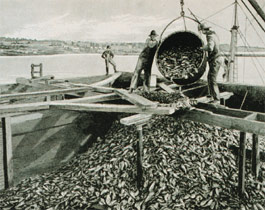
Image: Courtesy NOAA National Marine Fisheries Service
IN A 1997 EPISODE OF THE SIMPSONS, evil tycoon C. Montgomery Burns claims that, under the tutelage of relentless environmentalist Lisa Simpson, he’s become a benefactor of society because he sweeps hundreds of millions of fish from the sea, grinds them up, and turns them into “Lil’ Lisa’s patented animal slurry”—“a high-protein feed for farm animals, insulation for low-income housing, a powerful explosive, and a top-notch engine coolant.” “Best of all,” he boasts, “it’s made from 100 percent recycled animals.”
Few viewers would have realized how closely the episode mirrored reality. Mr. Burns’ real-life counterpart is Malcolm Glazer, a billionaire tycoon who controls Omega Protein, a corporation that claims to benefit society because every year it sweeps hundreds of millions of fish from the sea, grinds them up, and turns them into high-protein animal feed, fertilizer, and oil used in linoleum, soap, lubricants, health-food supplements, cookies, and lipstick. Omega has only one business, hauling in just one kind of fish and converting it into those industrial commodities. That fish is menhaden, and in 1997, just as Mr. Burns was proudly displaying his loads of ground-up fish, Omega was consolidating its virtual monopoly on what is known as the menhaden “reduction” fishery.
So what problem could there be with using the Mr. Burns process on fish that few people have even heard of and nobody eats because they are too oily and full of bones and smell awful? The problem is that menhaden are the most important fish in North America.
This little fish has long been an integral part of our natural—and national—history. Menhaden were vital to the colonization of North America and the development of 19th-century American agriculture and industry. For most of the 20th century, menhaden provided the largest catch of any U.S. fishery, annually exceeding in both numbers and weight all other fish combined. More important still, by providing food for bigger fish and filtering the waters of the Atlantic and Gulf coasts, menhaden play an essential dual role in marine ecology on a scale perhaps unmatched anywhere on the planet. And though menhaden have survived centuries of relentless natural and human predation, the current industrial onslaught on them may be unleashing an ecological catastrophe.
BLUNT HEAD, TOOTHLESS MOUTH, pudgy body—a menhaden sure doesn’t look like the superstar of coastal ecology. A mature adult is only about a foot long and weighs about a pound. Nobody will ever write a Moby-Dick about the menhaden. Yet a school numbering in the tens of thousands can weigh as much as the largest whale and behave like a single organism. Watch an acre-wide school creating flashes of silver with flips of forked tails and splashes, zigging and zagging, diving and surfacing, pursued relentlessly by bluefish and striped bass from below and gulls, terns, gannets, and ospreys from above—and you’re not so sure there’s no epic story here.
When Europeans first arrived on the east coast of America, they encountered a living river of menhaden flowing with the seasons north and south along the coast, extending out for miles, and sometimes filling bays and estuaries from Florida to Maine with almost solid flesh. In 1608, explorer John Smith found his two-ton boat laboring through a mass of menhaden in the Chesapeake Bay “lying so thick with their heads above the water, as for want of nets (our barge driving amongst them) we attempted to catch them with a frying pan.” To the Pilgrims, menhaden were just another of the bountiful sea creatures God had intelligently designed for them, as described by an awestruck Reverend Francis Higginson in 1630: “The abundance of Sea-Fish are almost beyond beleeving, and sure I should scarce have beleeved it except that I had seene it with mine owne Eyes.”
Because menhaden were essential to this natural bounty, they were a powerful hidden force in the colonization of North America. As Mark Kurlansky wrote in Cod: A Biography of the Fish That Changed the World, it was superabundant food fish that first drew Europeans—the Vikings, then the Basques, and later the British—to North American waters. Nineteenth-century scientists, partly drawing on the knowledge of generations of fishermen, concluded that menhaden, members of the same family as herring and shad, were essential to the diet of almost all Atlantic predatory fish, including bluefish, cod, haddock, halibut, mackerel, weakfish, striped bass, swordfish, king mackerel, and tuna, as well as many marine birds and mammals, including porpoises and toothed whales. As the ichthyologist G. Brown Goode put it in his monumental 1880 volume, A History of Menhaden, “It is not hard to surmise the menhaden’s place in nature; swarming our waters in countless myriads, swimming in closely-packed, unwieldy masses, helpless as flocks of sheep, close to the surface and at the mercy of any enemy, destitute of means of defense or offense, their mission is unmistakably to be eaten.” He wasn’t far from the truth when he proclaimed that anyone enjoying a meal of American Atlantic saltwater fish was eating “nothing but menhaden!”
But where did this enormous biomass of menhaden, so crucial to the food chain above it, come from? Just as all those saltwater fish are composed mainly of menhaden, all those billions of tons of menhaden are composed almost entirely of billions of tons of the tiny particles of vegetable matter known as phytoplankton. Eating is just as crucial an ecological mission for menhaden as being eaten.
Eons before humans arrived in North America, menhaden evolved along the low-lying Atlantic and Gulf coasts, where nutrients flood into estuaries, bays, and wetlands, stimulating the potentially overwhelming growth of phytoplankton. Although menhaden are the major herbivorous fish of these coasts, they don’t chomp on plants. They are filter feeders that live on phytoplankton, which most other aquatic animals are unable to eat. Dense schools of menhaden, sometimes numbering in the hundreds of thousands, pour through these waters, toothless mouths agape, slurping up plankton and detritus like a colossal submarine vacuum cleaner as wide as a city block and as deep as a train tunnel. Each adult fish can filter about four gallons of water a minute. Purging suspended particles that cause turbidity, this filter feeding clarifies the water, allowing sunlight to penetrate and encourage the growth of aquatic plants that release dissolved oxygen and harbor a host of fish and shellfish.
Much of the phytoplankton consumed by menhaden consists of algae. Excess nitrogen can make algae grow out of control, and that’s what happens when vast quantities of nitrogen flood into our inshore waters from runoff fed by paved surfaces, roofs, wastewater, overfertilized golf courses and suburban lawns, and industrial poultry and pig farms. This can generate devastating blooms of algae, such as red tide and brown tide, which cause massive fish kills, then sink in thick carpets to the bottom, where they smother plants and shellfish, suck dissolved oxygen from the water, and leave dead zones that expand year by year.
In the natural ecosystem, menhaden cleaned the upper layers while another great filter feeder, the oyster, cleaned the bottom. But as oysters have been driven to near extinction in many Atlantic bays and estuaries by overfishing and pollution, menhaden are left as the only remaining check on deadly phytoplankton explosions. Marine biologist Sara Gottlieb, author of a groundbreaking study on menhaden’s filtering capability, compares their role with the human liver’s: “Just as your body needs its liver to filter out toxins, ecosystems also need those natural filters.” Overfishing menhaden, she says, “is just like removing your liver.”
THE NARRAGANSET CALLED THE FISH munnawhatteaug, “that which manures,” soon corrupted to “menhaden” by the English colonists. The Abenaki of Maine called them pauhagen, their word for “fertilizer,” hence “pogy,” still a common name for the fish. This is the fish Squanto may have taught the Pilgrims to plant with their corn.
In the early 19th century, menhaden became an industrial-scale fertilizer for the coastal farmland of New England and the mid-Atlantic, with countless rotting fish spread out over many acres to prepare the land for crops. Groups of farmers often formed small companies—with jaunty names like Coots, Fish Hawks, Eagles, Pedoodles, and Water Witches—that owned the boats, huge nets, and draught horses necessary to catch and haul tens and even hundreds of thousands of fish at a time.
With industrialization, the demand for lubricants and liquid fuel soared, a demand at first satisfied mainly by whale oil. But after the 1850s, with whales hunted to scarcity, menhaden became America’s main source of industrial oil. By the mid-1870s, the production of menhaden oil was 50 percent greater than the production of whale oil. More than 400 sailing ships and steamships hunted menhaden up and down the coast from Maine to the Carolinas, chasing schools sometimes 40 miles long. A single haul of a purse seine would often be filled with fish weighing as much as a blue whale. Almost 100 factories extracted the oil and sold the remaining “scrap” or “guano” as fertilizer for nascent agribusiness. The menhaden reduction industry had become a major component of the U.S. economy.
The reduction fishery reached its zenith during the technological frenzy that possessed the nation in the wake of World War II. The tools of war were directed at the little fish, as leftover naval vessels were converted into menhaden ships guided by spotter planes. Locating the schools no longer depended upon a lookout in the crow’s nest of a ship wallowing amid the waves. A spotter plane, canvassing huge areas at high speeds, could quickly spy schools that ships would not have detected. Hall Watters, a former World War II fighter pilot who in 1946 became the first menhaden spotter, recalled how in 1947, flying at 10,000 feet about 15 miles off Cape Hatteras, he spied a school so big that it looked like an island. Another time, Watters spotted a school about “five city blocks in diameter” and “dragging mud in 125 feet of water,” that is, solid from the surface all the way down 125 feet to the seabed. Dozens of boats managed to surround and annihilate the entire school. “I couldn’t believe they could destroy a school that size,” Watters recalled.
The Atlantic menhaden industry was booming. By 1949, National Geographic and Life magazine were saluting it with headlines ballyhooing “Uncle Sam’s Top Commercial Fish” and “Biggest Ocean Harvest.” The catch soared year after year, reaching a peak of 1.6 billion pounds in 1956. But not even the fish’s phenomenal fecundity could sustain them under this industrial onslaught. Menhaden usually spawn far out at sea, and spotters were finding schools as far out as 50 miles, some with so many egg-filled females that the nets would come up slimy with roe. Then, inevitably, the catch began to fall. By 1969, it had plummeted almost 80 percent. Looking back ruefully on the role he and other spotter pilots had played in the demise of the species, Watters (who died in 2004 at age 79) told me, “We are what destroyed the fishery, because the menhaden had no place to hide.”
THE COLLAPSE of the Atlantic menhaden industry allowed one company to gain almost exclusive control of the endangered fishery. In 1953, during the heyday of the Atlantic menhaden industry, George H.W. Bush cofounded Zapata Corporation, a wildcatting oil and gas exploration company headquartered in Houston. After Bush sold his stake in Zapata in 1966, the company began to branch out into fishing in the Gulf of Mexico, “wringing oil out of fish,” as one business journal snidely put it. In the early 1990s, reclusive real estate mogul Malcolm Glazer took control of Zapata, installed his son Avram as president and CEO, sold off the company’s oil and gas interests, purchased the Tampa Bay Buccaneers (forcing the city to impose a sales tax, still in effect, to build a grandiose new stadium), and turned Zapata into a mere shell for a subsidiary with a jazzy new name more fit for a health-food company—Omega Protein.
The Glazers started snapping up the competition like so many menhaden. Most of the eastern seaboard companies, including some founded in the 19th century, were going bankrupt or frantically merging with each other. In 1997, Zapata took over the remaining Atlantic and Gulf competitors, leaving only one small independent in each region. In 1998, Zapata spun off Omega Protein as a separate corporation, although it still owns 58 percent of the company, which is worth a mere $145 million and is Zapata’s only remaining business. In May of that year, the Wall Street Journal noted Zapata’s futile attempts to become a dot-com powerhouse while sneering at the Glazer family’s “fish-oil empire.”
Although not exactly a household name in America (except around Tampa), Glazer has managed to become arguably Britain’s most hated man, reviled almost daily in the British press since last May, when he bought a national icon—the Manchester United soccer team—and turned it into his “corporate toy.” To finance this coup, Glazer assumed a mountain of debt. Last December, Zapata announced that it is trying to sell off Omega Protein, possibly to help service this debt or perhaps to unload the business before its troubles become too obvious.
Omega now owns 61 ships and 32 spotter planes. Only 10 of the ships and seven of the planes—all based at the company’s factory complex in Reedville, Virginia—still operate on the Atlantic coast. And there Omega has big problems.
As Atlantic menhaden have declined, their range has contracted. The biggest, most oil-rich fish used to concentrate off New England in the summer. But from 1993 until 2004, no significant schools of adult menhaden were observed north of Cape Cod. As awareness grew of menhaden’s importance to the dwindling stocks of Atlantic food and game fish, state after state banned the fishery from its waters. Today the only Atlantic states that still allow it are North Carolina and Virginia. Unable to fish in the waters of any other states and no longer able to find large oceanic schools in federal waters, which begin three miles out from the states’ coasts, Omega Protein now gets close to 70 percent of its Atlantic catch from the Virginia waters of the Chesapeake Bay. The industry has been forced “into a box,” Omega spokesman Toby Gascon told the Atlantic States Marine Fisheries Commission (ASMFC) last July. “We have nowhere else to go.”
But the Chesapeake, the tremendous tidal estuary that once produced more seafood per acre than any body of water on earth, is an ecological disaster. Historically, it was once the world’s greatest source of oysters, menhaden’s partners in filtration. But by the 1990s, overfishing and pollution had reduced the bay’s oyster population to less than 1 percent of what it had been at the turn of the 20th century. An alarming study by environmental scientist James Hagy and others in the scientific journal Estuaries in 2004 demonstrated that from 1950 to 2001 nitrogen overloads from human activities were stimulating rampant overgrowths of phytoplankton, literally choking the bay, creating ever-expanding dead zones. Benjamin Cuker, professor of marine and environmental science at Virginia’s Hampton University, has discovered that these dead zones have continued to enlarge every year since 2001: “All the way from south of the Potomac to the Bay Bridge the water below eight meters is now severely hypoxic, uninhabitable by any organism that demands any significant amount of oxygen.”
All of which makes the conservation of menhaden even more urgent. “With the oyster population gone and little hope of its return, menhaden are absolutely critical to restoring the health of the bay,” says Bill Matuszeski, former executive director of the National Marine Fisheries Service and former director of the EPA’s Chesapeake Bay Program. Bill Goldsborough, senior scientist of the Chesapeake Bay Foundation, is alarmed by the huge catch of menhaden, “the main filter feeders that keep the bay’s food web in balance,” and sees these guardians of the bay becoming victims of a deadly “perfect circle”: “Menhaden are big targets of Pfiesteria, the toxic algae known as ‘the cell from hell.’ The menhaden are ground up and fed to the big chicken farms on Maryland’s Eastern Shore. Chicken manure from these chicken farms is the dominant source of the nitrogen entering the Chesapeake from the Eastern Shore. The nitrogen triggers the Pfiesteria, which then infects the menhaden.”
Thanks to Omega’s slaughter of approximately 233 million pounds of Chesapeake menhaden each year, the fish can no longer perform their other great ecological mission: being eaten by animals higher up the food chain. The most dramatic effect is on striped bass, the bay’s signature fish.
The Chesapeake is the world’s principal spawning region for striped bass, but half the stripers in the bay are now diseased with mycobacterial infections. Some scientists now think that the stripers are sick because they are malnourished, and malnourished because they are not getting enough menhaden to eat.
Thanks to the slaughter of 233 million pounds of Chesapeake menhaden each year, the fish can no longer perform their great ecological mission.
The person who first connected the loss of menhaden with the diseases of the stripers, or rockfish, as they are known around the bay, is Jim Price, a fifth-generation waterman who used to captain a rockfish charter boat. When Price encountered his first diseased rockfish in the fall of 1997, he recalls, “It was so sickening it really took something out of me.” When he opened the stomachs of others, “I couldn’t believe what I saw—nothing, nothing, absolutely nothing. Not only was there no food, but there was no fat. Everything was shrunk up and small.”
Omega’s Gascon, who did not respond to requests for comment for this story, insists that Chesapeake stripers are suffering from neither disease nor malnutrition. After he claimed last June, “I don’t know where they’re getting that info that they’re not healthy and suffer from a lack of forage,” I decided to see for myself.
LAST JULY, I went out for stripers with Price on his 29-foot Bertram. We sailed into the bay from the four-mile-wide mouth of eastern Maryland’s Choptank River, close to where Price and the previous four generations of his family have always lived. Accompanying us were Joe Boone, an ex-paratrooper who had worked for 27 years as an estuarine biologist in the Maryland Department of Natural Resources, and Jim Uphoff, then the stock assessment coordinator for the DNR’s fisheries service. Having caught or seen hundreds of healthy striped bass in New Jersey and New York, I was horrified by what I saw that night. Except for one, every striper we caught was covered with open red sores, often eating deep into the flesh. The only fish without sores was pathetically skinny.
The three men were unanimous in targeting the problem. “It’s plain evidence of how critical menhaden are to the health of the striped bass,” Boone said. “Menhaden are the keystone species.” “This is what happens when we use our menhaden as forage for chickens rather than forage for fish,” Uphoff said, adding, “There’s nothing in this bay that can take menhaden’s place.” Boone later told me that in writing about what I had witnessed, “you can’t overemphasize the importance of this fish to the ecology of the entire East Coast.”
The Atlantic States Marine Fisheries Commission imposes limits on the catch of almost every species of commercially valuable fish within three miles of the coast—except for menhaden. When the ASMFC began hearings last year on whether to place limits on the menhaden reduction industry, it was swamped with many thousands of messages urging it to restrain Omega’s strip mining of the Chesapeake. Conservation and anglers organizations—including Coastal Conservation Association, Environmental Defense, Chesapeake Bay Foundation, and National Coalition for Marine Conservation—banded together to form Menhaden Matter, dedicated to raising public awareness. Greenpeace led a flotilla of dozens of small vessels to Omega’s complex at Reedville, where young enviros and veteran fishermen united in a floating demonstration beside the company’s fleet while inhaling the stench from its factory. In a press release, Omega’s Gascon claimed all this ruckus was instigated by “fanatical big-game angler organizations…willing to go to any lengths of deception and defamation in their attempts to expand the sport-fishing industry at the expense of the centuries-old sustainable harvest of menhaden.”
For the first time ever, the ASMFC imposed a limit on the menhaden reduction industry, restricting its annual catch in the Chesapeake for the next five years to around 117,000 tons, its average catch for the last five years. Although some argue that this merely grants Omega a license to keep doing what it’s been doing, the company has indicated that it may try to have the limit revoked by the Virginia Legislature, which has long granted the industry’s wishes, and, if that fails, go to court or even move its Atlantic fleet to the Gulf of Mexico.
Such a move might exacerbate the ominous conditions in the Gulf. Scientists there are seeing the same problems studied in the Chesapeake—especially phytoplankton blooms from nitrogen overloads—on a much larger scale. Hypoxia and dead zones in the Gulf already encompass an estimated 8,000 square miles, an area as big as the entire Chesapeake and all its tributaries. The waters directly impacted by nitrogen from the Mississippi basin are precisely where Omega’s dozens of huge factory ships are concentrated.
What purpose does the menhaden reduction industry serve by slaughtering and commodifying menhaden? Omega’s financial reports disclose that fish oil is a substitute for vegetable fats and oils, and fish meal, the company’s main product, is a substitute for soybean meal, which even the industry journal National Fisherman acknowledges “serves the same purpose.” If Omega’s main product—chicken and pig feed—is just a stand-in for soy, why not shut down or at least downsize the fishery and plant more soybeans? That would benefit fish and farmers, create jobs, and reduce nitrogen runoff, since soybeans keep nitrogen fixed in the soil.
But Omega Protein doesn’t grow soybeans.