This Little Piggy Goes Home
A kinder, gentler, and more convenient abattoir.
"here, piggy piggy," calls the man peering through the early-morning fog into a livestock trailer, a .22-caliber rifle in his hands. It is 7 a.m. in farm country outside Santa Rosa, California. A rooster crows. "Here we go. Right here."
He raises the rifle to his shoulder and takes aim. BAM! There's a thud, and a few excited squeals from the remaining pigs behind the bars. Carefully, the man sets down the gun and steps into the trailer. He emerges dragging a small, dead—but still twitching—reddish pig with a bullet hole the diameter of a pencil eraser just about perfectly centered in its forehead.
Advertisement
Advertisement
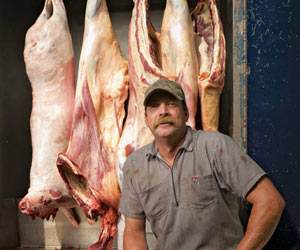
Meet John Taylor, or "One Shot Johnny," as his customers call him. His business card offers just "JT's Custom Slaughtering" and his cell phone number, along with clip art of a cow, pig, sheep, and lamb. But then, he doesn't really need a card. Just about everyone in California north of San Francisco who raises animals for meat knows the tall "ranch butcher" with the bristly mustache and straight-arrow demeanor of a frontier sheriff. Now 43, he began sweeping floors in his family's butcher shop (since sold) in third grade, and started helping his uncle in the pasture not long after. "I was doomed—I knew this was what I was meant to do," he says.
Taylor ties on a black rubber apron that hangs past the tops of his rubber boots and chains a knife holder around his waist. He sticks a hook through the animal's lower jaw and attaches it to a winch mounted on his truck. Twenty minutes of expert scraping, shaving, and eviscerating later, the pig has become pork.
The trailer belongs to Brock Fulmer, of Black Sheep Farm near Potter Valley, California, who's hauled three swine 90 minutes south from his farm and paid $50 per head to have them slaughtered on this dead-end road outside a friend's property. Fulmer could have paid just $20 per head at a usda-inspected facility two hours' drive east of his farm, but that would have required booking a slot at least a month ago. And the customer who bought these pigs for a barbecue didn't think that far ahead.
"Besides, J.T.'s the best there is," says Fulmer. "He's like a ninja."
Marksmanship is important, but so is legal savvy, since a single misstep could land Taylor in hot water. By California law, he can slaughter livestock only for a farmer's personal use or for a farmer's customer who buys the animal alive and whole; in the latter case, he has to do so off farm premises. And under federal law, every carcass Taylor delivers to a butcher shop for cutting—and every piece from it—must be stamped "Not for Sale." Only meat from usda-inspected slaughterhouses can be sold across state lines or on a retail basis (including at farmers markets and restaurants) in the 25 states without their own inspection systems, like California and New York. Taylor has something of a "don't ask, don't tell" policy with his farmers—if Taylor knew his clients were going to sell the meat he shot and officials found out, he could be liable for any food-borne illnesses, for example.
Such rules are partly why federally inspected slaughterhouses kill 98 percent of all cattle and 99 percent of hogs in this country. But as giants like Tyson and Smithfield Foods—which have their own abattoirs—have increasingly dominated the meat industry, the number of usda-approved slaughterhouses nationwide has fallen, from 1,405 in 1992 to just 808 in 2008. (Wyoming doesn't have a single one.) In 2007, just 14 plants killed 18.5 million cattle, more than half the country's total; that's a per-slaughterhouse average of 2.5 head per minute, 24-7. These big operations "are not talking to the little guy, the farmer who says, 'I have 500 head of beef'"—let alone 50 or 5, says Bruce Dunlop, who raises lamb and pork on Lopez Island in Washington state. "They laugh at him." Nor is the little guy excited to take his animals to the plant, considering the very real possibility that they will be mistreated (see the 2007 scandal involving workers at a Chino, California, facility who sprayed water up the noses of lame cattle to get them to walk to slaughter, as required by law, and moved those that couldn't walk by forklift), or that their meat will be caught in the net of a massive E. coli-driven recall.
In desperation, farmers are going into the abattoir business themselves. In 2002, Dunlop, who worked as an engineer before raising sheep, headed a group of farmers who funded, designed, and built a usda-approved mobile slaughterhouse unit that now serves Washington state's four northwest counties. A 34-foot trailer with a cooler and a water system, it dispatches up to 10 cattle a day, four days a week. Dunlop has sold six similar units for about $175,000 each to ranchers around the country. Joel Salatin, whose Polyface farm starred in Michael Pollan's The Omnivore's Dilemma, is thinking bigger: In July, with a partner, he bought a small usda-inspected slaughterhouse in Harrisonburg, Virginia.
But smaller slaughterhouses are struggling mightily to stay in business. The initial investment is steep and the payoff slow if you're not processing thousands of head each day. It takes a minimum of $2 million to build a new plant or even overhaul an old one, says Mike Lorentz, who built a 30-head-a-day facility in 1999 in Cannon Falls, Minnesota. "We lost a million dollars in the first three years. I am like a cancer survivor—exhilarated that I survived, but I wouldn't wish it on anyone."
So into the breach steps One Shot Johnny. Booked solid six days a week, he hasn't taken a sick day in more than seven years, since he impaled his hand skinning a lamb. Small farms in Northern California are raising ever more animals, but all the area's ranch butchers have retired; Taylor recently trained one other man, but he kills only a few days a week for a small number of clients. "Sure, my back hurts a lot," Taylor says. "But what am I going to do, cancel on people? This is their livelihood at stake."
Comments
Small scale slaughter and
Re: Small scale slaughter and...
Bob, can you explain?
Frankly, Trollstein, your
Frankly, Trollstein, your and other vegans' high-horse moral absolutism is tiresome. The consumption of meat will continue to be an important part of the diet of much of the world. The key to improving our lifestyle and our ecology is to farm and consume our meat responsibly and prudently, not pursue quixotic crusades to eliminate it entirely.
I find your comment
I find your comment insulting and wrong. Most people in the world eat little to no meat, with Americans consuming more meat than any other society. Factory farming has not one redeeming quality to it. It is a system built on abuse- abuse of the planet, of the workers who slaughter the animals and on the animals themselves. As a vegan I eat no meat or use any animal product whatsoever. I do this because it is a system that I disagree with and do not support, and because everything I need to sustain myself can come from plants, fruits and grains- with out slaughter. I do it because it is a positive thing that I can do to change my world. Veganism is a compassionate lifestyle not high-horse moral absolutism- I do not agree with flesh consumption. This article gives me a little faith that there are people who are trying to break the factory system, and do things more environmentally sound, and in a more humane way. I realize that Americans are not going to stop eating meat anytime soon, and I don't know if that is an attainable goal, yet high-horse moral absolutism is not a negative thing to have. It is a mind set that led to the end of slavery and equal rights for all in this country, so don't discount those that wish to make the world a better place.
More victims of the "unintended" consequences of government regs
This little piggy says: evolve.
Vegans are destroying the planet
ridiculous comments
omnivores will survive!
If you want to make a
Thank you very much. This
Here is the clue: Omnivore
Well said!
I agree with everything you stated here...absolutely. Folks truly need to educate themselves on sustainable farming- animal and vegetable. The only answer is to practice both carefully, respectfully and consciously.
Cheers.
Cherie
cheriepicked.com
This is probably the most
This is probably the most ridiculous comment i have ever read. Going vegan is good for the environment and for your body. Most societies in the world sustain themselves on plant based diets. Meat production is completely calorie inefficient. To produce one pound of beef it takes 12,000 gallons of water, several pounds of corn and emits tons of carbon dioxide and methane. the entire world could be fed if the land that was used to grow corn and soybeans for livestock was converted in to land to grow crops to feed people directly. Vegans live longer, healthier lives. Vegan living is about living as cruelty free as possible. Obviously every human action has consequences (even just moving kills bacteria on your body), but there is a big difference in planting a garden (and the accidental death of a bug or two) and the millions of animals that are slaughtered every day in this country.. ten billions animals or more a year. Get the facts before you make stupid comments.
Leo Tolstoy on small-scale-slaughter
Not long ago I had a talk with a retired soldier, a butcher, and he was surprised at my assertion that it was a pity to kill, and said the usual things about its being ordained. But afterwards he agreed with me: `Especially when they are quiet, tame cattle. They come, poor things! trusting you. It is very pitiful.' This is dreadful! Not the suffering and death of the animals, but that a man suppresses in himself, unnecessarily, the highest spiritual capacity -- that of sympathy and pity towards living creatures like himself -- and by violating his own feelings becomes cruel. And how deeply seated in the human heart is the injunction not to take life!Please read on. Tolstoy called the whole phenomena LINK: "Christianity with beefstakes".
Leo Tolstoy on small-scale-slaughter
Not long ago I had a talk with a retired soldier, a butcher, and he was surprised at my assertion that it was a pity to kill, and said the usual things about its being ordained. But afterwards he agreed with me: `Especially when they are quiet, tame cattle. They come, poor things! trusting you. It is very pitiful.' This is dreadful! Not the suffering and death of the animals, but that a man suppresses in himself, unnecessarily, the highest spiritual capacity -- that of sympathy and pity towards living creatures like himself -- and by violating his own feelings becomes cruel. And how deeply seated in the human heart is the injunction not to take life!Please read on. Tolstoy called the whole phenomena "Christianity with beefstakes".
Not only meat
Peanut Butter?
The recent peanut butter recall just shows that a vegan ...!
Northern Cyprus Holidays
Antibiotics on small farms & NAIS
Brain Cancer
Well to be honest, I dont
To Anonymous
I have no idea what you mean
Rabies in Foodies
Natural order
Trollstein: I find it
Dangerous Diets
Dangerous diets??
which healthy vegans?
istanbul hotel
" . . . you accuse him/her
istanbul rent a car
Dangerous minds
Trollstein you have the luxury of being completely clueless
"PS> of the few illnesses she had, more then half were directly after an innoculation."
now we know your observations are driven by your religious belief in veganism and your fear of technology. Its such a luxury that you can sit around thinking immunization is dangerous: it changed the game for my grandparents' generation. They watched countless friends and family die of or be crippled by stuff like Polio. now that its not around, you get to hatch your conspiracy theories.
Bravo to the posters who acknowledge that nature includes animals, which in turn eat other animals. Its such a luxury that you can sit around thinking humanity has moved beyond eating animals. My guess is you are not a farmer, have never lived in the country, and haven't ever even studied biology, ecology, oceanography, or anything related to natural systems with their various feedback loops etc. You probably think that the best thing to do to nature at this point is "leave it alone" You probably think that's what the native americans did. But you are wrong. We are participants in the natural system whether we like it or not. If we left the world to people like you, who clearly do not understand how it all works, it would go to hell in a hand-basket in hurry.
Only because you have the luxury of living in a bubble can you hold those marginal views. If you had to be in the position of actually hunting, gathering, or farming 100% of your own food, you'd change your views or die in a hurry. Go ahead, be vegan. But please stop trying to tell others they are being evil by eating grass-fed beef. Its the best thing you can do for the planet fool, along with buying from local farmers who love and nurture their land because they understand it (as you never will I'm afraid). That grass evolved to be eaten by ruminants, and its not happy without it.
USDA woes
MY HERO
Ind E Thinker
This is exactly why my
human anatomy shows we're frugivorous
Better, But Is This The Best Way to Do It?
excerpts from Please Don't Eat the Animals
No more rationalisation
Murder is murder
more excerpts from Please Don't Eat the Animals
And we're attacking vegans WHY?!?
meat is tasty
adopt plant based diet for humans, nonhumans & climate change
Post new comment
MoJo Comments: Send Us Your Feedback
We changed our spam software to better filter comments. Should you encounter any issues, please let us know.