Photo: Eugene Richards
See Eugene Richards’ related photo essay here.
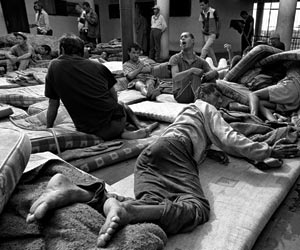
hidalgo, mexico, 1999. Though the sun is beginning to filter in through the barred windows, it’s damp and cold in the men’s ward at Fernando Ocaranza Psychiatric Hospital—no more than 50 degrees. Around the edges of the common room are tangled nests of men lying together in heaps, trying to stay warm. Others shuffle busily back and forth, as if they have a destination in mind. In the middle of the floor, running half the length of the ward, is a pool of urine.
Attendants prod a group of 15 or 20 naked men down a hallway into a shower room. The patients moan and shiver as a worker bathes them. Then they are herded back along the drafty hall, still dripping wet, and forced to compete with one another for items of clothing: shirts that cover only their shoulders, pants so large they have to be held up. A few pull on dresses, since women’s clothing has been mixed in with the men’s during washing.
At the other end of the hospital, in the female ward, frail, heavily medicated women shudder beneath fluorescent fixtures. An elderly lady who I think might have Alzheimer’s is tied to a wheelchair, her arms wrapped around herself. When I ask who she is, the attendant answers that she doesn’t know “the old one’s” name, only that she’s been here a very long time.
This was the first of many trips. Over the last decade, I’ve crossed the globe as a volunteer photographer for Mental Disability Rights International, an advocacy group dedicated to improving conditions in psychiatric hospitals worldwide. The kinds of cruelty I witnessed in Hidalgo, I’ve since seen in Kosovo, Hungary, Argentina, Armenia, and Paraguay. Overcrowded, cash-strapped mental health facilities in the United States are bad enough, but the conditions in the Third World are truly nightmarish. Patients are bathed in ice water; some are kept in rooms with no lights, while others are wrapped in straitjackets 20 hours a day. Rapes go unpunished. As of 2005, 25 percent of countries—including China, Thailand, El Salvador, Turkey, and Vietnam—had no laws protecting psychiatric patients, while as of 2002, laws in 15 percent of countries hadn’t changed for at least 40 years. It’s as if there’s a kind of worldwide agreement that once people are classified as mentally disabled or mentally ill, you can do things to them that you’d otherwise never do.
Before arriving at the Neuro-Psychiatric Hospital in Asunción, Paraguay, in 2003, I had heard rumors of an autistic teenage boy named Jorge locked in a tiny cell somewhere inside the facility. I follow one of the workers along a dark corridor to a six-by-nine-foot isolation area with a hole in the floor for a toilet, a piece of foam for a bed, and bars through which food is passed. Jorge, naked, crouches in the front part of the enclosure. When we move closer, he reaches for our hands, throats, and faces, laughing and making loud, guttural noises. Said to have been abandoned by his family, Jorge has been held for four years in this dank cell.
For two hours every other day, Jorge is let out, barefoot, into an outside enclosure where the ground is covered with broken glass. The attendants don’t speak to him; instead, they look the other way. I see a similar situation at a private group home a mile from the hospital, where a 13-year-old boy lives in a cage barely big enough for a dog. An epileptic since birth, he’s on so many sedatives that he drools constantly. Socks on his hands prevent him from sucking on fingers that were burned in a fire.
In so many photographs of the disenfranchised, subjects are shot to look wise and dignified, as if there is something ennobling about suffering. We like these images for their optimism—all that serenity makes the squalor more palatable. But all too often, when people are locked up, they lose their dignity. Psychiatric patients rarely look transcendent—mostly, they seem frightened, vacant, miserable. But shooting honest, brutal images presents another problem: That can be too much to bear. We peer in at the patients behind the iron bars and wonder if it might actually be safer with them in there. Once you meet the patients, they’re not so easy to push out of your mind. If you go into the children’s ward, you’ll hear kids screaming, banging their heads against the wall. Those could be your children. That’s the part I can’t show you.
(Richards photographed this project with the generous help of Mental Disability Rights International.)