Photo: Beawharta/Reuters/Corbis
UPDATE: Join us for an expert-led reader forum April 13-17 on MotherJones.com around the question: Is organic and local so 2008?
nestled deep in the tropical rainforest on the island of Borneo, Pareh is a collection of about 60 weathered wooden houses perched on stilts and enfolded by coconut palms, banana trees, and the dappled green overhang of the towering forest. Pareh’s inhabitants belong to the indigenous tribes of Borneo collectively identified as the Dayak. They have lived here for centuries, raising rubber trees, pumpkin, cassava, and rice, and harvesting wood for fuel and lumber.
In 2005, a group of village men went hunting in the forest several hours from Pareh and stumbled on a clearing in which the trees had recently been felled. That was how they discovered that Perseroan Terbatas Ledo Lestari, or ptll, a subsidiary of an Indonesian company named Duta Palma Nusantara, was seizing their ancestral land to establish a massive plantation of oil palms, a tree whose oil is rendered and refined into biodiesel. (One of Duta Palma’s major customers is Wilmar International Ltd, a Singapore-based firm in which US agribusiness giant Archer Daniels Midland holds a 16 percent stake.)
Over the next two years ptll destroyed 15,000 acres, which the Dayak say amounts to three-quarters of their “customary forest”—land that’s vital for their survival and to which they have certain rights under Indonesian law. The plantation also uprooted monkeys and wild boar, which began raiding the community’s food supply. Because ptll replaced diverse forest with a monocrop, pests invaded Pareh’s subsistence gardens. Rice crops failed. The Dayak filed complaints with regional and national officials; at one point they commandeered one of ptll‘s bulldozers (an offense for which Momonus, the village head, and Jamaluddin, an elder, served jail time—.pdf). The clearing went on.
Increasingly desperate, in 2007 the people of Pareh offered ptll a drastic compromise. The villagers would surrender every acre the plantation had illegally seized if the company agreed to take no more land. There was no response. Soon after, a villager obtained a ptll map showing the company’s long-term plan: It aimed to clearcut 50,000 acres, more than three times as much land as it had already taken. On the map, both Pareh and its sister village, Semunying, were gone.
Later that fall, a hunting party was searching for wild boar when the men heard the unmistakable whine of chain saws. This time, they didn’t write up a complaint—they assembled a posse. More than 60 people from Pareh and Semunying descended on the site. They found a clearcutting crew in action, protected by Indonesian army troops; by way of protest, they seized 11 chain saws. “If we didn’t do anything, our land would be gone,” a defiant Jamaluddin told me.
with governments and consumers scrambling for alternatives to fossil fuel, worldwide demand for biofuels has gone through the roof; in Europe, where more than half of all new automobiles run on diesel, consumption of biodiesel is set to triple by 2010. US subsidies for biofuels, mostly ethanol, will add up to $92 billion between 2006 and 2012, and producers in developing countries like Indonesia are often eligible for millions of dollars in development money from the World Bank.
But amid the hype, problems have emerged. Biodiesel emits less than one-quarter the carbon of regular diesel once it’s burned. But when production—and the destruction of ecosystems in the developing countries where most biofuel crops are grown—is factored in, many biofuels may actually emit more carbon than does petroleum, the journal Science reported last year. Because oil palms don’t absorb as much CO2 as the rainforest or peatlands they replace, palm oil can generate as much as 10 times more carbon than petroleum, according to the advocacy group Food First. Thanks in large part to oil palm plantations, Indonesia is now the world’s third-largest emitter of CO2, trailing only the US and China.
Yet Indonesia aims to expand these plantations from 16 million acres currently to almost 26 million by 2015. If deforestation, which is due largely to oil palm, continues at the present rate, 98 percent of the country’s forest—one of only a handful of large rainforests remaining in the world—will be degraded or gone by 2022. And although Indonesia has strict environmental regulations and formally recognizes customary land rights, those laws are only as effective as the local bureaucrats enforcing them. “For the permit certification, a guy just comes to your office and you just pay him off,” explains Ong Kee Chau, a former Wilmar executive who was responsible for most of the company’s operations on Borneo. “This is how it works.” For everyone from national politicians to struggling villagers, biofuel represents opportunity. “Oil palm is one of our areas of competitiveness,” explains Herry Purnomo, an Indonesia-based forestry researcher. “We can’t compete with information technologies or in auto manufacturing, but we have plantations.”
the only way to get to Pareh is to travel up the Kumba River, typically in a traditional wooden boat fitted with an outboard motor. When I make the trip with a researcher from Friends of the Earth-Indonesia, we arrive about two hours after sundown. Momonus and his wife, Margareta, receive us in their home. (The people I meet in Pareh all go by single names.) There is no furniture; we sit in flickering candlelight around plastic tablecloths spread on the floor. Pages of newspaper have been pasted over gaps in the walls, and in one room I read a story about girls being kidnapped and used as sex slaves by plantation workers.
After a meal of fiddlehead ferns and banana flowers, the front room begins to fill with village men who spill out onto the porch and linger in the doorway. All wear freshly washed T-shirts and jeans or khakis, and all of them smoke except Momonus, a 38-year-old with a low, solid build, dark hair, and a thin mustache. The men tell me that if the government and Duta Palma continue to rebuff them, they will resort to their machetes. (The Dayak have a history of head-hunting, although nowadays they mostly use that reputation to inspire fear.) As the meeting winds down, Julian, a young father of two, asks if anyone has been to the boundary between the forest and the plantation. Another young man speaks up. Yes, he was recently there, and didn’t see any logging.
The next day, I go with Momonus, Julian, and two other villagers to see for ourselves. On motorbikes, we navigate the ribbon of slick mud that passes for a road. After two perilous hours, we reach the land Duta Palma has seized.
The contrast between past and future is extreme. The ancestral forest is carpeted with ferns and flowers; monkeys swing from branches of wild mango, teak, and ironwood trees, and soaring above it all is a majestic canopy of dipterocarps. One of the rainforest’s iconic treasures, dipterocarps bloom just once every four years but do so in unison, their vivid red flowers erupting over millions of acres.
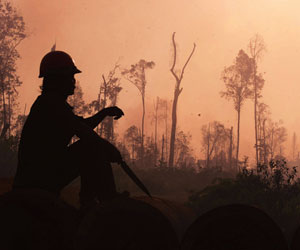
Across the road is a moonscape. Charred trunks lie prone as far as the eye can see. On the horizon we can make out a thin emerald seam—the encroaching column of palms. Duta Palma has also planted seedlings in a narrow band along the border of the community’s land, like a message written in green: The forest belongs to the palm.
We pass the area denuded last fall, and the empty military guard post set up to protect the loggers. Farther along we find a camp. A blue tarp is pitched over a platform covered with bedding and folded clothes. Momonus lifts the lid on a pot of rice; it’s still warm. He takes a stub of wood from the cooking fire and writes on the platform in thick black letters: Stop destroying the ancestral forest!!!
We hit the road again. After a few miles, we come to an abrupt halt—several recently downed trees are blocking the way. As the drone of chain saws reverberates, a few workers emerge from the trees. Unlike the people of Pareh, they have tattered clothes and black teeth. Momonus calmly exchanges words with one of them and heads into the forest to see what’s going on. When he returns 10 minutes later, his eyes shine with rage. Then another man, better dressed than the laborers, comes barreling toward us on a white motorcycle. He, too, looks furious. Momonus orders us on the bikes, and we speed away. When we finally stop, Momonus reminds me where I’ve seen the man before. He was the villager at the meeting last night who said the clearing had stopped. He is Momonus’ brother-in-law.
I have just witnessed the palm companies’ modus operandi in miniature. Operatives will proposition community members to assemble a logging crew in return for a sum that is insignificant to the company and a fortune to a villager. Some people will say no—Julian refused $6,000. But the company will keep trying until someone says yes, and someone almost always does. This helps the plantations expand into the forests, but, even more important, it sows betrayal and division that undermine the opposition.
A few days later, I get a text message from Momonus saying that the community went back to the clearing and confiscated 20 chain saws.
is there any hope for Indonesia’s rainforests—and the people who depend on them? To answer that question, I visit an older oil palm plantation, Perseroan Terbatas Bumi Pratama Khatulistiwa. It’s owned by Wilmar and located in the coastal district of Pontianak, near the village of Mega Timur. This terrain used to be tropical peatland forest, but in 1996, Wilmar began razing the groves and digging deep canals to drain the soil. Now the land is a uniform grid of oil palms. According to Greenpeace (.pdf), the destruction and degradation of Indonesian peatlands releases 4 percent of the world’s total greenhouse gas emissions.
Unlike the Dayak of Pareh, the peasants of Mega Timur welcomed the plantation, seeing it as their ticket to a better life. Many families agreed to surrender their land to Wilmar; each received in exchange a smaller plot sown with palm, with the cost of the planting passed on to the family in the form of a loan. This is a common arrangement that somewhat resembles sharecropping: The peasants are obliged to sell their harvest to the company at a set price, regardless of the market rate. The Wilmar plantation siphons off half the money as payments on the planting loans; it also deducts fees for roads and drainage systems, fertilizer and pesticides, harvest collection, security and administrative charges, and a deposit into a mandatory savings account. After almost a decade of working with the company, none of the smallholders I talk to know how much they’ve earned, how much they’ve saved, or what portion of their loans they’ve paid. They do know, however, that floods are common now that the wetlands are gone. Several times a year their fields are submerged, sometimes for weeks on end.
Wilmar is currently under scrutiny for illegalities at three other plantations, including logging protected areas, using fire to clear trees, forcibly removing peasants and indigenous people, and operating without proper permits. These activities violate Wilmar’s own social responsibility policies, as well as the standards of the Roundtable on Sustainable Palm Oil, an industry-led oversight group the company belongs to, and the International Finance Corporation, a World Bank agency that has provided Wilmar tens of millions of dollars. After considerable pressure from Indonesian activists, both agencies have launched investigations. The industry group’s probe ended last year after Wilmar promised to make improvements.
My last stop in Indonesia is the Center for International Forestry Research, a serene, wooded compound where more than 100 top scientists are working out ways to protect the world’s forests and their peoples. Researcher Herry Purnomo is part of an international team that has devised a plan to pay developing countries to leave the trees standing. Known as the Reducing Emissions From Deforestation and Degradation initiative, the program is projected to cost a mere $12 billion annually worldwide—not bad considering that the US government has spent $126 billion on post-Katrina reconstruction. But international agencies and Western governments have promised only $1 billion so far—”nowhere near what there needs to be,” Purnomo says with frustration.
While I was in Pareh, some village men asked if I wanted to see the 11 chain saws they’d seized the previous fall. They led me to a hiding place and took out the orange-handled saws one by one, carefully placing them in a straight line on the ground. A few minutes later they meticulously arranged them in a circle. I could tell how proud they were: The chain saws were trophies of their bravery. I also realized that despite all they’d been through, the villagers continued to see the saws as bargaining chips, a monumental misperception of the size and scope of their opponent.