What's Your Water Footprint?

What's Your Water Footprint?

whats-your-water-footprint-300x200.jpg

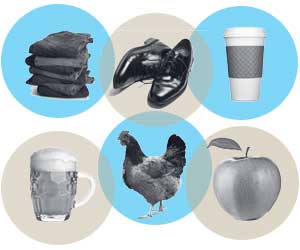
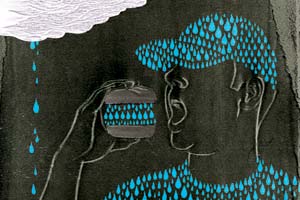
Nice jeans. Too bad they cost the planet 2,866 gallons of precious H2O.

ON THE EDGE of Jim Diedrich's 1,500-acre almond and tomato farm is a rustic office where his son would normally be sitting in front of a flat screen, controlling a superefficient drip irrigation network. But he'll have some more time on his hands this summer. California is in the midst of its most severe drought in nearly 20 years. And to make things worse, two years ago a federal judge ruled that pumps in the Sacramento-San Joaquin Delta were killing off the threatened delta smelt. And so Diedrich's farm outside the Central Valley town of Firebaugh is receiving almost no irrigation water this year. Sitting in his office, commiserating with a neighboring farmer, he griped, "It's unbelievable the power of the goddamn wacko environmentalists."

Then his neighbor, Shawn Coburn, turned toward me and demanded if I knew how much water it took to grow one almond, a cantaloupe, or a pound of tomato paste. (I didn't. Turns out it's 1 gallon, 25 gallons, and 55 gallons, respectively.) "The people in the city, they don't know what their footprint on nature is," he scoffed. "They sit there in an ivory tower and don't realize what it takes to keep them alive."

Advertisement

Advertisement

Even in thirsty California, where the battle lines between the big rural irrigation districts and urban water utilities were drawn long ago, this was a new angle on an old argument. The farmers' complaint underscores a curious, often unexamined aspect of our relationship with water: Even as the greenest among us cut our showers short and let our toilets go yellow, we may be blissfully unaware that our household water use accounts for only 6 percent of the water that we consume. The other 94 percent comes from the products we buy, everything from almonds and tomatoes to blue jeans and microchips. (See "Big Gulp.") The average person in the developed world drinks a gallon of water each day but "eats" another 800 gallons. And as Americans, our water consumption per capita is twice the world's average. Each one of us uses enough water annually to fill an Olympic-size swimming pool—four times what someone in Yemen uses.

In an effort to get consumers, companies, and entire countries to recognize the true costs of their water use, a few environmental groups are promoting the concept of our "water footprint." The idea "very much brings the water problem to the people," explains its creator, Arjen Hoekstra, scientific director of the Netherlands-based Water Footprint Network. Just as calculating carbon footprints has encouraged—and shocked—many Americans into seriously considering their personal environmental impacts, Hoekstra hopes that water footprinting will reveal the gushing faucet behind every purchase we make. "And then it shows that maybe people can do something about it."

We've got a long way to go. In the past 50 years, the world's water use has tripled. More than a third of the western United States sits atop groundwater that is being consumed faster than it's replenished. Half of the world's wetlands are gone, killed off in part by irrigation and dams, which have destroyed habitats along 60 percent of the planet's largest river systems. Since 1970, the population of freshwater species has been halved; one-fifth of all freshwater fish vanished in the past century—an extinction rate nearly 50 times that of mammals. And consuming more water has concentrated pesticides and fertilizers in what's left over: It's unsafe to swim or fish in nearly 40 percent of US rivers and streams, and polluted water sickens nearly 3.5 million Americans a year.

Farmers often get blamed for these water woes. Take California, where agriculture uses 80 percent of the state's water. According to the Pacific Institute, better conservation on farms in the semiarid Central Valley could save 1.1 trillion gallons of water a year. That's almost enough to supply all nonfarm uses in Nevada, Arizona, and Colorado. But adopting efficient technologies like drip irrigation systems and computerized moisture sensors is too expensive for many farmers, whose profits depend on shoppers with no sense of a vegetable's water footprint but a keen eye for a penny's difference in price. The federal government sends mixed signals on conservation: The estimated $263 million the farm bill annually spends to get farmers to save water is dwarfed by the roughly $5 billion it hands out for growing water-intensive crops like rice, soybeans, and cotton, often in parched regions like Arizona. All of which conspires to keep water flowing freely and cheaply without regard for scarcity or impact.

To put an end to these perverse incentives, the Alliance for Water Stewardship, a partnership between a water industry trade group and five environmental organizations, including the Pacific Institute and the Nature Conservancy, wants to reward farmers who minimize their water footprints. By 2012, AWS aims to begin certifying businesses as "water stewards" and possibly introduce a "blue" ecolabel that would identify water-friendly products on grocery store shelves.

Devising this label is a lot trickier than coming up with a feel-good logo. A field of cotton in Alabama and one in California can use the same amount of water but have very different environmental impacts; cotton is more sustainable in the humid South than in the arid West. "We often say everything about water is ultimately local," says Brian Richter, a water scientist at the Nature Conservancy's freshwater program. That's why the alliance's footprint certifiers will use a formula that balances the size of a farm's water footprint with its efficiency and impact on its watershed. Yet deciding exactly how that formula should work will take years of research and debate. "Water is not like carbon, which has impacts that are fairly evenly distributed around the globe," Richter says. "You have to approach water stewardship in a fundamentally different way."

Water footprinting has already caught the attention of some large, PR-savvy corporations. In the past two years, 50 companies, including Coca-Cola and Levi Strauss, have signed on to the United Nations CEO Water Mandate, making a loose commitment to cut their water use and encourage their suppliers and customers to do the same. Last year, Unilever, the Dutch and British conglomerate that buys 7 percent of the world's tomatoes, announced that in making its Ragú pasta sauce it would favor California tomatoes grown by farmers who use efficient drip irrigation systems. "We're highly reliant on water as a source material," explains John Temple, the company's sustainability director. "If we don't have a handle on water availability, we might not have the business in the future."

In April, the Finnish food conglomerate Raisio became the first company of its kind to print a product's water footprint on its packaging. In the absence of an internationally accepted footprint formula, it had to devise its own. Spokeswoman Heidi Hirvonen says the move was in response to "an increasing consumer demand" for this kind of data. Yet other large food companies and some members of the Alliance for Water Stewardship argue that consumers won't fully understand a water-footprint label, let alone a more sophisticated "blue" label that factors in how and where water is used. "It's very hard to find the words to make it clear enough for people to understand," explains Stuart Orr, the World Wildlife Fund's representative at the alliance. He thinks the campaign should focus on showing companies how they can minimize their exposure to water scarcity by creating a "bluer" supply chain.

Water footprinting may also clash with some tenets of the sustainability movement. Locally grown, organic, or fair-trade food might seem less appetizing if consumers knew it was grown using water from fragile salmon habitat or a depleted aquifer. "For some of those people who are heavily involved in the food-miles issue, the water issue throws a complete curveball," Orr notes. "Should we rely on countries that have a lot of water and allow them to trade that through foodstuffs?" In other words, could it be better for a shopper in Los Angeles to buy an avocado from water-rich New Zealand than from Southern California's irrigated desert? (See "Liquid Assets.")

The answers to such questions hold promise and peril for farmers such as Jim Diedrich. The Alliance for Water Stewardship plan could deem the entire Sacramento River watershed unsuitable for use in irrigated agriculture, or it could embrace farmers like him who've invested heavily in conserving water.

For now, however, he doesn't feel like he's part of the solution. On a recent afternoon, he climbed into his Dodge Laramie with his golden retriever, Joey, and drove through his fallowed fields. He passed a jumble of blue pipes, part of his $20 million drip irrigation system, which uses a third of the water of his old furrow system. "We paid more for that drip system than we paid for the goddamn ground," he grumbled. It didn't seem fair that he'd been cut off from his carefully allotted supply while nearby farmers with grandfathered water claims were still flooding their fields. "We're trying to be the most efficient as we can, and now we get no water."

If the water sustainability movement can navigate through the tangle of existing water rights, it might lay the groundwork for an entirely different approach to regulating agriculture. Water could be parceled out to the farmers who use it most efficiently and with the least environmental impact. Much as a cap-and-trade program would make manufacturers compete for the right to spew CO2, farms could compete through efficiency for the right to suck up water.

California's unending cycles of drought might ultimately compel it to adopt a footprint-based solution. Under such an arrangement, says Jason Morrison, program director for the Pacific Institute, farmers who are the most responsible irrigators could be guaranteed subsidies or interest-free loans by the state—and maybe even water—during drought years. This approach, combined with the launch of a blue ecolabel, would create a profitable incentive for farmers to save water. It could even forge a truce between conventional farmers and the "environmental wackos" who have been their traditional foes. Diedrich, for one, told me he liked the notion of getting a loan during dry years in exchange for reducing his—and, by extension, my and everyone else's—water footprint. "That would probably be a good deal," he said. "You wouldn't have to take a welfare check, either."

Josh Harkinson is a staff reporter at Mother Jones. For more of his stories, click here.

Get Mother Jones by Email - Free. Like what you're reading? Get the best of MoJo three times a week.

Comments

Water Footprint

Good God, you've found another BS end of the world scenario to worry about!

It's been one thing after another since I entered college 50 years ago.

Don't you ever get tired of peddling these panics?

What is it about these panics that appeals so to the knucklehead leftist?

If you really need an end of the world religion, try Christianity and God.

God's Footprint

Dude, if you don't want to think about what's going on in the world around you, why are you reading Mother Jones?

Well put! Maybe GOD will

Well put!
Maybe GOD will save the water...hehehehehe

How come the real culprit gets off scott free?

Why is is that Mother Jones is unwilling to call out the single biggest water hog in this country: Meat production and the American diet.

"In 1978, Herb Schulbach (Soil and Water Specialist, University of California Agricultural Extension), along with livestock farm advisors Tom Aldrich, Richard E. Johnson, and Ken Mueller, published extensive research on water use in California agriculture in the journal Soil and Water (no. 38, fall 1978). They concluded that the average pound of beef produced in California required 5,214 gallons of water."
(From 2,500 Gallons All Wet? by John Robbins)

Even by the cattle industry's own self-serving estimate, it takes at least 441 gallons of water to produce a pound of beef (presumably in less arid regions of the country than California).

Viewed in this light, 55 gallons of water for a pound of tomato paste is a puny extravagance indeed.

>> Article on water use: 2,500 Gallons All Wet

That's right... ignore the

That's right... ignore the problem, and then it's not real! If it makes me uncomfortable, I'll just pretend that it's hysteria! Brilliant! I can return to my self-imposed stupor of false security.

Meanwhile, I'll get hysterical over utter fantasy and unfounded fears of fascist takeovers of health insurance, as I champion the virtues of our perfected for-profit delivery system.

Ignorance is magical! No go water your unicorn.

Agriculture does NOT use

Agriculture does NOT use "80% of the state's water." In an average year of precipitation, the states gets about 200 million acre feet of water from all sources, mostly precipitation. Of that, irrigated agriculture uses about 34 million acre feet out of the 82 million acre feet of developed water - water that we can capture and control with reservoirs and canals. The environmentalists, tell others that ag uses 80%, because they SUBTRACT the 48 million acre feet of developed water that is released for fish and wildlife, and then claim that ag uses 80%. The fact is, 65% of Central Valley farmers have invested heavily in water-saving technologies (over $500 million this decade) and they have increased crop yields by 89% over the past 40 years using about the same amount of water. Under the Endangered Species Act, over 4 million acre feet of agricultural water has been taken for fish (from ag - not urban users) since 1991. Better water-saving technology is a good thing, because farmers have to pay for their water, but when they are told they will get zero% of their annual allocation, it doesn't matter how they water their crops - zero of zero is zero and you can't buy expensive technology with zero of anything.

Modern wave and tidal power

tagged as: 

Modern wave and tidal power generation would power desalination and pumping of sea water. End of shortage. Except for two problems:
1. Certain so called environmentalists oppose such measures as an effront to their eyes, even though the power is totally clean and limitless.
2. This would require long term thinking and action, something the USA is extremely bad at, mainly because hyper-capitolism is by its core nature, very short term oriented.

Water Shortage on the horizon!!!

tagged as: 

The mere threat of loosing one of our most necessary natural resources is enough for me to be worried. Why are global corps. buying up water rights everywhere then? We need to start living as part of the ecosystem.

conserve water, energy, AND natural resources: go veg!

Half the water consumed in the U.S. goes to irrigate land growing feed and fodder for livestock. Huge amounts of water are also used to wash away their excrement. U.S. livestock produce 20 times as much excrement as does the entire human population, creating sewage which is 10 to several hundred times as concentrated as raw domestic sewage. Animal wastes cause 10 times as much water pollution than does the U.S. human population; the meat industry causes 3 times as much harmful organic water pollution than the rest of the nation's industries combined.

Meat producers, the number one industrial polluters in our nation, contribute to half the water pollution in the United States. The water that goes into a 1,000 lb. steer could float a destroyer. It takes 25 gallons of water to produce a pound of wheat, but 2,500 gallons to produce a pound of meat. If these costs weren't subsidized by the American taxpayers, the cheapest hamburger meat would be $35 per pound!

The burden of subsidizing the California meat industry costs taxpayers $24 billion annually. Livestock producers are California's biggest consumers of water. Every tax dollar the state doles out to livestock producers costs taxpayers over 7 dollars in lost wages, higher living costs and reduced business income. 17 western states have enough water supplies to support economies and populations twice as large as the present.

Overgrazing of cattle leads to topsoil erosion, turning once-arable land into desert. We lose 4 million acres of topsoil each year and 85 percent of this loss is directly caused by raising livestock. To replace the soil we've lost, we're destroying our forests. Since 1967, the rate of deforestation in the U.S. has been 1 acre every 5 seconds. For each acre cleared in urbanization, 7 are cleared for grazing or growing livestock feed.

One-third of all raw materials in the U.S. are consumed by the livestock industry and it takes 3 times as much fossil fuel energy to produce meat than it does to produce plant foods. A report on the energy crisis in Scientific American warned: "The trends in meat consumption and energy consumption are on a collision course."

Nor can fish provide any help here. There are signs that the fishing industry (which is quite energy-intensive) has already overfished the oceans in several areas. And fish could never play a major role in the worlds diet anyway: the entire global fish catch of the world, if divided among all the world's inhabitants would amount to only a few ounces of fish per person per week.

The American Dietetic Association reports that throughout history, the human race has lived on "vegetarian or near vegetarian diets," and meat has traditionally been a luxury. Studies show the healthiest human populations on the globe live almost entirely on plant foods--useful data, given our skyrocketing healthcare costs. Nathan Pritikin, author of The Pritikin Plan, recommended not more than 3 ounces of animal protein per day; three ounces per week for his patients who had already suffered a heart attack.

Obviously, then, the idea of providing the entire world with a Western-style diet is absurd. But what about satisfying today's demand for meat--which provides only a fraction of the population with a Western-style diet? If the world population triples in the next 100 years, and meat consumption continues, then meat production would have to triple as well. Instead of 3.7 billion acres of cropland and 7.5 billion acres of grazing land, we would require 11.1 billion acres of cropland and 22.5 billion acres of grazing land.

But this is slightly larger than the total land area of the six inhabited continents! We are desperately short of forests, water and energy already. Even if we resort to extreme methods of population control: abortion, infanticide, genocide, etc...modest increases in the world population would make it impossible to maintain current levels of meat consumption. On a vegetarian diet, however, the world could easily support a population several times its present size. The world's cattle alone consume enough to feed over 8.7 billion humans.

It's a good thing to be

It's a good thing to be aware of all the uses of water and how much we're likely to need in the future, but let's not talk about its use in the same terms as, for example, fossil fuels. When fossil fuels are used they're used up. Water, by contrast, comes and goes around in a cycle; the waste water households use gets recycled at the sewage plant and used again, or gets washed into the sewer and then the local waterways, where it often evaporates and comes down again as rain.

The tone of this article does seem alarmist to an unwarranted degree.

Although we learned in

Although we learned in primary school that Water is a renewable resource, the current water consumption rates are much larger than the rate at which it is renewed, not to mention the chemicals that waste water treatment plants fail to eliminate (Encocrine Disrupting Compunds for example). This is also happening with soil, which is renewable in the long-term but we are using it faster than it can form. The next 'panic' subject (if not already) will be 'loss of fertile soils'. There is no use in continuing to think these reports are alarmist... wake up!! we are not living in a limitless world!

Hey everyone, check out my

Hey everyone, check out my new website. I read the news, then get mad at it.

www.joshfulton.blogspot.com

The meaning of a "water shortage"

The above commenter misses the point. In California, the problem is not that water is disapperaring, it's that so much of it is being diverted from the environment that there is no longer enough left to support fish. Diversions for irrigation are a major reason why the state's smelt and salmon are endangered. But in other places, water is essentially vanishing. Across much of the west, groundwater is being extracted faster than it is replaced. Some of this water is "fossil water," meaning that it takes so long to be replenished that it might as well be oil. Like fossil fuels, this water does "go around in a cycle," but it's a cycle that takes thousands of years to complete.

Wait...

So you're saying the "Local Foods" movement isn't good because it promotes inefficiency (say, by trying to grow crops in areas where there aren't abundant supplies of water)?

Color me shocked! Just once, I'd love to see a prominent environmentalist actually think a program through.

Something for Shouting Thomas to think about...

In 1959, 50 years ago, there were less than 3 billion people on the planet. Today there are over 6 billion of us. Best guestimate, barring a 'BS end of the world scenario' playing out in the meantime, in 2059 the world population will be significantly more than 12 billion men, women and children.

With that many people occupying the planet's finite space, the probability rises that something will happen, or is already happening, that will prove catastrophic to hundreds of millions of us. The size of those numbers - the scale of that potential suffering - literally boggles my mind.

Doomsayer or prophet - only time will tell which pundit is which. In the meantime, I'll listen for the common-sense portion of their hype, and do what I can do...like the little sign in the bathroom: "If it's brown, flush it down. If it's yellow, let it mellow."

Ecology & Techniques

Well Shouting Tomas, water is important and we should not waste it in any case. Anon; I am not sure who uses 80 percent of California’s water, but while farms use their share, food production is important. I live between Stockton and Sacramento and we have loads of vineyards and other nice crops. Trollstien, you invent and build that tidal generator and run it for ten years in salt water and see if you are making a profit. As for de-salination plants, that takes electricity and so you can hook that to your tidal wave electric generator. And Melissa; you poor thing. Try not to worry so much.

As I said, my wife and I live in the San Joaquin valley in central California. I am originally from S. Dakota and I notice that while many Californians talk a good game about "being green", as many Californians do not follow through. California is only now beginning to mandate that all communities use water meters. From my childhood in SD, I recall every house having a water meter. Each month the water meter reader guy would knock on the door and go into the basement and read the meter. Without water meters and indiviual water billing, we in CA have little incentive to conserve water.

We Californians are fortunate to live in a state where weather is mild and the terrain is rich, it is easy to either let the “green” thing slide, or to come to the mistaken conclusion that green solutions involve the wonders of high technology and big dollars.

An example is tending the grass. I use a plug-in electric lawn mower, and awhile back I came across a used, push-type manual mower i.e.; the type where the barrel-type blade is driven by the mower’s wheels. The mower only cuts when you are pushing it. I live in typical CA small city style (Lodi has about 40 or 50 thousand population), with small front and back yard and typical 3-bedroom ranch style home built in about 1960. I use the manual push mower for two times in a row, and the third time I use the electric mower. The clippings left by the manual push-mower help shade the grass a bit and hold water; generally reducing the stress from our usual hot weather. Also, I use a stick-type (i.e. manual) sidewalk edger, and for getting after the areas close to trees and a flower pot my wife set in part of the yard, I have a $10 squeeze-type garden scissors. For clean-up, I use a broom and bucket. My electric mower cost $240, the manual mower cost about $20, the manual edger cost $12, and the lawn scissors cost $10. My total "sunken" cost is $240 + $20 + $12 + $10 = $282

My bi-weekly operating cost is low; zero cost to run the manual tools, maybe two kilowatt hours to run the mower once every third time round, and one six pack of beer (for each mowing) costs $6.

My neighbour on the other hand (with similar house and yard) has a gas mower (cost $240), gas lawn edger (cost about $140) an electric weed-eater (cost $100) and a gas leaf blower (about $100). He mows the yard the same as I do i.e., once every two weeks. However he bears the cost of gasoline, makes tons of noise, and also “bears” the same beer cost. Hey, whether one is green of not, beer and tending the lawn go together well! However then my neighbour was putting on the pounds and has started at the gym ($75 per month), and his wife bought a $300 treadmill machine.

My neighbor's sunken costs are: the mower ($240) + edger ($140) + weed eater ($100) + leaf blower ($100) + treadmill ($300) = $880

He bears a bi-weekly recurring cost of: Gas for the machines ($5 each round) + one six pack beer ($6) = $11

Finally, he carries a monthly recurring cost for gym membership of $75.

My point is that “being green” does not always mean spending money or employing high-technology solutions. Many times it can simply mean using your brain and throwing a little effort into things.

Now, my wife says that it takes energy to make beer too, but since Joe (my neighbour) and I probably consume the same amount, I consider that a fixed, or sunk cost. Surely it is not without value qualitatively, but it is difficult to quantify.

...

While growing cotton in the South may be 'water' efficient, it's often grown in CA where the land and water is replenished by yearly flooding, which would happen whether or not there was cotton grown there. In the deep South, there are areas that can't sustain any crops because cotton bears a heavy toll upon the soil balance, making it unable to grow more cotton!

But strangely, these points are ignored for the wailing of 'oh no, fish and wildlife use most of our water, not agriculture!' and 'oh no, that cotton used thousands of gallons of water,' nevermind that as fabric or insulator it will last for decades, maybe centuries in human use.

No mention of meat?

Meat production, particularly pork and beef, consume HUGE amounts of water, -- far, far more for equivalent food value -- than any other kind of agriculture. Reducing or eliminating meat consumption would go a long, long way toward easing the water deficit. As a vegetarian, I treat myself to the occasional long shower -- completely guilt-free.

Factory farming of animals

Factory farming of animals not only uses copious amounts of water but pollutes large amounts as well. Additionally, it uses large qtys of power inefficiently and consumes (wastes) vast food resources, as far as grains and other plants. Since much of this utilization is directly or indirectly government subsidized, everyone pays the bills. If not for: a. corporate welfare and b. disgusting practices--such as feeding chicken-squat to milk cows (for add'l protein), a hamburger would cost about three bucks. Then, less animal would be consumed and in turn, less people would wind up in intensive care (with congestive heart failure and cancers.) So part of the overall health-care burden would then be removed from society's shoulders.
Too bad meat consumption is a defacto religion. (It is the only religion in the world which is also a biological toxic-addiction.)

Ka-Ka fuels

tagged as: 

Sweden bio-gasses its sewage and offal into consumer gas and topsoil improving fertilizers! Howcum Factory Farms can't be mandated into processing that horrible stinky Shiite, thereby reducing the smell-pollution and disease spreading pollution and giving us fuel and top-soil improving fertilizers - radiated to sterile for our safety! As far as changing the basic fabric of the "American Dream" -fewer showers, smaller families, less beef on the table, forget it! These are conventions grown into our very physiognomies, change them, and we no longer exist! Elvis is not dead, Michael Jackson now has tea with him on some tropical island, and they are served by Marylin Monroe! The Stetson hat will be in style forever, The Harley Davidson complete with 1920's engine will never be beat! Corvettes reign as the greatest sports car of all time, and let the Jack Daniels flow forever! We in America will sit on 17th century designed "Crappier" toilets from Europe until the end-times and beyond, and no amount of science will ever change our farming techniques, we will salt the soil, drive Cockshutte tractors and deep-till just the way G d intended, and drive away in our pick-up trucks even if the gasoline costs one soldier a gallon and comes from China's claims in Turkmenistan! And don't you Goddamn forget it! We like Shiite in our drinking water, lakes and streams, we won't ever eat fish, and veggies are for fagots not working men! Smoke a pack a day, paint your neck red, grow a "Mullet" and be as American as you want! Its a "Free" country! Ford's 1932, V - 8 engine was the last word in human propulsion and still reigns in the U.S.A. today and forever and diesels are no damn good and stink! so there! What did you do for your country today?

Verical Farming Tecniques

I agree Femtobeam, about the farming techniques, but hey, we ought not to forget about a little beer and a fair amount of humor.

If I paid the neighbor kid to mow my lawn, the wife would just find something else for me to do - something which might not included drinking beer :)

My point is that in addition to developing high-tech wonders that help clean the environment, we should all pitch in where we can, we can pitch if more often than we think, and it need not be a crashing bore.

We ought to clean up after ourselves (and teach our kids the same); a good way is to leave any place we use (e.g. the picnic area, park, or beach) cleaner and nicer than we found it. In our family we try to make this sort of thing a quick little routine.

It is nice to be "clean and green", but it is dull to be grim about it. The upshot is that ife is no fun if every day is a " worry about the planet" day.

Mention of Meat

You are correct Jim; we could probably all stand to eat less meat. Just look around and see how hefty the average American is.

I notice this especially when we visit and return from Chile (my wife has family there). It seems the Latin Americans' recipe for staying trim is quite simple. First (in Chile anyway), while they of course eat some meat, Chileans tend to eat more fish and lots of vegetables and fruit. Secondly; while thankfully most Chileans comfortably eat three good meals each day, they do not waste money on snacks between meals. Third; since most households have only one car at most, folks make routine use of busses and trains, and so they walk a bit more than we do. They do not much walk "for excercise"; they walk to and from the local markets, the bus and train stations or the taxi-stop. While Latin Americans love soccer of course (futbol), the notion of excercising for its own sake is not that prevalent. Finally, they prefer hot drinks like tea or coffee. Of course they like an occasional cold soda, but soft drinks are not as popular there as here.

In our house, we have one meatless day each week. On that day my wife cooks either some fish or sometimes just some vegetatble dishes.

Mention of Meat

And how could I forget dance and fun - the Salsa, the Cumbia, and the Mambo!

Mention of Meat

And how could I have forgotten the fun part - dance - Salsa, Cumbia, and Mambo!

yeah

It's true that we are consuming massive amounts of water (without even knowing it) when we go to purchase a cup of coffee or a pair of jeans. If you want to really get into water consumption, check out water consumption levels from the meat industry. (As mentioned above.) Since we'll always need diapers and jeans, it's clear that we need some major policies to regulate water use in producing everyday items. There have got to be alternative ways.

Water

tagged as: 

Water is a special resource in that it is renewable and static; global and local. The Chinese, for example, are destroying their water resources. This matters to us in America, but only to the extent that it affects China. If they use more water, the supplies available to us will not change. If we use less water, it will do nothing to alleviate their problem and if we use more it won’t exacerbate it. It is different with air, where the pollution from China directly impacts the air over the U.S. I am only using China as an example because of its extreme levels of pollution. The example works other places too.

You never “consume” water and the question about whether or not you wasted water is completely meaningless w/o specifying location. And each drop of water has been through countless kidneys, been part of a billions of baths, be respired by plants for billions of years and still comes to you the same as before.

That means the whole premise of this article is silly, as silly as trying indeed to make a footprint in water and for some of the same reasons. You cannot treat water like you might resources like oil or even a completely renewable one like wood. If you insist on having a lawn in the middle of the desert, the water you spray on the grass will be wasted locally, but it simply recycles into the earth system.

Water management can be complex, but it is a series of particular local decisions. You do not have global "water footprint". Let’s not try to apply the puritanical quasi-religion that we are sinning by “wasting water”. That childish formulation gets in the way of real water management.

So...

Water is just dematerializing, huh? Strange thing, like something out of a bad sci-fi movie.
And just as likely.
Yep, takes a lot of water to grow the corn, and resultant livestock and mass produced Food Corp. grocery store isle filler we're all programmed to consume. But, come on, the water isn't disappearing. The cycle may not be rejuvenating the available resource fast enough to compete with our consumption, but it will- given a chance to.
Think, people.
If it's such an issue, and you want to make your small contribution to a solution, get out and get to growing. Remember Victory Gardens? Never to late to state a new Garden movement. At the very least, support local agriculture, fisheries, and indigenous livestock movements. Stop buying the canned and frozen junk, where and when possible.

"Criminals thrive on the indulgence of society's understanding..."

Years of drought on the

Years of drought on the Colorado River, below-normal rainfall and snowpack in the Sierra Nevada mountains, combined with environmental restrictions on pumping water, have severely reduced the region’s water supply. http://bit.ly/Ad77f . As a result, we are currently heading into Mandatory Conservation. What this means is that restrictions or fines on water usage could be imposed in order to address our water shortage. Therefore we need to make a conscious effort to reduce and minimize our water usage. Easy things we can do to help save water include fixing leaky sprinklers, installing water efficient shower heads, flushes and sprinklers. Check out all the tips on the site and pass it on to fellow Southern Californians! http://bit.ly/1cKtyH

Adoptpet

I recently came across your blog and have been reading along. I thought I would leave my first comment. I don't know what to say except that I have enjoyed reading. Nice blog. I will keep visiting this blog very often.

Betty

http://adoptpet.info

The subject is serious

The subject is serious though, as water is a source of all life. To waste it seems an unecessary ecological crime. The comment about desalination of the ocean water as a souce unending is truly the answer, but it should be motivated by solar energy, and sucked out of the ocean, desalinated in saline plants, then pumped by solar pumps into water pipelines on to the agricultural lands. Along the water pipelines solar batteries the entire length.

One example that I have read about is from Montana where with one push of a button, 3600 acres are irrigated in one hour of watering. The power is solar electricity that is captured from the sun by three miles of solar panels and transmitted to a central station where it is controled by a simple on/off button. Voila, three thousand six hundred acres irrigated in one hour, and the work involves a simple use of one finger to push an on, then one hour later the off button. Of course supplying irrigation from the oceans involves a little more sophistication, but the source is endless and does not ruin the environment. That is the way of the future for a non-polluted world.

You Can Save Water - Gallons at a Time

tagged as: 

So much can be done for water conservation around the home, with the hope that businesses will also adopt greener measures. Here in Chicago, rain barrels are popular. We are awash in rainwater, and it is easily captured via the gutters or running a sump pump into the barrel. My rain barrels offered more than 600 gallons of good quality water for the lawn and plants this year. During dry spells, the barrels were stocked with gently used laundry water from washing delicate clothing. Laundry water and even air conditioning condensate is used to water plants and flowers, wash cars and outdoor surfaces, and more. I hardly used the hose all summer.

In dry climates, I would encourage homeowners to utilize the air conditioner's condensate to water plants and flowers. These measures sound small, but collectively they can make a difference.

Corporations can change their ways to reuse water from the tops of their buildings and install dual-flow toilets. We're just starting to see these products here in the Chicago area.

Places like Southern

Places like Southern California are facing water shortages,hence we must use water wisely and minimize the amount of water that we waste. http://j.mp/YiEpt will show you how far the water reserve levels have declined in Southern California. You will find a gauge on the site with three-color zones: Blue – good, Yellow – not good and Red – bad. The needle on this gauge is dropping out of the blue zone and heading into the yellow zone. The website also has some simple water-wise tips.

louis vuitton

tagged as: 

We are providing all kinds of louis vuitton handbags, wallets and purses in ourgucci Online Store, all items of which have the most popular styles and are the newest and at discounted prices.

We also provide helpful shopping guide tips for you to choose and compare our bags and other accessories. Get your sale of replica handbags today and you will never be disappointed with it.

No matter where you choose

No matter where you choose to buy your Eugenie Wallet
,louis vuitton onlineno matter whether you decide on a replica handbag of Louis Vuitton Eugenie Wallet or the authentic one, Louis Vuitton Multiple Wallet in mind that take your time choosing the bag of your dreams to Multiple Wallet that you have the best possible deal for your money.

meh

This article is a great read. I definitely agree with reducing water consumption as we really do not need all that much meat to survive. Also the other poster above who wrote about Chile made a good point. Aka we should all turn to public transportation.

I'm not so sure about desalination. Sure its great because there is an endless supply, along with solar technologies you cant go wrong. However, your probably gonna kill a bunch of species of plankton, krill, etc which hurts the local ecosystem of fish and because of that even apex species. Dunno about that one. It's still up for dicussion.

Visit our blog.

Post new comment

Alternately, you may login to or register an account
The content of this field is kept private and will not be shown publicly.
  • Web page addresses and e-mail addresses turn into links automatically.
  • Allowed HTML tags: <a> <ul> <ol> <li> <blockquote>
  • Lines and paragraphs break automatically.

More information about formatting options

MoJo Comments: Send Us Your Feedback

We changed our spam software to better filter comments. Should you encounter any issues, please let us know.

Photo Essays

The chaos and humanity of war.
The craftspeople and musicians of Appalachia.
A selection of '70s ads depicting African-Americans.
As climate change melts the permafrost, native villages slip into the sea, taking a way of life with them.