Climate Change: Better REDD Than Dead

The byzantine politics of paying countries to save trees.
Amid the blizzard of acronyms you're likely to hear a lot as global climate talks heat up is REDD, which is United Nations lingo for Reducing Emissions From Deforestation and Forest Degradation. In other words, finding ways to pay for preserving forests and planting new trees—an issue that has set major political and financial interests on a collision course. Some of the key players:
The UN's Clean Development Mechanism, set up under the 1997 Kyoto treaty, allows governments and corporations to buy offsets from tree-planting projects in developing countries (including, for example, monocrop eucalyptus plantations that grow quickly and sequester carbon). But it does not cover projects that save existing forests, and there's a lot of pressure for that to change in Copenhagen.
Advertisement
Advertisement
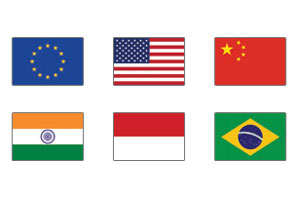
Divisions have already emerged among the developing countries with significant forests. Brazil, wary of placing the fate of its trees in the hands of polluting industries in the north, is advocating for rich countries to give anti-deforestation aid directly to developing countries; the money would come from emission permit sales as well as institutions like the World Bank. This is known as the "sectoral" approach, in which large areas of forestland could become part of a nationwide preservation strategy—and governments would be paid to reduce the rate of deforestation below an agreed-upon baseline, for example 2005 levels. By contrast, countries like Indonesia, Papua New Guinea, and the Congo, which have cut their forests at slower rates than Brazil (and would thus not benefit as much from such a baseline approach), want to be paid via offsets, much as businesses now pay directly for offsets like windmills. What's implied is that if not compensated, they could ratchet up their deforestation rates to match, say, Brazil's.
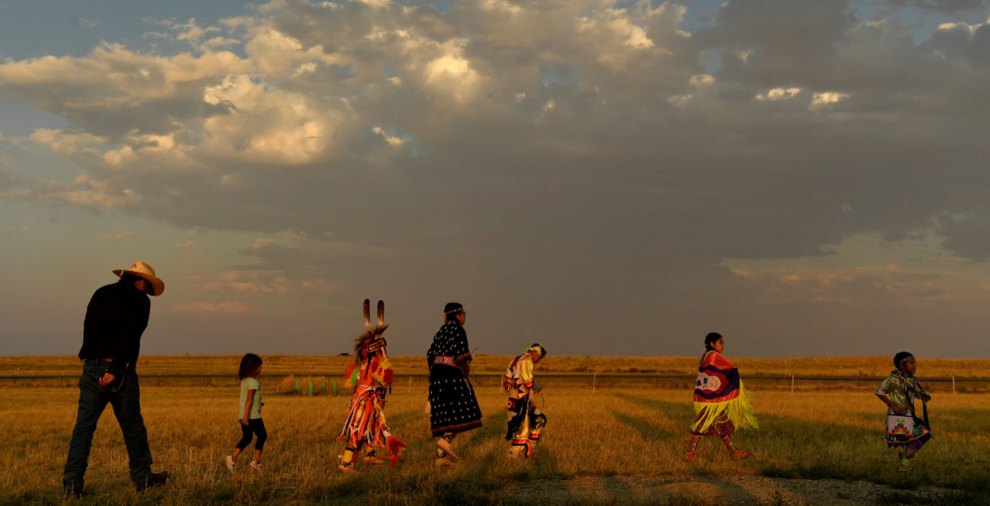
Indigenous people around the world, many of whom have been displaced through preservation efforts, are demanding "free, prior, and informed consent" before new restrictions move forward. Some also want tribes, like the Guarani in Brazil, to be compensated for preserving forests for centuries.
In the industrialized world, the big fight is between the EU and the United States: The European carbon-trading market, by far the largest in the world, does not allow avoided-deforestation offsets, which the EU says are hard to monitor and can't bring down emissions in the long term. In the US, a very different approach has developed thanks to massive lobbying from energy companies such as American Electric Power, Duke Energy, and PG&E. They have joined forces with green groups like the Nature Conservancy, the Environmental Defense Fund, and the Natural Resources Defense Council to advocate for harnessing "the power of US carbon markets," where carbon offsets would be traded to preserve forests. Groups such as Greenpeace and Friends of the Earth argue such schemes would hold forests hostage to the price of carbon, but so far, the industry coalition is winning the day: Waxman-Markey permits avoided-deforestation credits, a provision that could be worth millions of dollars for the companies that have stockpiled thousands of tons' worth of carbon in their forest preserves far from Washington, DC.
Comments
spas .. Check Real Climate Econ
http://realclimateeconomics.org/ for info. I found some in these 2 articles:
Building With Whole Trees www.nytimes.com/2009/11/05/garden/05tree.html?_r=1&ref=garden
The Carnivore's Delima www.nytimes.com/2009/10/31/opinion/31niman.html?ref=opinion which brought a letter to the editor about the little footprint left by hunting and gathering, like the locals once did in "GM's Money Trees--In Brazil, people with some of the world's smallest carbon footprints are being displaced--so their forests can become offsets for SUVs" - also on: www.motherjones.com/environment
I agree: "Give forests back to local people to save them .. So concludes a study that's tracked the fate of 80 forests worldwide over 15 years" http://www.newscientist.com/article/dn17937-give-forests-back-to-local-p...
Consider too, what those who perpetuate the gw debate have to gain. (If you're not a part of the solution, there's good money to be made in prolonging the problem ~Larry Kersten) and check these out:
Consumption dwarfs population as main enviro threat - A small portion of the world's people use up most of t earth's resources and produce most of its greenhouse gas emissions, www.guardian.co.uk/environment/2009/apr/15/consumption-versus-population...
The Population Delusion: www.newscientist.com/special/population
A millionaire with a super yacht is a larger strain on resources than 100s of peasant families The Population Myth: www.monbiot.com/archives/2009/09/29/the-population-myth/
UK 'exporting emissions' to China http://news.bbc.co.uk/2/hi/science/nature/7028573.stm
'Ecological Debt' day marks the point in the year when consumption around the world exceeds the Earth's annual "biocapacity" .. 'A typical American will by 4am on January 2 have produced as many emissions as a Tanzanian generates in a year.' http://www.commondreams.org/headline/2009/09/25-3
Enough debate. Let's just get busy helping any people left on our planet-- who still share ancient wisdom of how to live on it--expand its forests, grasslands, etc out into the surrounding mono-cropland and advancing deserts. To help pay for this and to add a few months to an av American eco debt day, and lots of solar roofs and such, lets help the super rich suck up some of their huge footprint with a nice tax.
'Another world is not only possible, she is on her way. On a quiet day, I can hear her breathing ~ Arundhati Roy http://www.globaljusticeecology.org/
how about a new
how about a new lifestyle..which will affect peoples agument about our earth and hopefully can give us a better future...
Global Warming and indigenous peoples
Survival's new report 'The Most Inconvenient Truth of All: Climate Change and Indigenous People' looks at how climate change and measures to stop climate change will potentially hit indigenous peoples harder than anyone else.
Read more:
http://www.survivalinternational.org/news/5273
--------
Survival International helps tribal peoples defend their lives, protect their lands and determine their own futures.
Magnets Are The Future
I am a strong believer in free energy sources, and I thing that governments are spending sooo much money in order to make even more in the future! They dont care about environment and the ecology. Magnets are definitely one of the best sources of free energy, and it is just matter of time when this great energy source will become nr 1.
Hardly any suprprise at the
Hardly any suprprise at the indiffernce shown by posters here to one of Nature's marvels - home of huge biodiversity, out of which disease-curing drugs have already been extracted, and which are marvels of Planet Earth.
Clearly these people have no sense of wonder, are never inspired by David Attenborough's mind-opening documentaries.
With a mindset like the bankers, who have already destroyed our world once, they are enamoured of commerce and profit, just like James Bartholomew, mentioned elsewhere here.
The climate-change case is an irrelevance, whether it is genuine or a fraud. What is no fraud is the preciousness of our ecosystem, of which the Rainforests are a jewel.
Post new comment
MoJo Comments: Send Us Your Feedback
We changed our spam software to better filter comments. Should you encounter any issues, please let us know.