The Ex-Lax Fish

There's a toxic bottom dweller lurking on your sushi menu. And its side effects are, uh, unpleasant, to say the least.
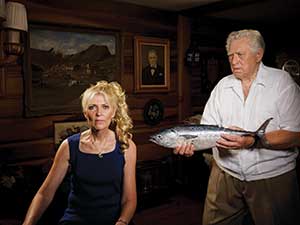
One day last year, Will Heidel and his wife were craving fish for dinner. They headed to San Francisco's upscale Ferry Building Marketplace and asked a fishmonger for a recommendation. "He said, 'Escolar, this is a great fish; you should give it a go,'" recalls Heidel. "So we went home and cooked the fish, and loved every single bite of it." The fish was rich and silky, with a uniform white smoothness that was almost unreal.
Two days later, Heidel was at his job in real estate development when he suddenly felt that "something was not right" in his gut. Back at home, his wife admitted she'd suffered the same oily unpleasantness the day before. They googled "anal seepage" and found a blog post devoted to escolar and its consequences. "It was exactly what happened to us."
Advertisement
Advertisement
A bycatch of tuna, escolar is often referred to as "white tuna" on sushi menus, as is the more common albacore. But the buttery fish is actually a kind of snake mackerel, a deep-sea bottom-feeder full of a wax ester that accounts for its dreamy velvety texture. Unfortunately, that oil is not digestible by humans and causes severe gastrointestinal distress in some people. It has earned escolar the nickname "Ex-Lax fish."
Once a rare catch, escolar came on the scene in the past few decades after fishing vessels began using deeper-water longlines to catch tuna and swordfish. Along with escolar, the new equipment pulled up other deepwater fish rarely seen on the market before—Patagonian toothfish, orange roughy, monkfish, and rattail. As target species began declining due to overfishing in the '60s and '70s, the industry turned to the bycatch as potential new product. "From the perspective of the fishing industry, bycatch is not a good thing—it gets in the way, it causes more work, and there's no market value," says Geoff Shester, senior science manager of Monterey Bay Aquarium's Seafood Watch program. "There is incentive in the seafood industry to develop markets for these species." To wit: Fishermen catch one-tenth as much bluefin tuna today as they did in 1970, and the wholesale price of the coveted sushi fish has increased more than fiftyfold, from 14 cents per pound in 1970 to more than $7 in 2008. Meanwhile, catches and value of Patagonian toothfish—once considered an undesirable tuna bycatch—have skyrocketed since it first hit US plates in the late '70s, thanks largely to a rebranding campaign by the industry to market the fish as a delicacy. They gave it a new name: Chilean sea bass. It worked so well, Chilean sea bass is now overfished itself.
Escolar has gone through its own rebranding; its current roster of pseudonyms includes "white tuna," "butterfish," "rudderfish," and "Hawaiian walu." Some government agencies warn consumers about the fish: In 2004, Washington's health department issued a bulletin on it, and the European Union mandates that escolar and its relatives be sold only in packaged form with health warnings. The fish is banned outright in Japan and Italy.
But a US Food and Drug Administration spokesperson told me that the agency has never considered banning escolar; it merely "requests" that seafood manufacturers and processors inform potential buyers and sellers of the "purgative effect." Some high-end chefs claim the fish is harmless in appetizer-size portions, and it continues to be sold in tony restaurants from New York (Eric Ripert at Le Bernardin loves it) to San Francisco, with customers receiving no warning. Shester of the Monterey Bay Aquarium says escolar likely won't be the last rebranded sea creature. "We're systematically going through what we can," he says. "But there really aren't a whole lot of truly unexploited fisheries left."
Comments
Chilean Sea-bass is one
Chilean Sea-bass is one awesome fish. I get that it's been over fished and don't order it anymore. But damn, anyone who could eat this fish and say it was a garbage fish must be as delusional as DLY.
Keywords: appetizer-size portion
"Some high-end chefs claim the fish is harmless in appetizer-size portions..."
If my fellow Americans understood what an appetizer-size portion was, we wouldn't have the obesity rate that we do.
overfishing
I've had this fish and not had any bowel problems, it probably has to do with the portion-size. However, the overfishing problem is very much a problem.
Orange roughy was overfished as was toothfish in a very short time. Unless we start to culture fish and shellfish we will not have a valuable source of protein and food which now are imported at a very high cost to the environment.
The obstacles to aquaculture are greed and ignorance on both sides. In California the industries are handicapped by Fish & Game which allowed one of their own to import abalone from South Africa and did not quarantine the animals. This has nearly wiped out all the species in Southern California. Do we allow jet skiers to own the water? Boaters and jet skiers have more rights on the ocean than everybody else...
There are problems with aquaculture but white sea bass in California is a success. Why? Because it's a native species and does not endanger the ecosystem. Abalone is not a success because it has been protected by stuffed-shirt Republican appointees over the expense of the environment. This is rooted in the Californian political system and Republican greed-heads who care only for the PAYING constituents. The Democrats are too stupid to expose this and allow it to happen. Probably because they want to displace the Republicans and take the revenue.
Aquaculture can be done without severe impacts but it has to be integrated, diverse, and native!
Saving Fish
If we're going to get serious about saving fish stocks, either we need to find a sustainable (which by necessity would include "safe") way to farm fish, and/or, we need to stop eating fish that isn't caught off our own shores. If we have no more salmon or crab in the Bay Area, why do we think we're entitled to see to it that there isn't any local fish to serve in Japanese or Chilean markets as well? How are we helping the crab population in the pacific northwest, if we're eating their crabs out of our season down here? How is the lobster population in the northeast going to survive if it's served on tables from San Francisco to Paris, Sydney and Beijing? It seems that supporting the environment, or it's recovery, is always popular until you have to take something you like off your plate, and then, suddenly, the blue state mentality goes bright red "mine mine mine, it's ALL mine".
Great post. I will read your
Great post. I will read your posts frequently. Added you to the RSS reader.
Escolar and Diarrhea
I just warned the readers of my sushi blog about escolar. If you have eaten the fish, please share your experience via comment at http://sushiloversunite.com/2009/11/30/escolar-sushi-diarrhea/.
links of london
With christian louboutin super -insincere wow power leveling grey suede ankle boots.The outlay is a certain christian louboutin discount for every event.you can World of Warcraft Gold it is very reduced. Sport a brace of christian louboutin sale and be the mostSexy andstreet lights princess. links of london is the best online links london stores where you can buy the cheapest links of london jewellery and links london jewelry . Our huge selection of Ed hardy and ed hardy clothing your edhardy.com good
Post new comment
MoJo Comments: Send Us Your Feedback
We changed our spam software to better filter comments. Should you encounter any issues, please let us know.