Extremely Dead and Incredibly Gross

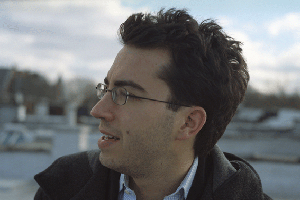
Author and vegetarian Jonathan Safran Foer on hunting, PETA, and why he won't have a cow if his kids grow up to be carnivores.
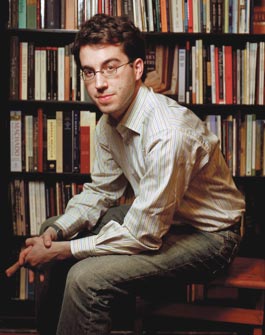
Since childhood, Jonathan Safran Foer has dabbled in vegetarianism—but when he became a father he finally decided to take a closer look at his dietary choices. The result is his first work of nonfiction, Eating Animals. Foer, author of the acclaimed novels Everything Is Illuminated and Extremely Loud and Incredibly Close, uncovers some ugly truths about America's meat production system, but he also weaves in stories from his own family history—and shows how stories can shape our diets. While others have argued for reforming our system of factory farms, Foer argues for much more radical change: giving up meat (or at least eating dramatically less of it). I talked to him about switching from novels to nonfiction, raising kids veggie, and daring to disagree with the pope of the sustainable food movement, Michael Pollan.
Mother Jones: You've written only fiction before. How did the switch to nonfiction go?
Jonathan Safran Foer: Not smoothly. One of the things that I love about writing novels is that it really doesn't matter what next step you take as long as you're pursuing some intuition or instinct. Of course, then, intuitions or instincts don't make for great novels, but they often make for good first drafts. And here, that was not the name of the game. There are something like 70 pages of footnotes in the book. So I did everything I possibly could to be really rigorously objective and up-to-date and conservative with the statistics because the conversation is useless if you don't have a really firm grounding in reality. That said, there's more to reality and the ways that we make our choices than just statistics. So there's another kind of reporting that I did, that didn't take place out in the world. I also reported on my own history with these things, finding out which of them were just vestiges from my childhood, which of them I had because I thought I was supposed to have them, and what it was that I actually believed when I really probed and thought about it.
MJ: Especially because, as you write in this book, the issues of food are so tied up with emotions and with stories that we learn from our families. It's hard to think about food as just a bunch of numbers and facts.
JSF: I think that when you allow those other things, those irrational things, into the conversation, you're not only being more honest, I think you're actually enhancing the argument. Because of course we crave something that smells good or tastes good. But we also crave being consistent and acting on the thing that we sense is right. Of course food has an important cultural use in families, but there are things that have more important cultural uses in families, and broadening the conversation out simply from what's reasonable also allows in those other things.
MJ: At the center of this book is the anecdote about your grandmother. Even when she was starving and on the run from the Nazis, she wouldn't eat pork. You write at the end, If nothing matters, then there's nothing to save. In our culture, though, one of the big problems that we have is wastefulness. Is it defensible to not eat meat even if you know that that meat is just going to be thrown away?
Advertisement
Advertisement
JSF: It takes between 6 and 26 calories to make one calorie of meat. It is an incredibly inefficient protein because we are cycling through all of these other grains that humans could eat. It's a little bit different for grass-fed cattle because humans don't eat grass. But they are, of all the kinds of animals we eat, those are a very rare exception. Certainly for all of the pigs and chickens and well more than 70 percent of all cattle, they're eating food that we could eat. Eating a piece of meat, at its most efficient, we could say is like throwing away six times that amount of food every time you eat it because you're recycling all those calories through it. I know a lot of people who came to this issue not through animal welfare but through wastefulness.
MJ: You have a whole section on PETA in your book. You acknowledge that they're the butt of a lot of jokes. But it seems like you take them seriously. Do you ever think they undermine their own cause by being so strident?
JSF: Part of their effectiveness is in acting like jackasses sometimes. Everybody knows who they are; they have an incredibly powerful brand and they get that in part by undermining their own legitimacy. It's like a deal they made.
MJ: You're raising your kids vegetarian. Will it be upsetting to you if your kids decide at some point that they no longer want to be a vegetarian?
JSF: I don't think "upsetting" is the right word. I think I would experience it as disappointing; I don't think I would show it that way. In part because that's a great way to encourage kids to do the opposite of what you want! But the goal is not to have them have the same values that I have. It's to have them act on their values.
MJ: Another thing I wanted to ask you about is hunting. Do you think hunting is a more humane alternative to factory farms?
JSF: How is it humane? In a slaughterhouse they all go really quickly—hunting they don't.
MJ: Well, it's humane in that the animal has led a good life up until the time of death.
JSF: But that doesn't make hunting good. It makes the fact that the animal had a good life up to that point good. And those aren't our choices. I'd rather get lethal injection than be hanged, but actually I'd rather have neither. People often set up these false choices, these false dichotomies, and it's not like we have to do either of them.
MJ: But some people in this country are not going to be willing to give up eating meat.
JSF: Hunting will never feed lots of people; it will always be a hobby.
MJ: You write about this great-sounding turkey operation, with these heritage birds. One of the things that makes it great is that it's so small, and I don't think that could ever be replicated on a large enough scale to feed everybody either.
JSF: No, it can't, which is why we just have to move away from this stuff. I'm not sure I agree with you that it will never be the case that people won't eat meat. I think it could conceivably be the case one day that people eat very small amounts of it. That it's a special thing, rather than reach for it because it's cheap or reach for it because it's convenient, that it becomes something festive or something celebratory, once a week, and that could actually be achieved on small farms if we really changed our habits. And I'm not talking about a radical change. I'm talking about a return. We now eat 150 times as much chicken as we did 80 years ago. That's totally insane. We don't need it. It's just that agribusiness realized we could raise chickens for practically nothing, realized they could feed it to us in ways that don't require silverware, don't require a kitchen table. So it's not just the system of raising animals that's changed so much as these diets that have been imposed on us, and imposed on poor people in particular. Other cultures don't eat that way, and we have historically not eaten that way. But the scary thing is they're starting to eat like us. There are more obese people in the world now than starving people. As China and India start to develop our eating habits—and not by accident but because agribusiness is now going over there and imposing our habits on them—if the population doesn't increase at all, we'll have to raise twice as many animals as we do now.
MJ: In the book, you disagree with Michael Pollan on a number of points. Has he responded?
JSF: It's funny, I agree with him on so many more. One is allowed to disagree with someone respectfully, and I hope it was respectful. There's nobody who's done more for this issue than he has, and I have nothing but respect for him. It doesn't mean I don't disagree with him on a few points, and those points might even be important, but they're exceedingly minor compared to our points of agreement. He really was an inspiration for the book. The point is, he's so so smart about so so much that when he doesn't take something to the place that it obviously should go then it's bothersome, because he's so thorough, because he's so intelligent. If he were some schlub it wouldn't matter at all.
MJ: You are almost a vegan right now, right?
JSF: That is what I am moving toward.
MJ: Drinking milk and eating eggs, even eating soy—there are problems with all those choices.
JSF: There's an important point there: Ninety-eight percent of all the soy that's raised goes to livestock. So people make fun of vegetarians for being tofu eaters, but no one eats tofu like steak eaters, by a long shot. It's also funny that tofu is held up as what a vegetarian eats. I mean maybe I eat tofu once a month, but other than that, never. All of it, statistically speaking, is going to livestock.
MJ: My point is that it's hard to make a completely blameless choice.
JSF: It's impossible to. It's completely impossible to. I think that people have framed this conversation in absolutes. Either you are or you aren't. The word vegetarian, I think, does a disservice because there are a lot of people who care but maybe don't care, or can't care in an ultimate way. If you think about environmentalism, nobody would ask, "Are you an environmentalist or not?" The question doesn't make any sense. And the notion that the first time you drive in a car or fly in a plane that you should throw your hands up in the air and say, "Okay, well I give up. I'm not going to try at all anymore," is crazy. If people thought about food more like how we think about the environment, a lot of people would be eating differently and the whole system would look a lot different.
Comments
Hunting is grossly
Hunting is grossly inhumane......I live in the mountains.this year the state held an archery hunt for moose......the hunters tresspass every day...and once in a while they turn a moose into a dying pin cushion...then they leave most of the poor animal behind because they're usually too out of shape to carry it out.....they also drive like idiots and leave litter everywhere........this is something I actually see almost every day for about four months of the year......I think you should have to show a w2 form proving that you made less than 20 thousand last year to get a hunting permit.....
Shocking stats
There are some really shocking statistics and other objective measures that show just how MUCH goes into producing meat in this country---fertilizer, water, acreage, crops---nearly all the oats grown in this country go into animal food, and a LARGE percentage of the corn and soybeans as well. Water consumption related to meat production is also incredibly large. I don't "believe" in anthropogenic global warming (One volcano can release as much carbon dioxide as all of mankind put together, so I think Mother Earth can handle it, thank you.) but if you want to do something simple to conserve massive amounts of energy, eat less meat. If you don't want to do the Full Monty and become a vegetarian, you can still make a tremendous difference by eating veggie one day a week. I cut my food bill by 25% eating totally vegetarian three days a week. So both from a personal economic standpoint and a global one, it makes a lot of sense to eat less meat. There's no need for a big polarizing moral battle over this. Just do it because it's healthy and it saves money and energy. It also tastes really good....try some Hindu cuisine.
Once again, we Indigenous
Once again, we Indigenous peoples seem to be invisible in the debate around food harvesting.
My family has hunted here since the beginning of time.
Our way is to take only what we need, and we do use all of it. Also, we don't get all boozed up and go bombing through the woods on ATV's to gather our food, as the Non-Natives are want to do.
One of the first things that my Father told me about hunting was this: "Don't harry the animal, if you have to chase it down, you spoil the meat....if you can't get a clean shot, leave the thing, it is Creator's way of saying 'not this one'." We have always known that meat is spoiled if you torture the animal. We don't want to eat spoiled meat. Interesting that our traditional knowledge has finally been proved by science. Adrenaline and cortisones do make meat bitter.
It is customary to distribute the meat/fish throughout the family, ensuring that the Elders, and infirm are fed first. This has always been our way. It is also taboo for us to dispose of the animal in a disrespectful manner, we use all of the parts still. We must "be careful with our bones". Desecration of a carcass in any way, will ensure that you go hungry next season. We are sure of this.
Please consider the difference between trophy hunting, or hobby hunting, and true subsistence hunting. And refrain from lumping us in with the destructive ways of the colonialists.
Many members of my family, including myself, have never eaten commercially grown meat.
Our system worked for thousands of years...and in just a few centuries...look what damage and abominations have been wrought here.
We will not take the heat for the colonials refusal to heed the lessons of their most generous hosts.
We are not as stupid as many colonials would like to think.
And we are still here.
This discussion about Native
This discussion about Native American hunting practices is actually a common subject. Not because vegetarians bring it up. Because (in my personal experience) Native Americans tend to jump into the discussion, mainly in a defensive manner, to counteract the mere concept of vegetarianism. So here is my counter to your counter:
1) No one is taking your flesh away. (In fact, flesh-based foods may be the only thing that gentrified America has not beaten out of your culture). And for a perfectly understandable reason: The same mind-set which brutalized Native American culture and buried its people are only too happy to find this thin twig of common-ground to hold in common. The bottom line is: Vegetarians don't murder people. Vegetarians don't (generally) drive BMWs either and the side effect of this lower regard for material possessions is that vegetarians (typically) don't steal either. Because we maintain enhanced consciences.
2) Everything in life eventually changes. If I were hungry and the life of an animal stood in between me and a necessary meal, hey, looks like lunch. But we all have (Native Americans included) been blessed with an abundance of harmless (or less harmful) and perfectly nutritious substitutes. So I therefore suggest that a ritual of hunting can become a ritual of abstinence from hunting. The only thing which is therein harmed is (possibly) some sense of tradition. What is improved is the evolution and sustainability of all society.
Now, you may say that the practice, as carried out by the traditional hunting methods lacks much of the harm of the factory farming methods and you would be right. But the average American is not about to trade in his McDonalds bag of cholesterol for a bow-and-arrow. So this is an impractical concept for 99% of the public.
Respectfully I say, kindly Go Veggie!
Extremely Dead and Incredibly Gross...
If someone tried to counter my vegetarian with that statement, I'd respond by reminding them that he was also an artist and partial Jew. Just because history's most demonic villain shares one of your virtues, it does not make it less virtuous.
It's interesting to learn
It's interesting to learn how much more meat we eat nowadays. I wonder how much less we pay for it (in simple financial terms, at least). People seem to have an antiquated idea that meat is somehow "posh", although in our desperation to save money we've reduced it to a product which is anything but.
Some people ask me (occasionally aggressively) why I'm vegetarian, and I think they expect a one-issue answer. The truth, for me, is that animal welfare, meat quality (ie taste) and environmental impact are not separate issues. They all depend on each other and our respect for the planet we live on and the animals we share it with (including ourselves).
Incidentally, I'm from the UK, which means I'm not allowed to donate blood in most western nations. Why? Because around 1986 our farming industry considered it perfectly reasonable to feed dead cow remains (including the minced brain tissue of sick cattle) to other (herbivorous) cows. Because it was cheap. Over 4.4 million cattle were slaughtered in an attempt to stem the resulting BSE (mad cow disease) epidemic. Due to the long incubation period of the human version (vCJD) no-one really knows the human cost.
I actually have no issue with omnivorous humans eating other animals, but feeding cows to cows? That is wrong on so many levels...
2 Great Videos
Check out this uplifting and inspiring video on why people choose vegan: http://veganvideo.org/
Also see Gary Yourofsky: http://www.youtube.com/watch?v=bagt5L9wXGo
Check out this uplifting and
Check out this uplifting and inspiring video on why people choose vegan: http://veganvideo.org/
Also see Gary Yourofsky: http://www.youtube.com/watch?v=bagt5L9wXGo
Indigenous
Most of the indigenous people on this continent raised their food. The basis of the traditional diet was the "three sisters"; corn, beans and squash. Meat was a special thing. Now, meat is a constant. People think they have to have meat at every meal. On my Rez, the three sisters are always surrounded by meat, especially pork. They are also surrounded by diabetes, heart disease and cancer. My people are dying every day from cheap meat and cheap carbohydrates.
I so very much appreciate
I so very much appreciate all these descriptive, kind hearted comments that I have seen after reading this article. I'm so used to seeing angry, mean spirited, and incredibly mindless and poorly punctuated responses when viewing videos on YouTube about this subject. It's good to know that intelligent people like yourselves DO actually exist.
So thank you!
meat is fine and this author is a zelot
some people cannot even eat grain, it is poison to some
science tells us that we need meat as well as vegs, but definately less meat
we need science and rational thinking not fiction authors telling us what and how to eat
ask chet atkins, country western singer turns diet guru, eat barbecue and you'll cure your diabetes...
...something like that, huh?
On Absolutism...
JSF ends this interview by explaining how absolutism can deter progress. The example he gives is about Environmentalism, saying it's absurd to try and force someone to declare that they "are" or "aren't" an environmentalist.
The difference with the animal issue, however, is that unlike lightbulbs and cars, animals are sentient beings who are capable of feeling and suffering. Therefore, the question is more morally compelling -- akin to being "for" or "against" genocide, for example.
In many cases, absolutism makes absolute sense. I am ALWAYS against child rape, for example. I suspect most people are. Likewise, I am ALWAYS against harming and killing animals when there is no need to do so and especially in our country where alternative, compassionate choices are readily available.
From a Natural Man
I just looked in the mirror and it turns out I have the canine teeth of a carnivore and the close-set eyes of a predator. I'm guessing Mr. Foer does as well. These subtle and not-so subtle inferences that eating meat is somehow evil are wrong on so many levels. If you consider a lion killing and eating a zebra as evil then, I suppose, you can keep that opinion, but you are horribly wrong.
We have programmed into our brain stems to eat meat, that is a fact. Vegetarians are living an aberrant lifestyle, which is fine. They should not, however, be judgmental towards those of us who live the life of a natural human being.
I do realize that we are packing way too many members of our species onto this planet, and all of us might benefit from a less "planet damaging" lifestyle, but that is not the issue that is being discussed here. I am certain, though, that Nature will, at some point in the future, deal with the problem of there being too many Homo Sapiens.
Post new comment
MoJo Comments: Send Us Your Feedback
We changed our spam software to better filter comments. Should you encounter any issues, please let us know.