The New Dust Bowl

In the 1930s, Okies saw California's Central Valley as a Garden of Eden. Now it's dying of thirst.
When I meet Javier Vaca on a dusty strip of blacktop, he's been walking for three days. The skinny 18-year-old is being carried along in a procession of 7,000 farmworkers and farmers as it crosses California's Central Valley, his baggy jeans and hoodie standing out amid the work boots and button-downs. He's been told only one thing that matters: Marching 50 miles might earn him a job.
"I don't want to jack nobody," Vaca says, as though the thought had crossed his mind. When the housing boom imploded last year, he lost a $14-an-hour construction job, a job that had allowed this son of farmworkers to drop out of high school, buy a car, and rent an apartment for his young wife and baby in Fresno. It took him a month to find more work, this time picking peaches at less than half his previous wage. Then the worst drought in more than a decade hit, a court order to protect an endangered fish cut off water to the valley's farmers, and an area larger than Los Angeles went fallow. Vaca now works one day a week while his family survives on welfare and food stamps. "It's hard, man," he says. "Everybody's broke."
Advertisement
Advertisement
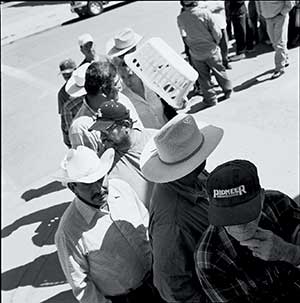
A three-hour line for a free chicken, a bag of potatoes, and some vegetables.
The spring morning chill becomes a broil as Vaca and his fellow marchers slowly follow a two-lane road through parched hills. A man squatting next to an ice chest on the median doles out carne asada burritos. "I'm hungry," Vaca says with a wan smile as he stuffs one into his pants pocket and bites into another. He passes an ATV draped in an American flag, where Sharon Wakefield, an almond farmer, is resting her feet. She says she believes that the Mexicans and Central Americans who have joined the California March for Water are basically no different from her mother, who fled Oklahoma during the Great Depression to earn a pittance harvesting hay and cotton in the valley. Except this time, the state has even less to offer them: "We've got no water, no food, no future," she says.
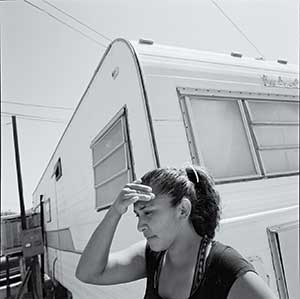
Guadalupe, 26, lives in a trailer with her five children.
The Central Valley, the thin, fertile band running down the middle of California, has long boasted the world's richest agricultural economy, reliably producing more than a quarter of the nation's fruits, nuts, and vegetables. But it's done so in defiance of ecological reality. The 70-year-old irrigation system that has pumped water into the otherwise arid valley is proving increasingly vulnerable to shifting weather patterns. It now appears that waterwise, 20th century California was an anomaly, a relatively wet period in the midst of a historical cycle of severe drought. And the changing climate will only magnify the problem: By the end of the century, scientists predict, Central California could experience temperatures rivaling Death Valley's and face the loss of 90 percent of the Sierra Nevada snowpack, the region's main water source. "Business as usual won't work in the future," says Eike Luedeling, an expert in plant sciences at the University of California-Davis, whose research shows that higher temperatures will likely decimate the state's $10 billion fruit and nut industry. "Especially for tree crops, adapting will require huge investments that probably a lot of small guys can't make anymore."
The sudden collapse of the Central Valley's economy illustrates how climate change can push a fragile region over the edge. Already vulnerable from rampant housing speculation and a dependence on industrial agriculture, the valley never prepared for a prolonged spate of bad weather. In 2008, local bankruptcy filings jumped 74 percent—from about 15,300 to 27,000—a rate of increase twice the national average. Three of the valley's counties were among the nation's six worst for foreclosures, with nearly 85,000 houses lost. The drought is expected to dry up a billion dollars in income and 35,000 jobs, adding to a statewide unemployment rate that recently hit 11.9 percent—the highest since the eve of World War II. Gov. Arnold Schwarzenegger has asked the federal government to declare the region a disaster area.
On the west side of the valley, which is often last in line for deliveries from federal water projects, farmers are selling prized almond trees for firewood, fields are reverting to weed, and farmworkers who once fled droughts in Mexico are overwhelming food banks. In short, the valley is becoming what an earlier generation of refugees thought they'd escaped: an ecological catastrophe in the middle of a social and economic one—a 21st century Dust Bowl.
IF ONE COMMUNITY can illustrate all that's going wrong in the Central Valley, it's Mendota, a town of 9,000 midway up its west side. In the past year, its unemployment rate hit 41 percent, very close to being the highest in the nation.
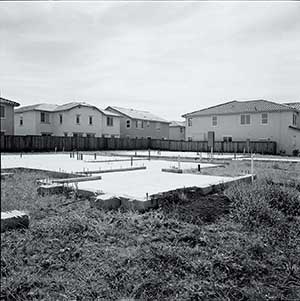
In Hacienda Gardens, a subdivision on the edge of town, farmworkers and truck drivers once jumped at cheap credit and moved into brand-new $250,000 houses. On a block where about a third of those houses are vacant, I step past a pile of shattered auto glass and enter a well-kept yard where a young girl is playing. Her father, a truck driver named José Quinteros, tells me he hasn't worked for three months for lack of produce to haul. He doesn't know how he'll make his $1,675 house payments. Yet he can't stand to sell his home for what it's currently worth—half what he paid for it three years ago—much less abandon it to the local gangs, which have been gutting the street's empty houses. "I can't say anything to them," he says. "They might shoot something—my house or my car."
Until recently, Mendota's building boom was a small bright spot amid decades of hard times. The town calls itself the "Cantaloupe Center of the World," though the packing plant downtown went bust about 10 years ago when growers began boxing melons in the fields using cheaper migrant labor. During the melon, tomato, and almond harvests, farmhands used to pack into backyard shacks and threadbare motels. "The conditions weren't good, so we felt we'd go out and push for development," Mayor Robert Silva explains as we drive in his pickup through cookie-cutter neighborhoods of new single-family homes—more than 100 were built in the town since 2007. "All this used to be cotton." Now it is driveways and front yards overgrown with weeds.
Silva turns down Mendota's main drag, where men mill about on every street corner, waiting for work. The most desperate will accept as little as $2 an hour. "These people are hurting big time," says Terry Ince, an unemployed forklift operator who lives in a mobile home across the street from the old sugar-beet plant, which shut down in January. He and his girlfriend have been making ends meet by selling off their furniture and eating wild boar shot by a neighbor. "What do we have to do, put an Ethiopian baby out there with a distended tummy?" he asks. "We are in dire straits."
The sidewalk is as crowded as the stores are empty. Silva heads into Westside Grocery, where owner and former mayor Joseph Riofrío tells me, "I need to get bailed out, man." Riofrío's general store, which has been in his family since the 1940s, has become little more than an occasional stoop for penniless mariachis and a collection agency for the electric company. He pulls out a stack of energy bills that customers have brought to his register and says, "Look at what they owe, and look at what they are paying." On a $1,000 bill, $300 had been paid; on $1,200, nothing.
Late that night, Riofrío, affectionately called "El Güero"—"Whitey"—by the farmworkers, leads me down the alley behind his store, using an open cell phone to light the way. Large dogs yelp at us through backyard fences as he points out clusters of sheds and garages—rented units, "all illegal," with as many as 20 boarders crammed inside. He waves his hand in a circle, his voice rising in frustration: "Every block in Mendota! Every single block."
DOWN THE STREET from Westside Grocery is a boxing gym, a brick building filled with old punching bags. When I visit the next morning, volunteers have moved aside the ring to make room for 800 frozen chickens. West Side Youth, the local charity that runs the gym, is one of the only sources of free food for the western valley's undocumented immigrants—many of whom came north to escape water scarcity and crop failure back in Mexico. Today, the monthly giveaway is scheduled for 2 p.m.; by 12:30, a line of people is wrapped around the building and halfway down the block.
The wait for a chicken, a small bag of potatoes, and some vegetables is about three hours. West Side Youth's director, Nancy Daniel, tries to shift the elderly and disabled into a shorter line—at the last giveaway, a frail man collapsed. Her move sets off a war of elbows and shouts: "We belong over there!" "You don't have any right to be there!" Two months earlier, a hungry crowd broke the front door in a jostle to get inside before supplies ran out.
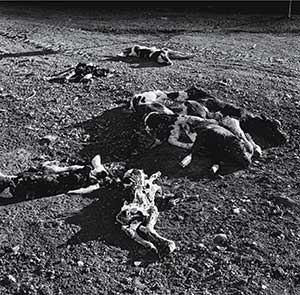
Dead cows left on the side of the road next to a dairy.
Farther down the treeless sidewalk, Rito Sanchez waits patiently. The 30-year-old hasn't worked since January but doesn't have the papers to qualify for unemployment, welfare, or food stamps. And yet life was harder back in Acapulco, where "there's no hope of anything to eat."
Standing nearby in a tight blue-jean skirt, Marina Calixto says that picking grapes in the valley pays more than 10 times what she earned at a maquiladora near Mexico City, where she manufactured bras and underwear that she later saw for sale at Costco and Wal-Mart on this side of the border. She's worked only two weeks in the past six months and can no longer send money home to her five daughters. "I don't want anything but to work," she says.
Farmworkers like Calixto and Sanchez "don't want to realize that where an employer used to hire fifty, they are now only gonna hire five," explains Candie Caro, service center manager for Proteus Inc., a state-funded nonprofit that assists farmworkers with food and rent while they're retrained in trades such as truck driving. Yet most farmworkers can't even qualify for Caro's programs because they don't have papers. The most she can give them is about $300 in subsidized food and rent—the only source of direct government assistance to Fresno County's undocumented farmhands other than the Community Food Bank, where demand has more than doubled this year. "Someone who comes into the office and cries because they don't know where their next meal is going to come from or how they are going to feed their kids—I've seen that," Caro says. "You don't know what to do. I wish we had more."
By five in the afternoon, West Side Youth is down to its last few boxes of food. Daniel shuts the front door, cutting off 15 people still in line. A few minutes later, a haggard man in a snakeskin belt emerges with the last box and climbs into a crowded van.
Comments
The article is right when it
The article is right when it quotes the sign, "Congress created dust bowl", except it should state when congress created the dustbowl and add that CA DWR contributed as well. Short sightedness that dams, large water transfers and over exploitation of groundwater resources can continue indefinitely is the flaw here.
A valley that perennially flooded, supported a large fishery, hits temps of well into the 105-110+ range, and used to support what some biologists call an elk population that rivaled the numbers of north american bison, is now the food basket of America. Salting and natural pollution (As and Se from old sea floor soils now on the surface) are causing 1000's of acres of land to be fallowed each year. Groundwater extraction has caused subsidence in excess of 40-60 feet in some areas. AND we continue to grow water thirsty crops like cotton.
I'll jump around with this discussion by also pointing out that taxpayers subsidized the water projects to irrigate this valley, and annually subsidize these farmers through massive dollar transfers from the congressional Ag bills.
Who wins here? Big Ag. Who loses? Small Ag, the farmworkers and small businesses that rely on them.
This is capitalism at it's finest albeit socialized capitalism for Big Ag. A system that could not (regardless of ESA issues) continue forever. So yes, government created this 'dust bowl' issue but not because of water cut backs (Reclamation's MP region public affairs staff is quoted that the ESA cutback only contributes about 1/3 of the water loss to the valley's water deliveries. The rest is due to drought!). The dust bowl is the long term impact of farming a region that cannot sustain the current agricultural practices.
It's time for a change. Is that not what capitalism is about? changing economic conditions will force companies (and individuals) to change? it's either change or 'die out' literally.
Perhaps a shift away from Ag will revive the once #1 fishing industry of the west coast. Yes, CA used to have the largest fishing industry (hence the moniker of fisherman's wharf in San Fran - try finding fishing boats and canneries there today LOL). All of which is pretty much gone due to water diversions for Ag. No one listened to the fisherman when their jobs were lost. Or to the midwest and southern farmers when their farms went belly up because they couldn't compete with subsidized western Ag with cheap water and long growing seasons.
Wise up. If you support capitalism, this is part of the 'natural' course of things. In the long run, it would have happened anyways again regardless of ESA issues.
Now the question is how do we help the individuals that are suffering as a result? Well that would be a socialism and not capitalism right?
hmm
This is an interesting article discussing pertinent problems...
and yet the photo of a 26 year old woman with a caption about how she lives in a trailer with her five children is a huge turn off. Am I supposed to feel sorry for her? A 4 dollar box of condoms may have been a very good investment for her. Her lack of good planning is her problem, it sounds like.
Don't blame the 26-yr-old
Don't blame the 26-yr-old girl for having 5 kids, blame the Pope - birth control/planning is against god's will according to him...
I agree all the way
I agree all the way
Yeah,26 with 5 kids and
Yeah,26 with 5 kids and living in a trailer with no job or future.Religion teaches people to have children regardless of being able to care for them.Condoms are sacrilegious,therefore they will have too many children who they are unable to care for properly and perpetuate the exact thing that got them in trouble in the first place
Oh...and also, if the
Oh...and also, if the immigrants from Mexico are hungry and can't find work here, um, why don't they go back to Mexico and try to work it out there. At least they'd confront less racism and irritation from poor Americans who are struggling for the same low paying jobs these immigrants are taking?
Recovery to US
For the past few months many countries were greatly affected by the effect of climate change. The recession, unemployment and poverty are also one of the problems that are government is facing on. Also the U.S. debt are staggering, as over $1.2 trillion has been added to the balance sheet already since the beginning of 2008. The shocking amount of U.S. debt means our government needs debt relief. And unfortunately, there are still many problems to come. Not only in health and environment issues but in other major fields. Now I would like to ask all of you, is there hope for our economy and country to recover?
I'm a CA native, so am
I'm a CA native, so am familiar with water shortages. What burns me, however, is this: CA used to, and maybe still does, sell water to So. CA. When we were on restrictions in the Bay Area, I attended a wedding in So. CA/LA area and as driving on the LA freeways.. what did I see? They were watering the ICEPLANT in the medians, presumably to keep the freeway 'pretty'. Deplorable!!!!!!!!!!!!
Still wonder what the problem is? Yes, shortage of water is serious. The use and sale of the precious commodity is the problem..
Restrict water usage for everyone, except farmers is my idea. We need to eat and be able to pay for it.
If a lawn dies. .big deal. It'll grow again. Give subsistance water to the trees - we need those. Ornamentals? Pretty, yes. Expensive, yes. Necessary? No.
Get a grip, folks! Americans consume, consume, consume with no thought to the consequences and then wonder what happened when the well runs dry!
CA Dust Bowl
This article is really strange in its Political Spin.
Mother Jones presents touching accounts of farm workers messed up by water policies in CA. Then presents Republican Arnold Scwwartzneggar as their saviour.
OH MY GOD So much politics today involves deception.
Proper, responsible journalism would recount the conflict between CA cities and central valley farm Corps and the western states for water resources, a long battle involving the Federal Government.
There have been numerous environmental articles about this in which the WASTE OF WATER BY FARMERS is proved and identified as a huge problem. I met a retired lawyer from Sacremento in Boulder a couple of years ago. He said and proved to me that farm interests run CA politics from Sacramento. So they would push for these big water projects. There is even a proposed project to bring water from British Columbia in Canada costing 100's of Billions to build!
So it is the cities of S CA that have been pushing to take water from farmers. Now we have MJ which would profile many social injustices taking up the cause for recent immigrants against the millions of legal second and third generation Latinos in Los Angeles etc. and around the USA.
We are finally reaching a point in the immigration debate where even legal and long time resident Latinos are able to understand that there is just not enough to go around and not enough social services to support millions of new and recent immigrants. We have to be sympathetic to the helplessness of the recently arrived, but just like in Europe many must be turned away to face harsh conditions in countires of origins.
The US must aid Mexico and other Latin countires so they can support their population and spend less on the Mideast and Afghanistan
I just read where...
Mexican families are now sending money north to their illegal immigrant relatives here in the US, who can't find work. Hey! Illegal immigrants! Go back home to Mexico, where love, family and food await! Why stay up here if you're just gonna starve to death? You'll only get the same cold shoulder if you stay. Sorry, no more sympathy up here.
what a callow, heartless
what a callow, heartless thug you are heather. they come here to work and raise families in this country, because they'd rather be here than anywhere else. Seems to me that spirit, of hard work and trying to make the best out of things, is infinitely more American than you will ever be. Why don't you get out?
Desert Silliness
As a resident of Illinois, where getting RID of excess water is a huge problem, I am reminded of the late, great, Sam Kinnison: "We have deserts in America too, we just don't live in them!"
Of course, over the last 30 years, many of us did indeed choose to live in deserts. And for over 100 years, we've been growing crops in California's central desert. The only way to sustain this was to steal water from somewhere else. Now that the stealing is being curtailed, those who choose to bang thier farms against a wall are crying foul.
So just like the Dust Bowl of the 1930's, bad agricultural practices are justified by "the allmighty dollar". Next thing they'll want to steal water from the Great Lakes and expend enormous amounts of pollution-causing energy just to pump water 2000 miles away so it can dry up and evaporate.
Did anyone every bother to think that maybe California isn't the paradise it's been made out to be?
40 Crops
Crawford County (an entirely unremarkable county in western Iowa) commercially grew 40 crops as recently as the 1950s. Fruit trees, vegetables, and the now common row crops were all commercially viable.
Today, corn, beans, and a few cover crops are all you can find. It will be interesting to see if Iowa and other midwestern states with adequate natural water supplies again become major growers of peaches, pears, apples, beans, carrots, peas, and all the other crops that were lost to California and the irrigated Central Valley. I suspect they will.
woman with five children
Blaming a women who may, or may not have exercised good judgement is trivial compared to the outright robbery that is going on in Wall Street as it raids the public treasury. Where is the sense of proportion? TRILLIONS of dollars are flowing out of the pockets of present, and future, taxpayers and straight into the pockets of a few superwealthy financial gamblers on Wall Street. Which is the greater misdeed? It's so easy to blame one poor person, in one picture for some imaginable fault, because she's vulnerable. The reason we don't put much attention or effort into blaming those who are engaged in massive thievery condoned by the President and Congress is because we have no power over them. It's ironic that the poor are attacked, the powerless poor. One person is stealing a pack of gum while the cash register is being looted with the approval of Congress--not just the approval of Congress, but those who steal from the public treasury are able to do so because some small fraction of the stolen money is used to pay off members of Congress in the form of campaign contributions. You want to fx the problems in the California Central Valley? Go to Washington D.C.
Feed America! Feed the world! Food! Food! Food!
If anyone remembers Star Trek (TOS), good old Captain Kirk and his trusty crew ran across a merchant that sold these wonderful fluffy little things called 'tribbles'. The episode was called 'The Trouble With Tribbles', and the little critters were cute, fluffy, and aw, so adorable. Problem was, the Tribbles got into the grain. And, then, all hell broke loose, because the grain was supposed to be for the colonists, and it turned out the only thing that Tribbles were really good for was detecting Klingons, and eating, and making...more Tribbles. You'll have to watch the rest for yourself, but talking more about food, and Frankenfood like genetically engineered grain, and entities that eat, eat, and make more entities, let's talk about global human population growth. Estimates range between 6.79, and 6.82 billion, that's BILLION people, walking around today, a billion of which are believed to be starving to death, overseas. Can America feed them all? Why sure...for now. Should we? Um, not unless we export a case of condoms with every truckload of food. Make that 3 cases. Because people flourish, and I DO mean flourish, in areas where resources are plentiful. Then they run out of room, or they run out of resources, and then, it gets ugly. It's already gotten ugly overseas, and, eventually, it will get ugly here, too. Or, we could be 3 % smarter than a fake furry science fiction TV show prop.
Klaatu marachas necktie
"Klaatu marachas
"Klaatu marachas necktie"
BRILLIANT!!!!
I appreciate that in
I appreciate that in compiling this article, the author completely failed to mention that the farming operations on the Central Valley's west side — those fields around Mendota — would be completely unsustainable even if water was in ever-lasting supply.
The soil on the west side is salty and rife with heavy metals and toxic elements, notably selenium. One of the problems of irrigating this soil is that runoff and seepage water collects this waste. But it has nowhere to go, given the impermeable layer of clay that rests a few feet underneath the valley's topsoil.
The salty, tocix water collects there, and without a way to dispose of it in an ecologically sound way (no way has been found since the federal and state water projects begain in the middle part of the 20th century), it eventually poisons the soil.
The hard truth of the matter is that this area of California was never going to be productive for eternity, no matter how much water was plundered from other parts of the state. But the hugely powerful landowners in the area didn't care — they were getting, and still get, subsidized water to grow subsidized crops in a desert. Now they're all complaining that Congress is causing the problem.
They're asking for a bailout of water even when those growers had junior water rights and from the beginning knew they would be the first to be left high and dry if a major drought hit. No one forced them to plant permanent crops like almonds, which would have to be cut down if their tenuous water supply dried up. But they did it anyway, and now it's Big Government's fault for trying to protect the Sacramento-San Joaquin Delta from complete ecological collapse.
Disingenuous bastards.
This story should be a morality lesson that you can't cheat nature without eventually reaping a ghastly reward — that highly irrigating a desert is possible for a while but will sooner or later prove impossible to continue.
Please, MoJo, do some research.
Salinity
The New Dust Bowl
Greetings from down under. Do you run many livestock in the area? We are currently debating climate change (like everyone) and the emissions from livestock. We have 28 million cattle and about 87 million sheep and they've caused ecological devastation in these arid lands. Dryland salinity and soil erosion is a serious problem. In the west, salinity is swallowing up a land mass - the equivalent of 19 football fields every day and the livestock exacerbate the problem.
Of course most people object to literature encouraging people to eat less meat, however, when you consider that a lactating dairy cow requires between 80 and 120 litres of water a day in summer, one can understand the need for a reduction. Strangely with our large consumption of dairy products, we in the western world have the highest rate of osteoporosis on the planet.
Several of our rivers are now on life support in Australia, from industrial pollution and agricultural run-off but it appears that farmers will be exempt from a carbon pollution cap and trade scheme. I sincerely trust they will voluntarily mitigate the use of fossil fuel based synthetic chemicals. We are experiencing more frequent mass fish and bird kills. Fewer fish for the birds to feed on I imagine. We will need to live more simply I think or Mother Nature will soon sort us out.
Anyhow I send best wishes and I hope it rains cats and dogs for you guys in the very near future. Cheers
As a professional geologist
As a professional geologist in the Central Valley I work for a lot of dairies. There are roughly 1,600 dairies in the Central valley and an average herd size may be close to 2,000. So yes, the central valley is loaded with thirsty livestock. If anyone seeks background/historical information on water issues in the central valley, I would suggest they read Cadillac Desert or watch the PBS documentary by the same name.
What about the salmon?
Also not mentioned in this otherwise fine article is the other reason for shutting down much of the water supply to the valley: namely, the salmon runs from places like the Sacramento River. A salmon run totally devastated by overpumping from the Sacramento delta. This resulted in a complete shutdown of the west coast salmon fishing industry from Baja to Oregon for the past two years. If the river is once again called upon to supply water to the California agriculture industry, not only will you have to wave goodbye to the smelt, but you might as well kiss salmon and that fishing industry goodbye forever.
CA dust bowl
I think it's a shame. We can provide many of the fruits, vegetables, and nuts to our own country and no one seems to care what kind of effect this will have on us in the future. They are worried about some fish. I would hope that feeding our country and our people would be more important that some endangered fish. I am sad that this is going on in my state, but it has been happening for quite some time now. Thank you for letting the rest of the world know what is happening.
Organic Beauty Girl
I thought that the "fish"
I thought that the "fish" that are in question are important for the marine wildlife (ie salmon) on the coast. I appreciate your sentiment but I don't think that this article is giving the complete picture. In other words the situation is more complex than you are implying when you said: "I would hope that feeding our country and our people would be more important that some endangered fish.". We should be mindful to consider the impact of the extinction of a species and its effect on our ecosystem because that too can impact people. I hope the best for all the life involved in this complex situation.
links of london
With christian louboutin super -insincere wow power leveling grey suede ankle boots.The outlay is a certain christian louboutin discount for every event.you can World of Warcraft Gold it is very reduced. Sport a brace of christian louboutin sale and be the mostSexy andstreet lights princess. links of london is the best online links london stores where you can buy the cheapest links of london jewellery and links london jewelry . Our huge selection of Ed hardy and ed hardy clothing your edhardy.com good
Westside Big Ag growers must
Westside Big Ag growers must be very happy with the narrative framing in this article that the Valley's economic woes can basically be explained by drought & water deliveries; how disappointing to read it in Mother Jones. Odd that the NYT ran a rather similar story nearly a year ago about Mendota (even down to using Joseph Riofrío for color quotes & UCD's Richard Howitt); why is this being published today? Curious to know the genesis of this "investigative" report/fluffpiece.
Is it too much to expect that progressives w/ a counter-narrative might be interviewed & quoted in this story? What were the water policy reasons the UFW boycotted? It would be nice to explain the concept of "junior water rights," how they apply here, & the current maneuvers going on around them.
Other than the UFW, the only (ouside MJ) non-gov. links in the article are to water-export advocacy groups.
One of the sponsors last spring of the march which is so prominently featured here was The California Farm Water Coalition for whom the author sees fit to provide a link. According to their website the
CFWC is a statewide organization representing a cross-section of the agricultural industry. Members include individual farmers, agricultural water districts and agencies, agri-business representatives and other agricultural organizations. . . .
Members include most agricultural irrigation districts in California, many private citizens, numerous individual farmers and the following major farm-related businesses:
Calcot, Ltd.
California Farm Bureau Federation
Farm Credit West
Paramount Farming, Inc.
San Joaquin Valley Quality Cotton
Setton Farms
US AgBank
American AgCredit, ACA
Colusa-Glenn Farm Credit
Farm Credit West/Yuba City
Fresno-Madera Farm Credit
FLBA of Kingsburg, FLCA
Northern California Farm Credit
Farm Credit Services Southwest
Yosemite Farm Credit, ACA
Wells Fargo Bank
Western Pistachio Association
According to Restore the Delta's Barbara Barrigan-Parrilla (who at least is frequently quoted by the MSM for 'balance' & whose views aren't even mentioned here):
Fake coalitions are nothing new in water politics. Earlier this year, news accounts exposed the Latino Water Coalition as another “Astroturf” group “formed as a nonprofit and registered by influential Sacramento lobbyist George Soares, whose A-list of about three dozen agricultural clients include the California Rice Commission, the California Cotton Growers and Ginners Associations, the Friant Water Authority, the Nisei Farmers League and The Grape and Tree Fruit League, among others. The group has been billed as the protector of the jobs of Latino farm workers, although labor leader Dolores Huerta and others have denounced it as a front group.” (Capitol Weekly, 10/01/09)
Readers wanting to learn more about astro-turf groups like the Latino Water Coalition might want to refer to Dan Bacher's recent article, Revealed: Astroturf Groups Planning Massive California Water Grab to Benefit Big Ag and SoCal
Readers might also be surprised to learn that there are alternative viewpoints other than that of the growers' which uncritcally seems to inform this entire article. The Director of the Business Forecasting Center at the University of the Pacific in Sotckton, Jeffrey Michael's Water won't wash away Valley's recession is a well circulated example:
What is causing unemployment in the San Joaquin Valley? According to water contractors and their political supporters, a "regulatory drought" has eliminated water-dependent farm jobs, and they point to high unemployment rates in farming communities as proof. Their solution is to suspend the Endangered Species Act and build a multibillion-dollar peripheral canal around the Delta.
However, the facts don't support the water contractors' view. The latest payroll data through March finds that farm jobs have grown faster than any other sector of the economy in the past 12 months, even outpacing health care. In fact, farm jobs have been growing throughout the three-year drought. Compared with 2006, farm jobs have increased 5 percent in California, while private nonfarm jobs have decreased 5 percent.
The same is true in Fresno County, home to communities such as Mendota that have been the focus of water exporters' news releases.
In Fresno County,farm payrolls increased 3.2 percent in the past 12 months,compared with a 3.4 percent decrease in private, nonfarm payrolls.
Since the drought began three years ago, Fresno County farm payrolls have increased by 12 percent, while nonfarm employment has crashed, led by a loss of more than 7,000 construction jobs. . . .
In the early years of the drought, agriculture expanded in response to a commodity bubble that more than doubled crop prices, farm profits, and farmland values in a span of a few years. Much of the increase is attributed to permanent crops in desert regions with interruptible junior water rights. Between 2006 and 2008, more than 50,000 acres of new almond orchards were planted, mostly south of the Delta pumps, while a nut glut led to a price collapse for all growers. Similarly, California's enormous dairy industry expanded rapidly, and now taxpayers are spending millions to buy surplus milk and prop up prices in an oversupplied market.
Michaels warns elsewhere that
The unemployment figures given for the Westside of the San Joaquin Valley are deceptive. Anyone using these data should consult the source, and read the warnings about data limitations. These unemployment estimates simply mirror the 2000 Census, a time of high water supply from the Delta to agriculture. In 2000, unemployment and poverty rates on the Westside were the highest in California. With water flowing in 2000, incomes were below many developing nations around the globe. Thus, these unemployment estimates represent how water has failed to bring prosperity to these communities in the past, not a problem that will disappear if we simply turn on the Delta water pumps. Those pushing for more water exports should explain why the results will be different this time.
Westside big ag growers
This story was never intended to be a comprehensive exploration of the Central Valley's water politics. Many stories have been written on the subject over the years. It was, however, intended to illuminate the current crisis from the perspective of farmworkers, who are often ignored by people on both sides of the political aisle. Republicans and growers love the cheap labor that farmworkers provide but don't want to support them when things go bad. Democrats would often prefer to ignore the farmworkers' plight, suggesting that it is overblown by the growers or that the farmworkers should not be here to begin with and should just go home. The story is more complicated than either perspective admits. Clearly we can't override the ESA or continue to degrade the Delta. But we also can't just throw these workers to the winds after (literally) living off the fruits of their labor. So we're in a tough spot. And the lesson is that we need to figure out how to deal with this because we're only going to see more of it due to climate change.
I think the solution involves a combination of temporary aid to farmworkers, water projects that increase efficiency, and longer term scaling back of expectations for what the Valley will be able to produce. But this story is not meant to weigh in on that in detail.
Regarding your other comments, I disagree that I've succumbed to political spin. I clearly state in the story that the UFW believes the LWC is a front for anti-union growers. And I also quote a UC Berkeley professor who says the crisis is a product of the delusion of growers. So those perspectives are well-represented. And while I agree that unemployment on the West Side has always been high, I strongly take issue with the idea that it isn't much higher due to the lack of water. Every farmworker with whom I spoke talked of having work before the drought but being unable to find it now.
California's Dustbowl
The author of this article should read Lloyd Carter's article entitle "Reaping Riches in a Wretched Region: Subsidized Industrial Farming and its Link to Perpetual Poverty." Blaming the situation in Westlands on the drought or fish is avoiding the real issue: the disastrous land policy there and the sad consequences of power politics. It is on his website: www.lloydgcarter.com. It is well-researched, factual and enlightening.
Valley as a dust bowl
There are four million acres of land in production in the San Joaquin Valley. The drought has idled 500,000, or one-eighth of the land. The Valley is hardly a dust bowl. The suffering farmworkers deserve compassion and some help but they are being manipulated. I suggest people who want a larger perspective read my law review article at this link:
http://www.ggu.edu/lawlibrary/environmental_law_journal/eljvol3/attachme...
I also suggest you read how the farmworkers are being manipulated by the big growers by read "The P-R Firm from Hell."
http://lloydgcarter.com/content/090629251_the-pr-firm-from-hell
Lloyd Carter
www.lloydgcarter.com
Suggestion: Do An Article on Corporate Agribusiness Astroturfing
Josh
I am shocked about how shabbily researched this article on the "New Dust Bowl" is.
How can a so-called progressive magazine push the agenda of Governor Arnold Schwarzenegger, corporate agribusiness and right wing astroturfers and not quote anybody from the Delta or fishing communities? The "New Dust Bowl" sounds just like a headline from the Sean Hannity Show or Fox "News."
This piece makes much of the corporate media reporting on the water issue, which leaves much to be desired, look "fair and balanced" in comparison. Mother Jones would be spinning in her grave if she saw how you accepted the agribusiness spin on California water politics and the lies of an Astroturf group such as the Latino Water Coalition as virtual gospel truth.
I am appalled by your statement, with no evidence to back it up, that " What remains is some of the most productive farmland in the world. Or was, before its water ran out."
Actually, the drainage impaired land in the Westlands Water District is among the least efficient and least productive on the planet. These rich corporate growers receive subsidized water to grow subsidized crops on land that should have never been irrigated because of the selenium and heavy metals that fill the soil. The drainage problems associated with land that should have never been irrigated have never been effectively addressed by the state or federal governments.
"The smelt are a key food for salmon, which is why their preservation is more than a simple question of man vs nature."
Where the heck did you get this information? The smelt aren't a "key food" for salmon now, nor have they ever been! The delta are an indicator species that shows the health of the estuary, but are not found in the ocean where the salmon feed after migrating down the river as juveniles!
The only bit of truth I find in an otherwise virtual propaganda piece for right wing Astroturfers is where you say, "Cesar Chavez knew the power of a good march," Schwarzenegger declares, not mentioning that the United Farm Workers, which Chavez founded, boycotted the march, calling it a front for anti-union growers."
The next time you writes an article on California water it would be a good idea to interview people like myself, Lloyd Carter, Bill Jennings of the California Sportfishing Protection Alliance and Barbara Barrigan-Parrilla of Restore the Delta who know what's really going on in the Central Valley and in California water politics. It would also be a good idea to actually interview Arturo Rodriguez, the president of the UFW, or a representative of an actual farmworker organization before you subject Mother Jones readers to the disinformation contained in your article.
I would suggest that you do a follow-up article where you include quotes and data from these sources about the agribusiness campaign to falsely portray the battle to save California fisheries and Delta/northern California farms as one of "fish versus people" when it is really one of people versus corporate agribusiness. Rather than taking the Astroturf information at face value as you have done, you should look at the real story behind what's going on in the Central Valley and the Delta.
response to Dan Bacher
Dan,
As I wrote on your indymedia site, before my comment was erased, my story was never intended to be a comprehensive piece about the Delta. It is primarily a story about how farmworkers are in dire straits because of the valley's lack of planning and bad decisions (and ultimately, climate change and drought, which affect both California and their homelands in Mexico). The story in no way gives a pass to farmers, or suggests that farms should be saved at the expense of fish and fishermen. I have covered a number of the wider issues in other stories about water here:
http://motherjones.com/environment/2009/07/whats-your-water-footprint
And here:
http://motherjones.com/environment/2009/07/why-wasting-water-so-damn-cheap
Thank you for pointing out the the smelt are not an important food source for salmon. I have corrected that in my comment above.
Dispelling the myth that the West Side 'feeds the nation'
Hey Josh
Thanks for the reply. I wanted to clarify three things.
First, I didn't remove your post from the indybay.org site. I was glad you posted your response and one of the moderators apparently took it down.
Second, I am glad that you made the correction about the Delta smelt.
Third, the contribution of the west side of San Joaquin Valley to the nation's agricultural economy is greatly exaggerated. The west doesn't "feed the world" or "feed the world" as the astroturfers claim.The US gross farm income in 2008 was $375 billion, while the Westlands Water District has a gross annual income of $1 billion. That means that Westlands contribution to the national agricultural income is only about one-quarter of a percent!
Here's my piece exposing the absurdity of the Astroturfer myth that the west side of the San Joaquin "feeds the nation."
USDA Data Dispels Myth that West Side Growers 'Feed the Nation'
by Dan Bacher
The "Astroturf" campaign by corporate agribusiness to build a peripheral canal and more dams to increase Delta water exports has relentlessly promoted the myth that crops grown on drainage-impaired land on the west side of the San Joaquin Valley "feed the nation" or "feed the world."
The corporate media and even some "alternative" media outlets have bought into this myth in their coverage of the California water wars, portraying the conflict as one between hard-working farmers like those portrayed in the classic Grant Wood painting who only want "feed America" versus "radical environmentalists" who want to protect a "minnow" like the Delta smelt.
The comments of Sean Hannity, in "The Valley Hope Forgot: California Farmers at Obama's Mercy" show on Fox TV News on September 18, are typical of those that perpetuate the myth that west side San Joaquin Valley farmers "feed America."
"You are the farmers that have sustained the entire country for decades," said Hannity, surrounded by hundreds of west side growers, bused-in farmworkers and Central Valley Tea Party activists. "We have generations of farmers here. And they are losing their farms. We have hundreds and hundreds of thousands of acres. We literally have — I met people earlier that now are on food lines because their farms have been shut down."
Paul Rodriguez, comedian and chair of the Latino Water Coalition, a front for corporate agribusiness, echoed Hannity's comments. "This is the San Joaquin Valley. This is the land of Canaan. This is the most fertile valley on the planet. This valley would feed the world," Rodriguez said.
However, an examination of the actual economic data compiled by the U.S. Department of Agriculture (USDA) reveals that there is no basis in fact for the contention that west side farmers are the "backbone" of American agriculture. According to a USDA Chart, US gross farm income in 2008 was around $375 billion.
Westlands Water District, the nation's largest water district, produces $1 billion annually in gross farm income, according to articles by Mark Grossi, Fresno Bee reporter, on November 7, 2009, and Garance Burke, Associated Press writer, on July 31.
"That means Westlands' contribution to the nation's food supply (and exports) is about a quarter of a percent," said Lloyd Carter, veteran investigative journalist.
According to this USDA website, net farm income is forecast to be $57 billion in 2009, down $30 billion (34.5 percent) from 2008. The 2009 forecast is $6.5 billion below the average of $63.6 billion in net farm income earned in the previous 10 years. Still, the $57 billion forecast for 2009 remains the eighth largest amount of income earned in U.S. farming.
"The US gross farm income in 2008 was $375 billion and average net income is $63.6 billion," said Carter. "In other words, the net is about one-sixth of the gross. That means Westlands actually is netting about one-sixth of its claimed $1 billion in farm revenues, or about $150 million a year."
Carter noted that if you take away the water, power and crop subsidies, you drop that true net increase quite a bit further. The Environmental Working Group estimated Westlands' annual subsidies in 2002 at $110 million a year.
"That means the true net of the Westlands, when you take away all the government giveways may be only $30-40 million," he concluded. "Now, if you subtract the anticipated costs of drainage and make Westlands pay for their own waste disposal, they may actually not be generating any true wealth out there at all, except what the government gives them."
The Cretaceous sedimentary rock shales that underlie Westlands Water District contain salts and trace elements like selenium, arsenic, boron and heavy metals, according to Bill Jennings, executive director of the California Sportfishing Protection Alliance. Several layers of virtually impermeable clay lie below the shales.
"Irrigation of these soils has led to high concentrations of these pollutants draining via surface and subsurface flow to the San Joaquin River," said Jennings. "Efforts to control these toxics led to the creation of Kesterson Reservoir and the disaster where selenium poisoning led to thousands of deformed birds. Kesterson Reservoir was ordered closed by the State Water Board in 1985, but drainage from Westlands continues to discharge to the San Joaquin River at levels that are highly toxic to fish."
Here's the point, according to Carter. "We all keep hearing about how Westlands 'feeds the nation' or even more preposterously, 'feeds the world.' They continually conflate themselves with the entire San Joaquin Valley or the entire state of California, which even then (at about $34 billion) is still less than 10 percent of national gross agricultural output."
Carter and other environmental water justice advocates are wondering why Leslie Stahl of CBS' 60 Minutes didn't examine this angle when she covered California water politics in her poorly-researched report on Sunday, December 26.
When you consider Carter's estimates that Westlands' contribution in gross income to the nation's food supply (and exports) is about a quarter of a percent - and that the true net value may be only $30 million to $40 million, once government subsides are considered - the claims by corporate agribusiness and media pundits that drainage impaired land on the west side of the San Joaquin Valley "feeds the nation" are simply not true.
The false claim that any cuts to water supplies for west side San Joaquin Valley agribusiness will prevent them from "feeding the nation" has been cited by corporate agribusiness, the Association of California Water Agencies (ACWA), Governor Arnold Schwarzenegger and Senator Dianne Feinstein as a key reason for the "necessity" to build the peripheral canal on the California Delta and Temperance Flat and Sites reservoirs. This myth has also been employed by Schwarzenegger, Feinstein and Central Valley Representatives to launch their administrative and legislative attacks on the federal biological opinions protecting Delta smelt, Sacramento River chinook salmon, Central Valley steelhead, green sturgeon and southern resident killer whales under the Endangered Species Act (ESA).
The absurdity of the campaign to build more dams and the peripheral canal, a project estimated to cost anywhere from $23 to $53.8 billion, and to strip ESA protections for Central Valley salmon and other species becomes very apparent, now that a review of the USDA data has dispelled the myth that drainage impaired land, irrigated by subsidized water, "feeds America."
For more information about Westlands Water District, read Lloyd Carter's Golden Gate University Law Review article, "Reaping Riches in a Wretched Region: Subsidized Industrial Farming and its Link to Perpetual Poverty," at: http://www.ggu.edu/lawlibrary/environmental_law_journal/eljvol3/attachme....
Post new comment
MoJo Comments: Send Us Your Feedback
We changed our spam software to better filter comments. Should you encounter any issues, please let us know.