Photo: Chase Jarvis
For an extended version of this interview, go to motherjones.com/sherman-alexie.
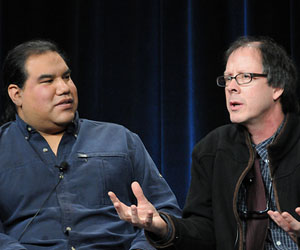
Sherman Alexie‘s literary ambitions often collide with his unofficial role as America’s most famous Indian author. So he suspects that his new short-story collection, War Dances, which features some distinctly unsavory Native American protagonists, might tick off sensitive readers. “I’m going to get grief from certain people about not having likable characters,” he says. “As an Indian writer I’m supposed to be showing us in our best light.” The 43-year-old has built his career on exploring the complexities and dark comedy of Indian identity. His first short-story collection, The Lone Ranger and Tonto Fistfight in Heaven, drew on his experiences growing up on the Spokane reservation in Washington. His 2007 young-adult novel, The Absolutely True Diary of a Part-Time Indian, tells the story of a shy, nerdy kid who leaves the rez for a suburban high school. Though his books can be heavy, they’re also funny. “People think funny is not serious,” says Alexie, who occasionally performs stand-up comedy. “Humor deals with our most serious problems.”
Mother Jones: On the campaign trail, Barack Obama was adopted into the Crow Nation and given the name One Who Helps People Throughout the Land. After that show of pandering, has he lived up to his name?
Sherman Alexie: [Laughs.] Well, first of all, these tribes that have given so many names and honorary memberships to people, they’re kinda trampy. I think some tribe adopted Norman Schwarzkopf, too. It’s the Indian version of getting a Hollywood star. So far Obama’s done nothing to be better or worse than any other president when it comes to Indians, which is what I suspected, because we represent no important voting bloc. His name should be One Who Helps Liberals and Moderates Throughout the Land.
MJ: A lot of people want to claim Indian identity. Have you followed the case of Ward Churchill, the former University of Colorado professor who claims Indian ancestry and was fired after making inflammatory remarks about 9/11?
SA: The tribes he claims he belongs to don’t even claim him. Let’s put it this way: You guys are all way behind in terms of what you know about his identity and his politics. Indians have been having those discussions since the beginning. His words got him in trouble, but he had lost plenty of Indian credibility before he lost white people’s credibility.
MJ: It seems like Indians were more present in the political and cultural mainstream when you were growing up in the ’70s than they are today.
SA: It was one of those eras where there were some incredibly charismatic Indian leaders. And I think those same kinds of charismatic people do other things now. They act, write, paint. The fight of the ’60s and ’70s was for the right to be human. And now we are being human.
MJ: That’s a victory.
SA: It’s gigantic. But in some sense it’s why we’re not visible in the mainstream. We’re not dangerous. Instead of guns we carry poker chips.
MJ: You recently got attacked for calling the Amazon Kindle elitist.
SA: I got hundreds of emails insulting me, accusing me of being some caveman. I am by no means a Luddite. I have two iPods. I have a cell phone. I have cable TV, HDTV! If I had been talking about drowning polar bears, people would have been weeping with me. But nobody recognizes that a bookstore or library can also be a drowning polar bear. And right now in this country, magazines, newspapers, and bookstores are drowning polar bears. And if people can’t see that or don’t want to talk about it, I don’t understand them at all.
MJ: The Absolutely True Diary of a Part-Time Indian was banned in some school districts. How did that feel?
SA: It means I did something right. The book has never been banned or challenged in a poor community, because the crap they’re dealing with makes the stuff in my book look like nothing. I just know there are kids who need books like this.
MJ: Your depiction of life on Indian reservations is that it’s very much apart from life off the rez. Has the Internet changed that?
SA: Every Indian kid has access to MySpace and Facebook now. But that doesn’t mean they have access to books and great teachers. This idea about bringing digital tech into schools is great, but once again I’ll say that this is not how people actually learn. We learn with our hands. You can pump millions of dollars into a school, and nothing will change. Throwing a computer at a kid does nothing to help him.
MJ: You once told sex advice columnist Dan Savage that there is a dearth of Native American porn.
SA: We’re a very sexually oriented people, culturally speaking—our stories, our songs, the way we talk—it’s all very sensual and sexual. But when it comes to the body, there is some repression involved there. Or modesty at least. There are a few porn actresses who claim Indian identity…
MJ: The Ward Churchills of the porn world?
SA: [Laughs.] Oh man, that’s good. I’m stealing that.
MJ: There’s a line that I liked in your poem “War Stories”: “I think that violent men will always find logical and rational and emotional and compelling ways to justify their violence.” Your characters in War Dances do just that.
SA: There’s this whole notion of being an Indian—the idea that “warrior” is a positive description of us. When an Indian guy does well, he’s a warrior, even now. He could be a computer salesman, but if he does well, he’s a warrior. I’m not a pacifist by any measure, but I’m also fully aware that the reasons I might go to war could be very dubious.
MJ: You’ve said that when you were younger you saw yourself as oppressed. Do you think you’ve gotten less angry, or just found a way to express your anger through humor?
SA: I think my anger now, rather than being focused on my Indian identity, is directed toward most of the planet. I recognize now that the conditions that Indians are living in are the conditions that poor people everywhere are living in. I’m still furious. It’s just that I’m older, and to carry around anger like that kills you.
For an extended version of this interview, go to motherjones.com/sherman-alexie.