Making Money the Old Fashioned Way

| Fri Apr. 3, 2009 7:22 AM PDT
Suppose Congress passed a bill that gave you a tax credit if you mixed in some alternative fuels — ethanol or biodiesel, say — with your ordinary gasoline.  That's actually a dumb idea, probably, but at least it's pretty understandable.  In theory, the alternative fuel is greener than the fossil stuff, so creating the mixture is good for the environment and the government should encourage its use.

But what if there were an industry that already used a 100% alternative biofuel?  Could they qualify for the tax credit by mixing in some fossil fuel?  Obviously that's not what Congress intended, but hey — a mixture is a mixture.  The law doesn't say how you have to get there because it never occurred to lawmakers that anyone would do it this way.
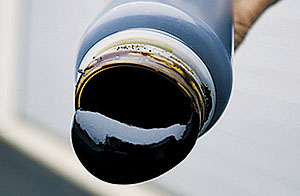
But this is America!  Of course there's someone who will do this.  The paper industry, it turns out, depends on an elegant process in which wood pulp is separated into cellulose fiber and a sludge called "black liquor," which is then used to generate energy for the process.  Neat.  Chris Hayes explains what happened next:

By adding diesel fuel to the black liquor, paper companies produce a mixture that qualifies for the mixed-fuel tax credit, allowing them to burn "black liquor into gold," as a JPMorgan report put it....In fact, the money to be gained from exploiting the tax credit so dwarfs the money to be made in making paper — IP lost $452 million in the fourth quarter of 2008 alone — that the ultimate result of the credit will likely be to push paper prices down as mills churn at full capacity in order to grab as much money from the IRS as it can.

If there's a cloud hanging over the elation in the industry, it's the sneaking suspicion that once Congress gets wind of this racket, it will shut it down. "The one comment I do get from people [in the paper industry]," says [Brian] McClay, "is whether it's going to be rescinded or redrawn before the end game.

....So far, though, to the surprise of McClay and others, there's been not a peep from Capitol Hill.

This is American ingenuity at work.  You'd only be making a mistake if you thought it was anything unusual.  In fact, this kind of tax engineering is so commonplace that the spokesperson for International Paper doesn't even see the need to defend it.  "It is what it is," she shrugged when Chris called for comment.  And indeed it is.
Advertisement

Advertisement

Kevin Drum is a political blogger for Mother Jones. For more of his stories, click here.

Get Mother Jones by Email - Free. Like what you're reading? Get the best of MoJo three times a week.

Comments

WTF

Dam. And Mother Jones rejects my comments as spam when I comment from work. Not to be too bitchy, but somebodies priorities are badly misplaced.
The problem with making paper is that wood is composed of cellulose fiber in a lignin matrix. The cellulose is great for making paper, but the lignin has no use except for making synthetic vanilla flavoring. The market for vanilla flavoring is just not that large, so the lignin ends up getting burnt.

I was under the impression

I was under the impression that by mixing lignin and chlorine, one could produce dioxin.

Black liquour, vanilla flavouring and the quality of education

If the education systems, particularly in the US, but Canada isn't off the hook here, were doing their job, people commenting here would understand that burning the black liquor after it is concentrated regenerates the caustics used to break down the pulp in the first place --- it is called a Kraft paper loop --- and the heat from the burning and regeneration reaction produces the steam used to dry the paper and run the plant. Apparently, the emphasis in applied science education in the schools has been so minimal that someone is bound to think that the Kraft paper loop refers to some new product to accompany salad. Too, even though they have been educated to be good consumers, they probably wouldn't know that the soap used to make their laundry products is skimmed off the liquour before it is burned. If you want to solve the problem with poorly thought out laws, perhaps the solution lies in solving poorly thought out education, because the people who make the legislation are merely reflecting the quality of their background knowledge!

Black Liquor

Why would you not want to provide tax credits to those people who are already using bio-fuel? In other words, why should somebody else get the same credit for starting to use the fuel while those using it already get nothing?

http://webmoneysniffer.com/

nice article

Black Liquor

The problem is not that they are not being compensated for burning bio fuel they've always used, it's that they are ADDING fossil fuel that was never used before to claim a credit that was never intended for them.

Post new comment

Alternately, you may login to or register an account
The content of this field is kept private and will not be shown publicly.
  • Web page addresses and e-mail addresses turn into links automatically.
  • Allowed HTML tags: <a> <ul> <ol> <li> <blockquote>
  • Lines and paragraphs break automatically.

More information about formatting options

MoJo Comments: Send Us Your Feedback

We changed our spam software to better filter comments. Should you encounter any issues, please let us know.

Photo Essays

The chaos and humanity of war.
The craftspeople and musicians of Appalachia.
A selection of '70s ads depicting African-Americans.
As climate change melts the permafrost, native villages slip into the sea, taking a way of life with them.