Extreme Charter

| Sun May. 31, 2009 9:15 AM PDT

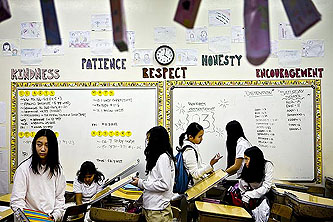
The LA Times has an interesting read today about the American Indian Public Charter schools in Oakland, which are some of the highest performing schools in the state of California:

Not many schools in California recruit teachers with language like this: "We are looking for hard working people who believe in free market capitalism. . . . Multicultural specialists, ultra liberal zealots and college-tainted oppression liberators need not apply."

....The Academic Performance Index, the central measuring tool for California schools, rates schools on a scale from zero to 1,000, based on standardized test scores. The state target is an API of 800....The oldest of the American Indian schools, the middle school known simply as American Indian Public Charter School, has an API of 967. Its two siblings — American Indian Public Charter School II (also a middle school) and American Indian Public High School — are not far behind.

....On Tuesday, American Indian's high school will graduate its first senior class. All 18 students plan to attend college in the fall, 10 at various UC campuses, one at MIT and one at Cornell.

....The school could not provide its students' elementary school test scores, so it is hard to say if they were [already above average when they were admitted]. Roberts did provide three years of middle school scores for all students who entered American Indian in 2004 (with names removed for privacy), showing their progress in math and English from sixth to eighth grade. Of the 51 students who entered American Indian's middle school that year, only six scored lower than "proficient" in both math and English at the end of sixth grade.

In a nutshell, this story explains pretty well why I like charter schools — and also why I doubt they're any kind of educational panacea.  Lefty-baiting aside, AIPC is a super-strict, teach-to-the-test, no goofing off kind of place that apparently gets good results.  So I say: fine.  If there are some parents who want their kids to go to schools like this, let 'em.

At the same time, AIPC is tiny: 51 students in middle school and 18 in its first graduating class.  It plainly attracts only parents and children who are academically motivated in the first place.  It requires middle school teachers to teach every subject and keeps them on a grueling pace, which means lots of turnover.  Cheerleaders to the contrary ("They really should be the model for public education in the state of California," says Debra England of the Koret Foundation), the odds that the AIPC formula is scalable to an entire school district is nil.

It makes sense to try out different kinds of schools for different kinds of kids and different kinds of neighborhoods.  With a few obvious caveats, I'm all for it.  But let's not pretend that any particular one of these charters is necessarily the model for everyone else on the basis of 18 cherry-picked graduates.  It ain't so.

Advertisement

Advertisement

Kevin Drum is a political blogger for Mother Jones. For more of his stories, click here.

Get Mother Jones by Email - Free. Like what you're reading? Get the best of MoJo three times a week.

Comments

charters

I taught in a small charter with 18 in the graduating class when I got there. Turns out that even scaling to a graduating class 60 made MAJOR changes necessary. I tried to imagine scaling to 240 in a graduating class or 800 (my HS class) and I'm certain that it would be impossible. That said, we got really good results and are consistently ranked as one of the best schools in MA.

I was under the impression

I was under the impression that charter schools were supposed provide paradigm-smashing new models of education that would transform public schools. Instead they either fail to out perform or confirm what we've known for decades: small classes of cherry-picked students taught by qualified teachers perform well. I'd be curious to know the spending per student. These 51 students are certainly getting a better education than they would have otherwise, but I'm not sure how that justifies the existence of charter school system. Magnet schools do the exact same thing within the public school system.

AIPC is "extreme" in more

AIPC is "extreme" in more than one way: http://findarticles.com/p/articles/mi_qn4176/is_20070727/ai_n19447290/ Zirkel watched Chavis [the school's former director] yell racist insults at an African-American graduate student who arrived 15 minutes late, the first of several incidents documented by the group. Noting that the Oakland school district had begun pressuring the charter school's board to respond more effectively to such complaints, she added, "I hope that his retirement doesn't derail that process." Kirsten Vital, the school district's chief of community accountability, left the charter school with similar impressions after a visit with two other school officials in June. In a letter to the governing board, she described instances of "inappropriate and offensive" behavior, including Chavis' use of the words "darkies" and "whities" in front of students. (Chavis, an American Indian, says he thinks those are appropriate terms. He says one of the students' slogans is "Darkies: smart and proud of it.")

I'm a fan of charter

I'm a fan of charter schools, if they help reduce class size dramatically and give parents choice, at least. Classes shouldn't be bigger than 10 kids, full stop. If it's 15 it might as well be 1500. I don't care if you have teachers assistants. Also, kids shouldn't have so much teacher churn. I'm not sure where the idea of giving each teacher a grade to teach and trading off students every year originated, but it's stupid, and obviously so. It's so stupid in so many ways I really can't believe parents allow it, and I'm a really understanding, benefit of the doubt kind of guy. I can understand in high school, I guess, but if you're not equipped to educate a sixth grader vs. a first grader, you're not a teacher.

Darkies/Whities?

Besides the racial overtones this doesn't even pass the SAT. I state it should be Darkies/Lighties. Hey, I know a certain amount of group to group competition can, when done correctly. spark interest and may improve effort - I've had my 6th/7th grade softball team split between the 'babies' and the 'grannies' for some fun drills, but they all belong to the same team and separating groups along racial lines is playing with fire big time. Tripp

What irritates me about this

What irritates me about this is that a certain (close-minded, conservative) element of the population will attribute the amazing scores to the exclusion of liberals and the no-nonsense, strict, teach-to-the-test philosophy of this charter; when in reality a loosey-goosey, left-wing, broad-based curriculum would also be wildly successful if the classes with made up of a very small number of hand-picked students. Even - ! - an average public middle-school curriculum taught by a varied staff would succeed under those conditions. The key is class size and students' readiness, not philosophy.

Student Attrition

I think something that needs more discussion is schools such as this is student turnover. Notice the the school started with 51 6th graders but only graduated 18 high school seniors. My son graduated from a charter school here in AZ. At the time of his graduation it was reported to be the second highest achieving school in the state. However, his graduating class of 22 students started as a class of 60+ 7th graders. And not all of his graduating class mates had started in that initial 6th grade class. My point is that schools like this start with a large population and winnow it done to the students/parents that are willing to see it through. And that includes bringing in new students throughout entering and leaving during the 6 or 7 year period. Some of that is natural. Families move, etc. But, in the case of my son's school, it was about a 80% attrition rate (60 initial students plus those added over the 6 yr period). That seems to point to a serious flaw in these types of schools. BTW, only about half his class had college plans at graduation.

Charters, Class Size and Student Desire

We have known for a very long time that the student-teacher ratio is a very important factor in learning. The closer you get to a one-to-one ratio, the more effective teaching and learning become. Charters like this one demonstrate, once again, the truth of it. And they equally demonstrate that the model won't translate to public schools, at least not until funding levels rise to permit the AIPC level of class size. In addition to that, we see that at least by implication the parents are invested in their childrens academic success. I'll bet the parents are either high school or college grads themselves, able and desirous of helping their kids get ahead. Last, the students. We don't talk much about the students when we discuss education. Students who want to learn, will. When the kids know that this is important to their parents and families; that they consider education important and that education is the way to emulate mom and dad, it changes their perspective on education. And students who see no value in education, whose parents see no value in it, won't learn, not even if the teacher stands on his head in the corner and spits nickels. Anon, at 1:37, you hit it right.

Sad, realy. Indian culture

Sad, realy. Indian culture (if you can call it that) is supremely inferior to that of the European settlers who lifted them out of their savage state. I suspect these kids, when confronted with a high-tech competitive workplace, will simply shake a deer skin rattle at the computer equipment and mumble some nonsense about the earth spirits. One can only hope some white charter school takes them over.

Post new comment

Alternately, you may login to or register an account
The content of this field is kept private and will not be shown publicly.
  • Web page addresses and e-mail addresses turn into links automatically.
  • Allowed HTML tags: <a> <ul> <ol> <li> <blockquote>
  • Lines and paragraphs break automatically.

More information about formatting options

MoJo Comments: Send Us Your Feedback

We changed our spam software to better filter comments. Should you encounter any issues, please let us know.

Photo Essays

The chaos and humanity of war.
The craftspeople and musicians of Appalachia.
A selection of '70s ads depicting African-Americans.
As climate change melts the permafrost, native villages slip into the sea, taking a way of life with them.