China and North Korea

| Mon Jun. 1, 2009 8:59 PM PDT

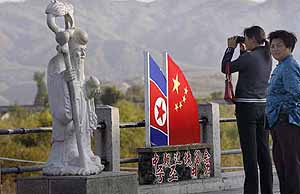
It's true, as Anne Applebaum says, that China is the only country in the world with any real influence over North Korea.  So why do they put up with Kim Jong-il's antics?  The usual answer is that they're afraid of pushing too hard lest his regime collapse and send millions of refugees streaming across the border into Manchuria.  Applebaum, however, speculates that that isn't it at all.  China actually wants North Korea to continue its hotheaded ways:

Despite the risks, there are good reasons for the Chinese to prod Kim Jong-il to keep those missiles coming. By permitting North Korea to rattle its sabers, the Chinese can monitor Obama's reaction to a military threat without having to deploy a threat themselves. They can see how serious the new American administration is about controlling the spread of nuclear weapons without having to risk sanctions or international condemnation of their own nuclear industry. They can distract and disturb the new administration without harming Chinese-American economic relations, which are crucial to their own regime's stability.

And if the game goes badly, they can call it off. North Korea is a puppet state, and the Chinese are the puppeteers. They could end this farce tomorrow. If they haven't done so yet, there must be a reason.

I don't really have much to add to this.  It's just that the refugee explanation of Chinese behavior has always struck me as moderately unconvincing, so I'm sort of interested in alternatives — even if they do come wrapped in some variant of "China must be stopped!" fearmongering.  Which this one does.  But it's worth a thought anyway.

Advertisement

Advertisement

Kevin Drum is a political blogger for Mother Jones. For more of his stories, click here.

Get Mother Jones by Email - Free. Like what you're reading? Get the best of MoJo three times a week.

Comments

China and North Korea

Maybe we should wait awhile before we cast China, yet again, into the role of master manipulator and sinister force. Zhu Feng, of Peking University whose recent essay is below, argues that China was happy enough while it thought it was in a position to roll back North Korea's nuclear ambitions. China's policy was invalidated when it recently became clear that NK is not about using nuclear ambitions as a way of manipulating the international community but rather a nuclear North Korea was the aim in and of itself. All this inextricably bound up in Kim Jong Il's personal and family leadership ambitions. As Zhu writes, "the breaking of China’s illusion that the DPRK’s nuclear capability could be dismantled through negotiations will very likely bring about a quick and fundamental change in China’s policy. . . . . Kim Jong-il’s folly has deprived the North of its last important friend in the international arena and has dramatically brought new unity to Asia. " Watch for more from China as it picks its chin off the floor and reassesses. This is all rather more important than some conspiratorial tweaking of Obama's nose. Really. From Pacific Forum CSIS, Hawaii PacNet #41 - Monday, June 1, 2009 North Korea Nuclear Test and Cornered China by Zhu Feng Zhu Feng (zhufeng@pku.edu.cn) is Deputy Director of the Center for International & Strategic Studies and Professor at the School of International Studies, Peking University. North Korea’s second nuclear test on May 25, 2009 was not unexpected. After threatening to strengthen its nuclear deterrent by all means, on April 28 Pyongyang clearly signaled it would go all the way in its defiance of the international community following its controversial missile test-firing April 5 and its April 14 announcement that it would withdraw from the Six-Party Talks and restore its nuclear facilities. As a result, the second nuclear test, the next step in the Dear Leader’s frenzy, did not stun Beijing. What has stunned Beijing for the moment is the way North Korea conducted the nuclear test. North Korea has habitually and uniformly blamed other states for its nuclear ambition and aggressive behavior. On April 13, it denounced the UN Security Council President’s Statement as a denial of its right to engage in the peaceful exploration of space and used this as an excuse to quit the Six-Party Talks; Pyongyang used the UNSC refusal to retract the condemnation to justify another nuclear test. However, these are misdirections. How could North Korea complete preparations for a nuclear test within just one month, presumably between April 28 and May 25? How was North Korea able to move so precipitously and conduct its second A-bomb blast? Chinese experts contend that it would take at least half a year for North Korea to locate the detonation point, dig the hole to install the nuclear bomb, and finish the testing apparatus around it. If this estimate is correct, it means that North Korea had decided to explode its second nuclear bomb no later than the end of last year. Scapegoating the international community is not just tactless but is desperate. It’s appalling. It’s clear that Pyongyang meant to conduct the second nuclear test whatever the state of relations between itself and the international community after the missile launch in early April, whether it was a missile test or a satellite launch. Furthermore, if North Korea had decided to explode its second nuclear device as early as the end of 2008, then all the successive events and actions by Pyongyang over the past three months are the outcome of a strategy and indicate North Korea’s grave calculations. This fact troubles the Chinese leadership because it shows that Pyongyang’s nuclear ambition is impossible to roll back as long as Kim Jong-il stays in power. His single-minded embrace of nuclear weapons means that his actions are not being shaped by whether the international community can somehow satisfy him, but hinges more on his determination that North Korea should be a nuclear power. That means the DPRK might use the vacuum created by the new U.S. administration which signaled it had no intent in its early days to try coercive diplomacy to push for nuclear dismantlement. North Korea may want to establish a fundamental reality of a nuclear North, forcing the other parties to swallow this bitter fruit. Unless the format of the diplomatic process changes in favor of the DPRK, or the White House compromises and changes course, Pyongyang says it will not return to the Six-Party Talks, and will not bargain simultaneously with the other five parties any more. By testing its second nuclear bomb, Pyongyang is telling the world that it should be perceived as the conductor on the podium rather than a “criminal suspect.” Traditionally, Beijing’s policy of mediating the DPRK nuclear crisis and hosting the Six-Party Talks has been based on the Chinese belief that North Korea’s nuclear program is negotiable. As long as its regime security and economic demands could be met, Pyongyang might be willing to give up its “nuclear card.” It seems to me, however, that all evidence now points in the opposite direction. In fact, the recent nuclear test by the DPRK is not just a slap in the face of China, but a sobering wake-up call for the Chinese leadership to face up to the malignant nature of their North Korean counterparts. China has had two concerns about a nuclear North Korea: completing the denuclearization of the Korea Peninsula, and preventing instability of the Kim Jong-il regime. These twin concerns roughly co-existed as long as Beijing believed Pyongyang would not push the envelope and was sincerely trying to strike a deal with the U.S., Japan, and South Korea. Once North Korea clarified that it had no intent to give up nuclear weapons and instead upped the nuclear ante by escalating military tension on the Korean Peninsula, Beijing’s longstanding and delicately balanced policy toward Pyongyang became a casualty of the second nuclear test from its neighbor of the North. It’s too early to say what Beijing would prefer to do in response to North Korea’s provocations. Yet, the breaking of China’s illusion that the DPRK’s nuclear capability could be dismantled through negotiations will very likely bring about a quick and fundamental change in China’s policy. The reason is simple: the DPRK’s possession of nuclear weapons was not scary as long as it was believed to be temporary and could be eventually eliminated. North Korea’s secretive conspiracy to become a de jure nuclear power, however, has recklessly crossed Beijing’s “bottom line” and will inevitably and catastrophically lead to the collapse of multinational talks. Beijing was willing to tolerate the diplomatic deficit caused by inefficient Six-Party Talks, but is not prepared to accept a truly nuclear North Korea. Exceptionally, Chinese Defense Minister Liang Guanglie joined the international community on May 27 to decry North Korea’s nuclear test. This is a significant sign that China’s policy toward the North might shift. Presumably, Beijing will fully engage other parties and seek a new UN Security Council resolution to address common concerns. But this time, Beijing will not offer any protection for the DPRK if the Security Council decides that a tougher policy is what Pyongyang deserves. Kim Jong-il’s folly has deprived the North of its last important friend in the international arena and has dramatically brought new unity to Asia.

Can't stand Anne Applebaum

Can't stand Anne Applebaum and her proto neo-con AEI view of the universe. She knows nothing about China, nor North Korea; who cares what she thinks?

I'm not buying Appelbaum's

I'm not buying Appelbaum's analysis. I'm no East Asian political expert, but it seems to me that a nuke-waving North Korea is not something China is particularly happy about and it would be particularly stupid for them to use so serious a problem as a way of "testing" Obama's reaction to military escalation. The Chinese really don't want to have to deal with refugees if the DPRK collapses into chaos, (although I would think this is a bigger problem for South Korea than China), but they also don't want it to become a rallying point for the further projection of American or Japanese power in the region.

Just a thought...

First, there's a persistent fallacy of thinking that countries other than one's own behave as if they were a single, very focused, person. It's risible when I encounter people overseas making this supposition about the USA. So why should it make any more sense about China? Second, it's quite plausible to suppose that the leadership of the DPRK and much of the leadership of the PRC take their expressed ideology very seriously. Some may believe, not without reason, that the United Nations Security Council is effectively under the control of Washington neoconservatives; that talk of the UNSC as "the international community" is absurd; and that the enemies of the DPRK are imperialists who are relentless enemies of all authentic movements of national liberation. For those with poor reading skills--I'm not endorsing this opinion. Nevertheless, the conduct of the US government towards countries like Haiti, the Dominican Republic, Bolivia, Cuba, Vietnam, Laos, and many others, certainly should make such opinions understandable.

lock-step

America and China are very different. China doesn't hold elections and its policies change glacially. You CAN make general assumptions about China. The Chinese even insist on it themselves. Same as they do here in Japan. In Asia, labelling the community as an exercise in group-think is a source of national pride, not western prejudice.

Something here makes sense

North Korean success in developing nuclear weapons and delivery systems can only lead to the nuclearization of Japan, South Korea, and any other neighbors who can pull it off -- Taiwan, perhaps? China cannot regard that as in its interests.

Anything Applebaum writes is

Anything Applebaum writes is a great excuse to mention the stupidest opinion piece every put into a major newspaper, her 2004 assertion that since Americans don't ask for ATM receipts or look at their bank statements, they shouldn't be worried about electronic voting machines, either. (Really.) With that over with, her argument about North Korea goes beyond her disclaimer "I can't prove that this was the case." As has already been noted, it's impossible to fathom how a nuclear arms race in northeast Asia could be something China would risk sparking, which they would be doing if they gave a go-ahead to a nuclear test. To address Kevin's question, the refugee issue is the most concrete aspect of what the Chinese do want, which is stability. The buzzword in domestic politics is "harmony." The current leadership is obsessed with keeping everything balanced as China's economy (and military) grows. Pushing the leadership of North Korea to the brink, by cutting off their food and fuel, can only be breezily mentioned by people thousands of miles away. If genuinely wounded, the North Korean regime might do something drastic, and if it toppled, cleaning up the mess would be in large part China's problem. So why do they "allow" North Korean hijinks? Calling North Korea a puppet state is deeply misleading. It's more like a grown child with a personality disorder that survives on parental handouts, without which it might end up in jail or a homeless camp. Up to just recently, as has been noted, they have believed that ultimately the government will behave, and not directly disobey Beijing's hard line. That calculus may be changing. Wait-and-see may be a cop-out, but if this defiance is a truly new development and the Chinese government hasn't decided its next move, wait-and-see is it. But you know what the biggest argument against the "testing Obama" theory comes from? The dynamics of the situation are quite clear. What exactly is he supposed to do or not do? What magic course of action, which no one has seen before, is he supposed to take? Personal prediction here, but I think the Chinese will keep doing what they've been doing, because what magic course of action are they supposed to take? Threats of drastic action don't keep North Korea in line, and they don't like risks associated with actually taking drastic action. So they'll twist the North Korean's arms, maybe hold back a few non-essential shipments of goods, and North Korea will be right back at the conference table making promises. And 5 years from now, 10 years from now, we'll be having this exact same conversation. The length of this post stretches the meaning of "comment." sorry.

A simple answer to a simple question.

It is really very simple, the Chinese do not want the US to have military bases right up against their own border.How would Americans feel if the Chinese had bases in Mexico or Canada? Just like they did when the Soviet Union had bases in Cuba? Has nobody in Washington learnt that simple lession from the recent police action in Georgia? That is why anyone thinking that the US and/or South Korea attacking North Korea is a good idea is a moron. The moment that attack crosses the border into North Korea, the PLA would almost certainly go into action not just in the Korean Peninsula but also, most likely, against Taiwan. Even if the US/South Korea only bomb North Korea, the North Koreans would quite legitimately start shelling South Korea, and once that starts, the US/South Korea would be forced to invade North Korea to stop it. For even suggesting bombing North Korea, Bill Kristol is a complete fucking wanker!

Applebaum Is A Fool

The Chinese are probably as concerned about nuclear proliferation as anyone else. They have restless Uighur Muslims in their West, and the prospect of a loose Pakistani or North Korean nuke would be a threat to them. My guess is that the Chinese are going to restrain the North Koreans, as they simply do not want to let things get to the shooting phase.

I've always bought the crazy

I've always bought the crazy uncle theory. He's a news maker and a diversion, he wastes the time and resources of the competition, and he makes you look sane and your human rights record look great in comparison. The best thing to do is to put some more mines on the border and ignore them.

Applebaum policy care warning

I'd second what a bunch of commenter above have already said about Ann Applebaum. Asian political affairs is not something I'm particularly familiar with, but I'd claim that to be the case with European foreign politics. Judged from that vantage point Ann Applebaum's writing is prone to what Ty Lookwell in his comment called a 'proto neo-con AEI view of the universe'. Applebaum's opinion piece in Slate is certainly providing an 'alternative explanation' to what is going on in the relationship between the PRC and NK. However, bar some support from more seasoned Asian policy experts it would appear advisable to consider her uttering a fringe position.

"I'm sort of interested in

"I'm sort of interested in alternatives" The alternative is that China only has limited influence over what happens in North Korea and cannot just snap its fingers to make it do what it wants.

Annie Applebaum

I'd also agree with much of the commentary above. Telling to me is this line: And if the game goes badly, they [the Bejing leadership] can call it off. Notice she doesn't say what she thinks "going badly" would look like. Clearly it isn't what the Bushies did for 8 years, and it isn't what Obama is doing either. So one is left to speculate what Ms. Applebaum believes would have China call off its North Korean dogs. It's hard, for me at least, to avoid the implication that she's talking about the "Bill Kristol option". You know, starting a war.

Agree it's kind of a dumb

Agree it's kind of a dumb explanation, for the simple reason that any Presidents reaction to saber rattling in N. Korea is pretty constrained by the facts on the ground. The can give them a little more carrot or a little more stick vis-a-vis aid/sanctions, but that's about it. So China doesn't really learn much about Obama here, plus there are plenty of difficult countries around the world where different Presidents can take different actions without China propping up another one. Also this: "They can see how serious the new American administration is about controlling the spread of nuclear weapons without having to risk sanctions or international condemnation of their own nuclear industry." almost makes it seem like the author is unaware that China already has a large nuclear capability (and is allowed to have such under international treaties).

A puppet state?

Is there anyone with any credible expertise on China/Korea who would agree with Applebaum's assertion that North Korea today is a puppet State of China?

You've been tooken, Kevin

Sometimes these goons can sound sooo reasonable and thoughtful and "serious," that if you don't watch out, you can be taken in. Applebaum is just promoting the GOP bully-boy theory of international relations. And I'd like to echo several commenters above. North Korea is no more a "puppet state" of China than, say, Mexico is of the U.S., so the whole premise is nonsense to begin with.

Tin foil hat country.

I can sympathize, that China has probably considered the potential benefits of letting NK continue to act like a spoiled child. But, assuming Bejing has control over him is real tin-foil hat thinking. China cannot tell Kim what to do, they can only threaten relatively ineffectual sanctions.

an imperial militarist

Applebaum's perspective appears moderate, but she is just as much an imperial militarist as any neo-con.

to leverage China to put pressure on Kim...

All we have to do is say we're entering bi-lateral negotiations with South Korea and Japan to sell them nukes -- to defend against North Korean aggression. Nothing need come of those negotiations... Heh,heh.

paranoid hawk

Applebaum seems to be assuming that China wants to launch an armed attack on the US or its allies, and is using North Korea to test out the waters.

Now there is no evidence this is so, and China has lots of reasons to stay on reasonably peaceful terms with the US. So why does she assume it? Because Appelbaum is a militant hawk, and like all militant hawks she is wildly paranoid. Faced with another country that is not a close ally, she always chooses the most dangerous possible interpretation of its intentions.

Post new comment

Alternately, you may login to or register an account
The content of this field is kept private and will not be shown publicly.
  • Web page addresses and e-mail addresses turn into links automatically.
  • Allowed HTML tags: <a> <ul> <ol> <li> <blockquote>
  • Lines and paragraphs break automatically.

More information about formatting options

MoJo Comments: Send Us Your Feedback

We changed our spam software to better filter comments. Should you encounter any issues, please let us know.

Photo Essays

The chaos and humanity of war.
The craftspeople and musicians of Appalachia.
A selection of '70s ads depicting African-Americans.
As climate change melts the permafrost, native villages slip into the sea, taking a way of life with them.