Books

Kindle v. Kindling

| Mon Jul. 20, 2009 3:47 PM PDT

This is apropos of nothing in particular, but I thought I'd update everybody on what I think about the Kindle after a few additional months of usage.

Here's what happened: a couple of months I found myself at loose ends, book-wise.  I didn't really have anything special I wanted to read, so I started browsing around on Amazon for books I might enjoy.  I found one, but it wasn't available for the Kindle.  Then another.  And another.  Hmmph.  Then Eric Boehlert's Bloggers on the Bus came in the mail, so I read that instead.  When I was done, I wandered over to the corner of my living room that temporarily holds the stack of books publishers send me and took one off the top.  Then the next, and the next. It was kind of fun: totally random book selection.  So over the course of a few weeks I ended up reading half a dozen real books printed on real paper: Bloggers on the Bus (excellent); In Search of Jefferson's Moose (Jefferson stuff pretty good, internet stuff not so much); Intelligence and How to Get It (better than I expected); The Summer of 1787 (pretty good, though not really groundbreaking or anything); Bailout Nation (polemic, but mostly good polemic); and The Evolution of God (one of the less convincing books I've read in a while).
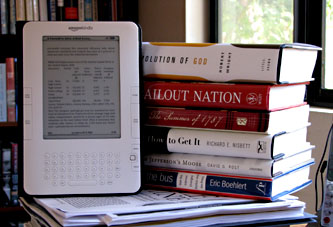
Then I got bored and went back to the Kindle.  This was all pretty unplanned, but what's struck me the most in my back and forth between Kindle and paper is that the Kindle is really unsatisfactory for books that have a lot of charts and tables.  The resolution is poor; columns don't line up right; captions break up halfway through; and both charts and tables can sometimes be pages and pages away from the text they're connected to.

More generally: the Kindle is bad for any book in which the actual layout of the text is important.  That's pretty obvious for something like a coffee table picture book, but it turns out to be true for nonfiction with lots of illustrations too. (I can't imagine what it's like reading In Search of Jefferson's Moose on the Kindle, for instance. Between all the charts, tables, footnotes, and callouts, it must be a real mess. If anyone's done it, let me know.)

I guess this is all pretty obvious, but a few months has driven it home more strongly.  The problem is, how do you know if a book relies on lots of illustrations?  Most fiction doesn't, of course, but a lot of nonfiction doesn't either.  But some does, and it's not always obvious from the title or subject of the book.  I suppose I could look at the table of contents on Amazon and see how long the list of figures and tables is.  That's not a perfect proxy, though, and not all books have a ToC for tables and figures anyway.  (And not all books are browsable on Amazon, either.)

Anyway, I'm not quite sure what to do about this.  Right now, for example, I'm reading A Farewell to Alms on the Kindle and it's driving me crazy.  I should be reading it on paper.  But I didn't know.  I'm not quite sure what the answer to this dilemma is.  Can the hive mind help?

POSTSCRIPT: Of course, this is all quite aside from this, which is pretty disturbing all on its own.  The future may not be quite as Kindle-riffic as I initially thought.

Advertisement

Advertisement

Kevin Drum is a political blogger for Mother Jones. For more of his stories, click here.

Get Mother Jones by Email - Free. Like what you're reading? Get the best of MoJo three times a week.

Comments

What are the contest rules?

What are the contest rules? When will you award one lucky commenter with your Kindle?

You got further than I did.

You got further than I did. When I first saw the Kindle, I thought it looked cool, but then thought better of it after I realized I'd be paying $400 for the privilege of reading a book on a device, but still have to pay extra for the actual "books" or rss feeds(!).

Also, you better read that book fast. You never know when Amazon might change their minds and forcibly buy your book back.

Yikes!

I was griping about all my old pulp scifi paperbacks turning to dust because of the highly acidic paper they were printed on and now you tell me Amazon is doing the same thing with Kindle books at a moment's notice?

Son of a . . .

No kindle for this old-timer!

Tripp

As a guy who used to travel

As a guy who used to travel fairly often, books are heavy. I love paper and I havent gotten my hands on a kindle yet, but I would love to carry my own personal cannon. There are books that I know I will have to read in the future. I often buy multiple copies of books simply because I cannot wait until I get home to read Baudelaire or Whitman or Celine. Dont judge me, I know.

The real question for me is not is Kindle better than books, but is Kindle a subsitute for reading on a laptop? Aside from the weight of books, I find that used bookstores and libraries supply most of the novels and nonfiction I need. But I read all the papers and magazines and blogs online. How is the kindle as a subsitute for for the browser?

The answer to your layout

The answer to your layout problem is really pretty obvious. Kindle books need separate editors who can ensure that these problems have been addressed. If the books were 50 cents each or free, the idea that someone wouldn't have reviewed every page on the most popular appropriate devices might be somewhat more forgivable. But when paying such a high percentage of the paper price, it's shameful that there are layout problems on the dominant device (and the 6 closest runners-up for that matter). A webpage developer would be fired. Or at least yelled at some.

Amazon lets you download the

Amazon lets you download the first chapter of a book you're thinking of buying to your Kindle (for free), so if you suspect a book may be better on paper than on the Kindle, you can get just the first chapter. If that goes well, you can buy the book on your Kindle, and if it doesn't you can find a paper copy.

I'm with Tripp

That Orwell business is pretty much a show-stopper for me. If you don't know what I'm referring to, read the article Kevin links to.
It's creepy enough that they know what paper books I've bought, but it would take a big jump in intrusiveness, and a major effort, for them to send people around to take them away from me.
If they can just do it remotely, at the push of a button, well... that is just too damn creepy.

From the Times article Kevin links to:

"Amazon effectively acknowledged that the deletions were a bad idea. 'We are changing our systems so that in the future we will not remove books from customers’ devices in these circumstances,'” Mr. Herdener said."

on delete cascade vs. on

on delete cascade

vs.

on delete set null

discuss.

Kindling -- much as you

Kindling -- much as you want, do not, repeat, do not, toss your Kindle into an open flame. Not green. Probably toxic.

A farewell to...

Okay, the first couple of times I read this I couldn't figure out why you found Hemingway so frustrating on the Kindle.

Anyway, I'm not sure why you're having this problem. Don't you always get the sample before buying? If it reads OK you can buy the book and continue reading, if you get stopped by charts and tables, you can probably guess that will continue and you should go get the hardcopy instead. I just download the sample of A Farewell to Alms and found two unviewable charts and two unreadable tables just in the sample; that's a pretty good sign that this isn't a good Kindle book.

The sample isn't always useful, I've found that for academic titles it will often only include the intro, but there's no reason not to take advantage of it.

When you are considering

When you are considering reading a book on the Kindle, read the first chapter. If that looks good, buy the book.

Once you have the whole book on your Kindle, take a quick look through. If the formatting looks bad, ask Amazon for a refund.

"Once you have the whole

"Once you have the whole book on your Kindle, take a quick look through"

Cause that's all you'll get before it disappears

"Cause that's all you'll get

"Cause that's all you'll get before it disappears"

I think the Orwell thing is unlikely to be repeated. Or, at least, it'll be self-limiting.

Publishers yanking back their ebooks will only cause readers to download pirated versions instead of buying them.

You can put any text, html, .doc, rtf, or (on the DX) PDF file on a kindle, so it's not like buyers are locked into using Amazon's DRM'd files.

Cookbooks

I was thinking Kindle would be great for cookbooks, since I often want to search for recipes that contain, for example, rice flour.

But now I'm not so sure. Has anyone tried a cookbook on Kindle? Is the layout an issue?

Hi Kathy, Yup, I've got a DX

Hi Kathy,
Yup, I've got a DX and have one cookbook on it. Very convenient because it stays open. Annoying when the screen saver comes on. Also annoying when I need to flip back and forth between instructions and ingredients. Otherwise, it's pretty cool.

I just don't get it. I

I just don't get it. I mean, if it cost like $20-$50 bucks i might buy one to carry books when i travel. But otherwise? I like reading books. I'm not just being a contrary luddite, it's the actual printing on paper that I enjoy looking at, the paper object I enjoy carrying. I spend enough of my day looking at a stupid pixelated screen. I just don't get why someone would want to read books on a kindle badly enough to actually buy one.

A few answers to others

@JimmyO, as a laptop replacement, the big difference is that the Kindle browser kinda sucks. I wouldn't want to browse with it. For me, when I see a long article on the web I want to read, I send it to the Kindle and read it at my convenience, and it works perfectly for that. The Kindle is more convenient to carry around than a laptop, reading is much easier on the eyes, and while the browser isn't full-featured, it *is* available virtually everywhere for free. For blogs, you can subscribe to them on the Kindle but I never have. Google Reader works OK for blogs but not really great IMHO.

As far as books go, Celine's still under copyright, but Baudelaire and Whitman are not only free, but downloadable instantly from almost anywhere. I hate DRM, and almost never buy DRM books, but I use my Kindle constantly for email, web articles and classics. Having instant access to a foreign languages dictionaries was probably the #1 selling point to me.

@KathyF, I've got a cookbook on the Kindle and the layout is absolutely no problem at all, but to be honest I've never used it. I just don't like having the Kindle lying around in the kitchen to be splashed on, it feels weird to me, so I'd rather print out something from the computer. Also, it's not as convenient to thumb through. YMMV.

@Urk, I don't really understand your post. OK, I accept that you enjoy the actual paper, but you really can't even understand people who are more interested in the content? As far as price goes, and the fact that the Kindle allows me to avoid purchasing internet access on my cell saves money every month, not to mention the money I save on books, but it *is* a good chunk of cash, agreed.

I think you're paying for

I think you're paying for the privilege of being a beta tester. The interface is all thumbs from the look of it. The Nintendo DS already has some public domain classics loaded onto a chip and available in Europe; a touch screen interface would be far more intuitive, and a second generation chip might include maps and photographs accessible with a stylus touch--see a place name or person, touch the text and get a graphic, or not. Oh, and the base DS is less than half the Kindle's cost. So I'll wait.

The other thing is a remark by Stanley Kaufman about Evelyn Waugh. He said that Waugh was such a stylist that he was conscious of the eventual shape of his paragraphs on the printed page. I'm not sure I want to see what they look like on a Kindle.

And I can't help remembering that I can walk into a Goodwill and find a paperback copy of "The Glass Key" or "Nostromo" for a dollar. They don't weigh much either.

I think you're paying for

I think you're paying for the privilege of being a beta tester. The interface is all thumbs from the look of it. The Nintendo DS already has some public domain classics loaded onto a chip and available in Europe; a touch screen interface would be far more intuitive, and a second generation chip might include maps and photographs accessible with a stylus touch--see a place name or person, touch the text and get a graphic, or not. Oh, and the base DS is less than half the Kindle's cost. So I'll wait.

The other thing is a remark by Stanley Kaufman about Evelyn Waugh. He said that Waugh was such a stylist that he was conscious of the eventual shape of his paragraphs on the printed page. I'm not sure I want to see what they look like on a Kindle.

And I can't help remembering that I can walk into a Goodwill and find a paperback copy of "The Glass Key" or "Nostromo" for a dollar. They don't weigh much either.

Be careful of public domain

Be careful of public domain versions of literature in translation. The translations are often old fashioned and terrible. Far better to look for a more recent translation that might be copyrighted.

A good example is any Russian literature. Most of the public domain translations are bad ones done by Constance Garnett around 1900. The recent translations by Pevear and Vololhonsky are vastly superior.

I only use my Kindle to read

I only use my Kindle to read The NY Times, The Economist, and The New Yorker on the subway. I absolutely hate the layout of newspapers (get 1/4 of the way through a story, then have to flip through 20 pages to find the rest) and they're a royal pain in the a** to read on the subway. The Kindle solves both problems, so I love it.

Try the Kindle DX

I hear your discontent but many of your issues are addressed by the Kindle DX - it displays charts, tables and pictures (albeit in B/W) beautifully. Pages are rendered in approximately the same size as a paper-based book. This being Mother Jones, of course other issues will be raised but really, you should give the DX a try before rushing to superficial judgement based on one model of the Kindle.

I second this

I second this recommendation. Just finished Guns, Germs and Steel on my dx and it has a few tables, charts and images. I needed to view in landscape mode for a couple of the tables to render properly, but it work well otherwise.

These comments seem

These comments seem preponderantly anti-Kindle--I wonder how many of you have actually tried it? I have two Kindles (original and dx versions) and I love them. Yes, they could be a lot better--the original is horrible for graphs and maps (although the dx is a big improvement) and sometimes the layout is horrible. And often I can't find exactly what I want in the Amazon store--I suspect the two problems are related, since the horrible layout is the result of the need to get as much material as possible into kindle-compatible format as fast as possible. I assume that in the long run editions produced with the Kindle in mind will become available, as Kevin suggests, fixing many of these problems.

But even with the problems, having a Kindle is a huge improvement over lugging around a sack of books. I read a lot--typically, at least a book a day--and it's great to know I don't have to worry about getting caught waiting somewhere without anything to read. I love being able to download a new book whenever I want one, without waiting or making a detour to a bookstore. That doesn't mean I don't go to bookstores anymore--lots of things aren't available on Kindle, and sometimes I want hard copies for reference. But for me the convenience of the Kindle far outweighs its flaws.

content

I think what WoofWoof is getting at above is that the medium the author writes for is extremely important. If the author were writing for the Kindle, the content would look different and the Kindle would be the ideal medium for reading it. Currently with the Kindle, what you're doing is reading content written with paper in mind. Digital content intended for the web will generally be awful on paper-- no hyperlinks.

The Kindle folks should concentrate on two things-- improving the browser that WoofWoof complains about and inducing some authors to write specifically for the Kindle in a way that won't translate well to paper.

A serious question. Can you

A serious question. Can you read your Kindle outdoors, the way you can with a book? I've tried taking my laptop outside to do work in the fresh air and visibility on the screen sucks. Has Kindle solved that problem or do you still have to be in deep shade to see anything?

an answer

Yes, it's completely readable outdoors; there's no glare issue at all. I think people tend to have the idea that the Kindle screen is like a cellphone or small computer, but e-ink is really completely different.

Yes, it is readable outdoors

e-ink screens, like calculator LCD screens, don't emit light; they reflect ambient light just like paper, which means the contrast is better the more light you have around you. Laptop screens emit light, and have to compete against ambient light to make themselves viewable.

I think Kindle would be nice

I think Kindle would be nice for traveling, especially, but despite the pile growing around my bed, I still like books. One nice thing about books is that you can share them by giving them away. Depending on content, I give books to my local nursing home, library, daycare center and Safeway -- which runs an impromptu book shop that takes donated books and sells everything for a dollar to raise money for charity.

I really dont understand why

I really dont understand why anyone would buy a Kindle when there are so many other cooler, better, non-drm solutions on the market.

My favorite is the Bookeen from a french company that is frequently on a backorder. It makes no sense to me why people would pay for an electronic copy of a book. Maybe if the electronic copy was included in the purchase price of the hard copy, that would be cool, otherwise just download the pdf. Not a lot different than going to borders and reading a couple of chapters before you put it back on the shelf.

High tech versus high touch

A lot has been said in the comments above, but the following has not. Yes, of course, old fossils like me buy bound paper and ink books. But when I'm through, I donate them to a needy library, so other people can enjoy. And nobody can erase them.

How about eschewing Amazon

How about eschewing Amazon altogether? Except as a source for researching a particular book - what it's about, what others thought of it. Then go down to your local independent book seller, if you're fortunate enough to have one. They probably won't have it on hand, but they'll be glad to order it for you. So it takes a couple of days. If you're like me, you'll have plenty of things to read in the interim.

Device cost

What I guess I still don't get is why pay $300 up front for the equivalent of the power to then buy books. As far as paying to learn how to read, I guess I had enough fancy education, but still....

@woofwoof I guess what I'm

@woofwoof I guess what I'm saying is that I don't understand what personal or customer need the kindle actually serves on a wide scale. I understand what it does for retailers since it gives them another platform to deliver instant content, and for publishers who can skip the physical costs of printing books. But beyond portability I don't (or didn't until I read some of the comments above) see what it does for readers/customers, and I still don't see much of anything that would make it a commanding choice for me. I do enjoy the form of books, but I'm not trying to fetishize their physical properties here, I just don't see them as a broken medium, tho I know that the economics fo modern publishing disagree with me here. I also don't see long form text as "content" that divorces so easily from the medium that has so far shaped its aesthetic principles.

Reading newspapers, blogs, etc. on some kind of smaller-than-a-laptop portable text browser does make sense to me, especially one where I could save individual articles. (can you do that?) Other than that though, i don't see why it would be preferable to read a long novel on a browser than on the page. Is it really just the portability? the instant gratification of shopping online and getting the "book" right in that moment? If it's much the latter, the nature of the transaction justifying a less pleasing (even slightly) experience, then it really seems like a bad trade off in terms of what we do with that "content": read it.

Now some of the reading I do I have to have printed matter in front of me for, since I take notes in the margins, underline, etc. And, if Kindles, etc. were super cheap I suppose I'd be happy to have one for newspapers and travel. But I'm curious: for those of you who do have them and use them for reading long form text, what is it in the experience of reading that makes it worthwhile, worth the money? Is it entirely a lifestyle thing- don't want an apartment full of books, don't want to mess with trips to the library, etc. or is there something I'm missing?

No real disagreement

OK, I actually don't disagree with that, e-books definitely aren't for everyone. I think they're actually useful for a fairly narrow audience. In answer to your question, the main things that draw me to the Kindle are:

a. The portability. The ability to have multiple books with me at once so I don't have to decide which book I'm going to read before I go out. One of the very few DRM books I've bought is Infinite Jest. With the hardcopy, I was forced to decide in the morning whether I'd read IJ or something else that day, while with the Kindle it's always there along with the other books I'm currently reading.

b. The dictionary/web lookup access. If I'm reading in French or Spanish, I really want a dictionary nearby. With the Kindle it's built in. This was actually the primary reason I got into e-books in the first place and is related to the portability thing. This is nice in English as well, though not as much a necessity.

c. Having *something* with portable web access is almost a necessity these days, and with the Kindle there's no monthly charge, and it's a bit better than most cellphone web access. And the "save it and read it later" aspect gets me away from the computer more, which is invaluable.

d. The fact that most books I read are now free helped offset the selling price quite a bit. All in all, it's the foreign language stuff that really makes the Kindle worthwhile to me. Finding the original version of some secondary Balzac novel is very difficult in a library or bookstore and is expensive to order, but it's easy to find online and free to download.

eBooks are the way of the

eBooks are the way of the future, but Amazon's approach is deficient.

Not only does Amazon itself have a model with a larger screen than the one Kevin seems to have -- but other companies have readers that support PDF (needed for good rendering of technical material) and other business models will be more flexible than Amazon's.

Barnes and Noble just announced a major entry into this market with support for a variety of devices including phones, laptops, and desktops, as well as for a new device from Plastic Logic that looks very interesting: standard paper size screen, unbreakable plastic, PDF support, etc. (see plasticlogic.com).

Besides being environmentally friendly, eBooks (with good reader software) make it easy to search, look up words in a dictionary (or on Google), underline and take notes (with the option of hiding them), copy/paste to other documents (subject to DRM), etc. There is no way this technology will not replace the dead tree version. If you are a student writing a paper on the Iliad, try finding all the places where Achilles (or Thersites) speaks by turning pages and scanning visually. Then use an electronic search. You will be at a serious disadvantage with the former. And when school is over, you can carry all your school books with you -- for the rest of your life -- stored in thin air rather than in dozens of heavy boxes.

Until the eBook reader technology matures, it is possible to use a laptop (or netbook) to read eBooks. PDFs can be rotated, so a netbook with the size and weight of a hardcover can be held like a book. And there is a wide choice of reader software for many different eBook formats.

netbooks

"Until the eBook reader technology matures, it is possible to use a laptop (or netbook) to read eBooks"

Not in sunlight, you can't. At least, not easily. And one-handed reading of a netbook, rotated or not, is going to get awkward. I've run for the bus with my kindle in one hand, which I wouldn't want to do while holding an open netbook.

I already have a laptop, which is too big and heavy to be a suitable portable ebook reader. And since I already have a laptop, I'm not about to go buy a netbook.

I look at buying a kindle as

I look at buying a kindle as being like buying a nice chair to read in. It's just a tool for reading.

To me your numbers are way

tagged as: 

To me your numbers are way off, at least if you define the terms as I do. When you say "Share of Total Taxes" I think percentage of Federal Tax Revenue paid. In that sense the top Quintile pays about 70% of the taxes not the 28% you list. But you must mean "Effective Tax Rate" which would make more sense. Using "Tax Share" is how Republicans like to talk about taxes. Theytiffany jewelry

tiffany and co
conveniently don't mention "Income Share". Ezra Klein has a good post on this here: http://www.prospect.org/csnc/blogs/ezraklein_archive?

Post new comment

Alternately, you may login to or register an account
The content of this field is kept private and will not be shown publicly.
  • Web page addresses and e-mail addresses turn into links automatically.
  • Allowed HTML tags: <a> <ul> <ol> <li> <blockquote>
  • Lines and paragraphs break automatically.

More information about formatting options

MoJo Comments: Send Us Your Feedback

We changed our spam software to better filter comments. Should you encounter any issues, please let us know.

Photo Essays

The chaos and humanity of war.
What becomes of Janesville, Wisconsin, now that GM's left town?
The other side of Gitmo.
American Holidays