Spending Like Cats and Dogs

| Tue Jul. 14, 2009 7:37 AM PDT

Here's an interesting healthcare tidbit.  AEI's Andrew Biggs presents us with this chart showing increased costs of human healthcare compared to increased costs of veterinary healthcare:
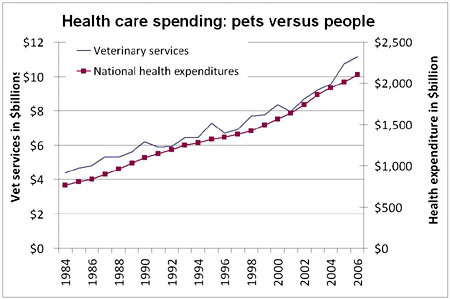
The point here is supposed to be that even in an area of healthcare where there's no insurance and we have to pay everything out of pocket, costs are still skyrocketing.  So maybe having "skin in the game" doesn't really have much effect after all.

Which is interesting — except for one thing: it might not be true.  As John Schwenkler points out, a big part of the increase is accounted for by a large increases in the number of pets.  We aren't necessarily spending a lot more per pet, we just have more pets.  In fact, he points to some market research that suggests cats have actually gotten cheaper over the years: we spent $85 per cat in 2001 but only $81 in 2007.  (Dogs, conversely have gotten a little more expensive, but only by 11%, not the 30-40% the chart suggests.)

So which data is correct?  Beats me.  But considering the high-pressure sales job vets have adopted in recent years, I have a hard time believing that cat expenditures have gone down.  After all, we didn't use to get their teeth cleaned or spend a couple hundred bucks a year on fancy flea/heartworm/hookworm/etc. goop.  Now we do.  Caveat emptor.
Continues Below

Continued From Above

Get Mother Jones by Email - Free. Like what you're reading? Get the best of MoJo three times a week.

Comments

Pets

this is purely anecdotal, but when I move from L.A. to Portland, the cost of our vet visits skyrocketed. I went from spending about $100 per visit to about $250 a visit every time I went. What I noticed was that the vets here pushed much harder on conducting all sorts of tests and chronic medications (like heartworm pills when heartworm is not a big risk at all in this area). After switching vets 3 times (including dumping the vet who "understood" my concerns about overtesting and then recommended a bunch of pointless tests anyway), I finally realized that a business culture had developed around here that recognized the profit potential in preying on pet-owners fears and maxing out charges (they give you this look like you're heartless when you turn down a test). I finally learned to live with the guilty look after spending $1500 on a biopsy that the vet admitted (after the procedure) was very unlikely to give us any good information about what was going on (it told us nothing).

You're lucky

I had a vet push a biopsy on a cat's mouth cancer that I figured out later could not tell us anything useful, and which the vet admitted afterward had a high probability of inflaming the tumor-- which it did, plunging a happy cat who should have had a few weeks of comfortable life left overnight into instant misery and pain.

I had another vet who insisted on immediate, urgent exploratory abdominal surgery to find out whether a cat that was throwing up too often had lymphoma. Turned out she just had hairballs.

I've finally found vets who do not do this but consider every treatment or diagnostic in terms of what's best for the animal's wellbeing, and secondly what makes sense for the owner's pocketbook. I have actually been discouraged from testing for things that would produce no useful information.

There are a lot of vets in this country who should be taken out and shot at sunrise, IMHO, or forced to spend eternity watching videos of the animals they tormented for money.

Another relevant difference:

Another relevant difference: We are far more likely not to treat certain afflictions for pets. We have them put to sleep if, for instance, they have terminal cancer. We don't embark a series of expensive procedures to prolong their life.

Vet care

We've been taking our five (!) dogs to the same vet for quite a few years and the prices are definitely increasing faster than the CPI. But where I've really noticed a big increase is in vet care for my wife's horses. I think that, like human medical care costs, this is driven by the availability of new procedures. And, as with human care, some of these procedures are very useful but quite expensive, and some are marginally useful - and quite expensive.

vet costs

Veterinary services covers a lot more than our dogs and cats. There are, as PescaderoFred points out, large animals, but even more there are are animal industries. How much of the money is going to keeping factory farms going or pushing antibiotics down the beaks of chickens to make them grow bigger?

No vets involved

Believe it or not, no vet need be involved in pushing antiobiotics into animal feed.

Pets, like electronic

Pets, like electronic devices, experience a bathtub curve. To keep pet care costs down, I eat my pets before their vet bills start skyrocketing.

You really get their teeth cleaned?

How often? And what's all the other medication? I have two cats and have never done any of this I don't think. I thought health care was best that cared the least.

Pet health care is *not* "an

Pet health care is *not* "an area of healthcare where there's no insurance".
Insurance is offered through, among others, theASPCA (www.aspcapetinsurance.com)

And it's very similar to human health insurance - paperwork, denied claims, pre-existing conditions, etc.

Life in a rich country

OK, so vet costs are going up. So are prices for NBA tickets. Computers and car prices are going down. Food is pretty cheap. Have increased vet costs made us poorer? Do we eat less? No, I don't think so. Just back in 1971, agriculture was 3.5% of GDP; by 2005 it had dropped to 1.2%. Yet we don't seem to be starving, even if health care "soaked up" agriculture's share of GDP. It's just that we're a rich country, we want good pet care, and when other things get cheaper, we're more willing to pay more for good vet care. Are we good shoppers? Do we rationally evaluate the cost-effectiveness of vet care? Maybe not, but I don't think we're totally irrational.

The health care cost issue is not really one of inflation. All rich countries are seeing health care as a percentage of GDP go up as the costs of other things go down in our globalized economy. The issues are the intercept and the value received. While France may be experiencing the same inflation as we are (if they are), at least they start from a lower base. Are their costs converging with ours or are we on a parallel -- and higher due to the intercept -- track? And secondly, are we getting value for our money? If we can get good health care at a France-like percentage of GDP, shouldn't that be what we aspire to?

I really don't care if ten years from now health care is 20% of GDP instead of 17% if everyone has health care and we get true value for increasing health care costs.

cha-ching

After recently dropping a whopping $3000 over the course of a couple of months on vet care, I'll agree that costs have gone way up. In my case, a change in food would have solved most of my problems and avoided a $1700 exploratory surgery. However, the attending vet is also the owner of the hospital, so there were just too many incentives for her to recommend the higher cost treatment before we had ruled out everything else.

Now, when you get into large-chain veterinary practices like Banfield - the revenue plan is right out in front of you. I use Banfield for lower-skill services and a cat specialty clinic for the really critical stuff. Both are pricey, one is just a whole lot closer. At Banfield, the corporate overlords control everything. You can't even leave without setting up your next appointment. And then there is the excessively overpriced "Wellness Plan" designed to get you in their door as often as possible for the upsell. The package is not a bad idea, but then there is an "enrollment fee" that is pure sleazy profit that provides no benefit to your or your pet. I feel comfortable with the vets at Banfield, but they are a profit generating machine and every area of the business is designed to be as lucrative as possible, no question about it.

The capitalists among us will be saying to themselves that supply and demand driving the pricing, but let's be honest - vet practice fees are totally out of whack with reality. The fact that you can only order certain foods and flea control through a vet (and pay their markup) just rubs salt in the wound. THE PROBLEM is that with prices this high, animals living with people in lower income circumstances don't receive care - especially not the critical spaying/neutering that is the answer to our pet overpopulation crisis. There simply are not enough low cost/free spay and neuter programs and vets charging $150 and up for this service drive off the very people who most need to make sure their pets aren't breeding.

So, in the end, it IS the exact same problem we see in human health care.

That chart is utter

That chart is utter bullshit, manufactured entirely so the two curves track closely. One goes from $0 to $12 billion, the other from $0 to $2.5 trillion (setting aside the multiple orders of magnitude difference that makes this chart a joke in the first place). By setting a few different numbers on either side of the graph, you could show the cost of one has plunged relative to the other, or just the opposite.

Being very generous, you could say that medical costs went from ~$700 billion to ~$2.1 trillion (a tripling in costs) over the timespan of the chart, where veterinary expenses went from ~$4.2 billion to ~$11 billion (about 2.6 times the cost), showing that the expansion is somewhat similar.

But it's still foolish. It's like observing that newspapers used to be a quarter, now they're 75 cents, and a cheap new car used to be 10 grand, now they're 22 grand, so cars are less expensive when compared to newspapers.

And correct me if I'm wrong, but aren't the same pharmaceutical companies making drugs for animals and humans? When I order Advantage for my cats, I can't help but notice it's manufactured by Bayer...

Pharma

The good thing it being the same pharmaceutical companies is that you can order flea control and other products from Canada at a substantial discount.

I recently bought a year's supply for 1/3 the cost of buying through the vet. I've read that you do have to be careful about who you deal with as there is some bogus product out there, but I checked my product very carefully when it arrived and feel confident that it was the real deal. With 4 cats and living in California where the fleas are always in season, flea control is an enormous expense at my house.

I always wondered if

I always wondered if anything the Vet recommends is necessary, but I haven't found a way to check on the science behind the recommendations.Anyone see any good resources about cat care that really looks into this? Everything I find is from the drug companies that make the shots and the heartworm meds!

I stopped bringing indoor cats to the vet years ago after being shocked at the price of a visit and all the shots that were "required." Those cats managed to make it into their mid-teens just fine. I now have one year old cats - they had all the kitten shots, were fixed, etc, and now I'm getting the postcards from the vet saying they need teeth cleaning, heartworm prevention, booster shots - hundreds of dollars for what?

Vast amounts of info on the Web

about this stuff. Also, have a very serious talk with your vet and make him/her justify every shot or treatment for an indoor cat. Most of them, you're right, are totally unnecessary.

And if I were you, I'd see if I could find a holistic vet, at least for a consultation.

Isn't all possible that we

Isn't all possible that we are now willing to spend money on health care for animals, whereas once people weren't?

I have pet insurance

It covers parts of my dog's vaccinations and teeth cleaning. When my dog had a knee injury requiring surgery, they didn't pick up a dime, saying it was "congenital." Wait, I forgot what I was talking about, I'm just wondering why I have pet insurance now.

Point being, there is such a thing as pet insurance.

I think it's important to

I think it's important to note that the absolute cost of vet services is much lower than the cost of human health care services. As an example, one of my dogs was recently treated at a hospital associated with a well-regarded veterinary school of medicine. Hospitalization charges were $44.27/day, with an additional $50.60/day for the days that intensive care observation was required. So that's a total of $94.87/day for the equivalent of a human stay in the ICU, vs. how much much for humans? Maybe $2,000 per day? If the price of vet services goes up by say 10 percent, the absolute increase in the bill may be quite small, in which case there is not much incentive for pet owners to conserve on treatments.

Take two...

tagged as: 

No doubt you meant to say: "Which data are correct."

For awhile I took surveys

For awhile I took surveys about possible new products, and I was under a non-disclosure agreement, but I think that has expired now.

One product I reviewed was essentially Doggy Gatorade packaged in small plastic bowls that you could open when needed. The idea was that while you were walking Fido, you could pop open the bowl and replenish his fluids.

This idea seemed completely absurd to me and I responded that way, but in the endless followup questions I remember one question that brought things into focus - it asked if I considered my pets to be one of my children. I assumed since they asked the question some people would honestly answer 'yes.'

So I am sure that some of the extra vet 'care' is marketed towards people who consider their pets to be their children, and who are actually willing to indulge Fido more than they indulge little Suzie and Timmy.

Tripp

Post new comment

Alternately, you may login to or register an account
The content of this field is kept private and will not be shown publicly.
  • Web page addresses and e-mail addresses turn into links automatically.
  • Allowed HTML tags: <a> <ul> <ol> <li> <blockquote> <img>
  • Lines and paragraphs break automatically.

More information about formatting options

Photo Essays

When you dial a 1-900 number, who picks up the phone?
Meet the KKK's seamstress of hate couture.
The other side of Gitmo.
A photographer’s year at Angola Prison.