Letting Go of Bernanke
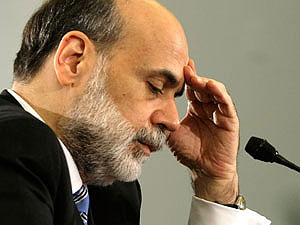
Edmund Andrews writes in the New York Times about Ben Bernanke:
As central bankers and economists from around the world gather on Thursday for the Fed’s annual retreat in Jackson Hole, Wyo., most are likely to welcome Mr. Bernanke as a conquering hero....Fellow economists [...] are heaping praise on Mr. Bernanke for his bold actions and steady hand in pulling the economy out of its worst crisis since the 1930s. Tossing out the Fed’s standard playbook, Mr. Bernanke orchestrated a long list of colossal rescue programs: Wall Street bailouts, shotgun weddings, emergency loan programs, vast amounts of newly printed money and the lowest interest rates in American history.
I really don't have it in for Bernanke or anything (honest!), but this level of adulation puzzles me. Yes, the blizzard of term facilities and liquidity programs he engineered during 2007 and 2008 was impressive, but is everyone really so sure that no other Fed chairman would have acted similarly? And beyond that, there's pretty broad agreement that Bernanke (a) badly mishandled the runup to the crisis, (b) inherited and then perpetuated weak regulation of consumer loan products, something that aggravated the housing bubble, and (c) was complicit in allowing Lehman Brothers to collapse. These are all serious black marks, especially the Lehman fiasco, which is widely believed to have been the trigger for the most acute phase of the crisis during the fall of last year.
Reappointing Bernanke would hardly be a disaster. But his judgment has been questionable on several fronts, his dedication to better consumer regulation is doubtful, and we'd all be better off if we stopped pretending that Wall Street has to be endlessly coddled by reappointing whatever Fed chairman they've gotten used to over the past few years. Hero worship of the Fed is a vice that's worth stamping out, and now's a good time to start. Let's give someone else a chance.
Advertisement
Advertisement
Comments
Broad Agreement among whom? The Left?
"(a) badly mishandled the runup to the crisis,"
In what fashion and what fashion different than the other leading Central Banks (among whom sit some of your precious "progressives."
It is useful to compare Bernake to real human beings (and in particular other Central Banks facing similar circumstances, notably Bank of England, and Euruopean Central Bank, but in any case also the rest of G20 say), not some magical Wizard of Oz capable of magically addressing Moral Hazard and making Panic go away.
If you can't answer that, you are merely parroting. (Not that I expect a coherent answer from Drum) In particular it seems queer to make such a statement when the man was appointed in Feb. 2006 and the crisis began to pick up steam about a year later.
Of course, you are the same Kevin Drum that wrote "Likewise, it turns out in retrospect that the collapse of Lehman Brothers wasn't quite the catastrophe we thought it was at the time." (http://www.motherjones.com/kevin-drum/2009/05/banking-crisis-revisited)
"(b) inherited and then perpetuated weak regulation of consumer loan products, something that aggravated the housing bubble"
Actually your Congress perpetuated weak regulation via an incoherent system wherein most consumer regulation relevant to the areas of the housing bubble resided with your States (in particular
I find it amusingly hypocritical that this is advanced as a critique, but at the same time presently when faced with actual regulatory decisions (analogous to what Bernake would have faced even were he charged with proposing legislation) in this area, in fact the Left opposes more Federal concentration (at least as far as writing and comments seen it would appear). No, the Evil Central Bank in the Hands of the Bankers..... better to keep it close to the people, etc.
Blaming Bernake for weak consumer regulation is absurd on its face.
"(c) was complicit in allowing Lehman Brothers to collapse."
The lot of you are bleeding hypocrites of the worst sort, the very worst. At the time you bloody well went on and on about Moral Hazard and time to let the bankers feel pain, you shriek and hand-wring when the actual consequences of said failure present, and seek your scapegoat.
In effect, you want to have your cake and eat it to, and are utterly incoherent on the issue. This really resolves down to an inchoate dislike of Bernake because he is Ancien Regime.
Given your judgement has been incoherent, illiterate and questionable on matters of Financial Sector regulation, I find your own judgement on Bernake and his judgement laughable.
I'm not here to sing
I'm not here to sing Bernanke's praises, but Drum may be overstating his case. Bernanke took over in 2006, and I think it's obvious at this point that Greenspan deserves a lot more blame than Bernanke does. Speaking of Greenspan, I have my doubts that he would have acted simillarly to save our economy.
I also don't think the Lehman Brothers collapse was such a terrible thing. It lowered confidence in our banks, but that's a feature rather than a bug--too much confidence had been placed in our banks before that. It's the only example we can point to of bankers actually having negative consequences for their mistakes, and in the long run it did not lead to our economy collapsing.
Kevin has a point on weak regulation, and for that reason I won't miss Bernanke when he's gone, but I would give him high marks based on what he has done so far.
Weak Regulatory Structure full of holes, not regulation
Most US regulation is world class, other nations copy it. It's your bloody system with a multitude of both National Level and provincial / state regulators, covering the SAME BLOODY FUNCTIONS! There is the problem. The extreme balkanisation of American regulatory structures renders many of your regs nonsense or incoherent (given different applications by different regulators, and some entities that became important entry points for the system such as mortgage brokers effectively escaping national regulation entirely, which was sheer madness).
It doubtless makes sense in putting consumer regulation in another entity (perhaps throw that to your FDIC, and take FDIC's duplicative prudential bank supervision back into the hands of the Central Bank - one entity with one policy objective).
I find it hard to see how one can blame a Bernake (vs Greenspan, who was and remains an ideologue, an inflexible ideologue) for the state of the US regulatory system. Your provincial congressional interests are as to blame as anything.
"but is everyone really so
"but is everyone really so sure that no other Fed chairman would have acted similarly?"
- KD
I am not making an argument for or against Bernake, but this is an unfair standard. If this standard was adopted, we would never have anyone to think for a job well done. The question is whether or not Bernake did a good job - not whether some hypothetical person who didn't get the job might have done just as well. This is unknowable.
The one criticsm of Bernanke
The one criticsm of Bernanke that I do agree with is that not enough was done to prepare for a failure of a big brokerage after Bear Sterns went under. The Fed had six months to prepare for Lehman, but it appears that they were caught completely off guard. That shouldn't have occured. But I agree with The Lounsbury's defense above.
But Bernanke is uniquely qualified for the position. He is a student of the Japanese experience over the last decade, which just happened to be precisely what was required for the current crisis. He recognized what was necessary and acted quickly. We were all very lucky that he was there.
In addition
The man clearly is someone who is flexible and sharp enough to learn from mistakes and innovate. That is not too common quality.
The preparation critique I think I may share.
Kevin is right, but...
Kevin is right, but I'll add one more point. A Fed chair has to be more than a top economist. He or she must be a leader, and Bernanke couldn't lead his way out of a wet paper bag. First, Bernanke let Hank Paulson run the Fed, now he's letting Geithner do the same. For the central bank to function properly, it needs to be independent, and under Bernanke, it's anything but.
Queer standard you have
Oddly among the world that deals with Bernake, he's rather considered a good leader so far (as opposed to Geithner who one hear's mixed reviews on).
Where you get the idea Treasury "led" the Fed (unless in your magical world collaboration = being led around) escapes me. The US Treasury was almost absent in the initial phases of the crisis.
Lehman
I'll second what The Lounsbury says above about the Lehman collapse. I'm surprised Kevin is now indulging in the idea that letting Lehman fail was an obviously bad idea. For one thing, as Lounsbury notes, socking it to the arrogant Lehmanites was certainly not viewed as a bad thing among liberals at the time. Second, and more importantly, if Lehman had been rescued, the trash talk from right and left about moral hazard and the NEED to let a few Lehmans fail would now be deafening. In fact, the fall of Lehman has taught us all a valuable lesson about avoiding such shit in future and, since we seem to have stepped back from the abyss at least a bit now, I'm glad Bernanke et al. let it happen.
Riley has put this better than I did
I do find it irritating and offensive, the gross hypocrisy on the Left in turning and using the very kind of bank failure that many were calling for as an argument against an otherwise apparently quite competent Cen Bank official (in any case, for Lehman it would appear Geithner's hands would be far dirtier).
But beyond that, I agree with Riley's observation that had Lehman not occured, the Moral Hazard clamour would be deafening, and the hand waving type of "not really that bad" argument rather prevalent. Lehman's failure in some ways merely revealed to one and all (ex the wilfully blind) that the global financial system was (is?) on the break of an abyss, a Great Depression level crisis. If not Lehman then perhaps it would have been AIG - which arguably due to its complexity and more or less falling between regulatory cracks (again THE SYSTEM, not the actual content) would have been far worse.
The system was teetering on the edge as panic driver liquidity crisis spread from one asset to another. Yet, I recall vividly many on Left and Right in the US (queerly not so much in EU...., I suppose the UK example had scared people straight) openly questioning if there was "really" a financial crisis, was it "really" necessary to take action, etc.
Turning on one's heels and pretending that was not the case is being willfully blind and hypocritical.
I am glad to see Kevin Drum
I am glad to see Kevin Drum expressing incredulity about the story. Did we learn anything from it? The Fed pushing back against the proposed consumer regulatory agency is the only thing I can think of.
More precisely
you learned nothing of the sort, what you got was a reiteration of the long-standing (since the effort was accounced) of the Central Bank giving up its consumer protection role (or the creation of the entity outside of their purview).
Here I would say they're wrong, but also suspect said opposition is really more about horse-trading re powers.
Re: Regulation
I have to agree with Lounsbury that the real villain of the story is our system itself. Our slimebag politicians have consistently managed to warp all regulation so that loopholes are always left for their big campaign contributors. There is so much fraud in the system because lobbyists write the bills. There are so many loopholes in the regulatory structure for the same reason. The problem starts and ends with our Congress and Senate. Until we clear up campaign finance and ban lobbying entirely, it will continue unabated.
You are late to this analysis.
I came to the same conclusion 10 days ago, that rock star Fed Chairs need to go.
As Charles De Gaulle noted, "The graveyards are full of indispensable men."
System, reasonable goals
Let me clarify, when I wrote System, I was speaking to your Regulatory System, although as I understand it, one item that keeps the bizarrely Balkanised system in place is that various Conressional Committees of different areas are responsible for different Federal Banl regulators (to keep things simple & focus merely on credit). While I have only the vaguest understanding of your Congressional system, this sounds plausible given my experience in large institutions. Too often deep plots are hypothesised when sadly banal turf battles are the real motivators.
Regardless, if your standard is 'getting money out of the system' or some other Virgin Birth reform, well you're a fool. Beni Adam Beni Adam one says in Arabic, the sons of Adam are (remain) the sons of Adam. it is a Quixotic and useless quest
This aside, the clearest and most focused objective for Fin Sec reform should be simplifying your Reg system. Market operators will ALWAYS be influential, but it seems to me regulatory fragmentation and duplication brings no value to the table (whatever the theoretical 'competition' gains, that's bollocks sold by my worst confreres and Useful Idiots, it only means loopholes and weakneess). Blowing up a system riddled with duplication and exceptions (e.g. Banks escaping National Supervision or credit brokers under similar escape clauses), would do wonders. And while simpler, will be far harder than say esoteric & doubtless intantly out of date rules on 'leverage' (I find it extraordinary that Drum continues on this bent having already demonstarted in his Basel posts near zero understanding of bank risks).
In the end his little anti Bernake Jihad is merely a moderately dishonestly framed and fundamentally poorly thought through whine about Wall Street (and I may add that I say dishonest insofar as he has now spent weeks whinging on about Bernake, including expressing disappointment twice that his Left Netroots comrades did not go after Bernake).
I'll Take Kevin Over "The Lounsbury" Any Day
The loudmouth can't even spell "Bernanke"...
Why people want Bernanke
Here's my take:
I’m not a fan of an Independent Fed or such reliance on the Chairman, but, if you read economics blogs, you know that some people believe that Bernanke’s actions saved us from a Debt-Deflationary Spiral, while some don’t. Some of us attribute his actions to his being a follower of sorts of Irving Fisher. To some of us, the idea that someone who doesn’t believe that a Debt-Deflationary Spiral was imminent and we needed to raise hell to avoid it could have been the Fed Chairman,is terrifying. Hence, we’re shell shocked. At least when we faced a recession or a depression, Bernanke made some good, if timid, choices. From my point of view, given where we were, that’s a lot to recommend him.
But I do agree with you about the Hero Worship being a problem.
If Bernake was "timid"
I should very much like to see your example of Aggressive relative to central bank action, insofar as he led the Fed Res BoG into unprecedented territory, in terms of balance sheet expansion, types of financial engagements and other innovative forms of Quantitative Easing. Perhaps you can explain what under actual Central Bank powers would this further action be taken....
More QE PLease!
I would have preferred this:
http://www.nber.org/~wbuiter/helijpe.pdf
I would have bailed put Lehman even without collateral. ( I understand that he says that he couldn't )
I would have used more QE immediately. ( see his 2002 talk, where he lists his remedies )
I would not be worrying about inflation yet.
I would have a higher inflation target, if I used inflation, at this point.
There are others.
For my basic view of the Fed, I follow this essay:
M.Friedman "Should There Be An Independent Monetary Authority?"
Also, Nick Rowe and Scott Sumner have an approach that I like. For my reaction to the crisis, I recommend the Chicago Plan of 1933.
Take care,
Don
So Timid = Did Not Take Action in Magical Perfect World?
Good bloody fucking lord, what the bloody fuck are you on about then?
With respect to Lehman, incorporating the comments above by Riley and Myself, not bailing Lehman would have merely pushed the ball forward. The only proper critique in re Lehman is the appearance of lack of proper preparation for the results, but then it is not clear that was something that one could have properly scoped.... Calling Bernake timid in this connexion is silly.
Qualitative Easing: so you're arguing timing? Given how bloody controversial QE was and IS, this is empty criticism, the worst form of second guessing. Unless one can make a cogent argument that Bernake has the political opening to engage in QE earlier, I find this critique stupid or dishonest (or both).
Inflation: mate, the motherfucker HAS to worry about inflation in a Very Public Way. It's called spinning. That's working the market to tamp down inflation expectations and prep the market. If he doesn't, given that rather excessively influential parties are worrying about "hyper inflation" (when deflation remains a risk, but..... well, the loud voices are there). This critique is worse than stupid, it's drooling idiotic. If Bernake was ratcheting up interest rates NOW then you'd have a point. It's clear to anyone with any bloody fucking sense this is market psych massaging (aimed at the loons really).
As for your non-cites, well, give me a cite to something international, I don't have Chicago on me brain and I don't give a bloody fuck for your Chicago School.
Now, as such, I see that in fact you don't have a rational and reasonable basis to call his actions Timid (in any proper English meaning of timid, maybe in some bizarre Wild Wild American West movie meaning of timid). You disagree with Timing, and possibly the scope / manner of Lehman. That is not a proper critique, that's whanking.
Timid
There's a conference going on right now sponsored by the Fed. Beranke has given a talk there, in fact. At this conference. Rogoff makes the points that I am about worrying too much about inflation at present. Here's a link to the WSJ.
http://blogs.wsj.com/economics/2009/08/21/dispatches-from-jackson-hole/
Then you can go to the link to the actual conference. Here's a similar reading to mine about Lehman:
"In trying to gauge Bernanke’s defense that systemic risk warranted the actions that were taken, Bernanke was asked if it was the Fed’s decision to allow Lehman to fail. Despite the Fed’s authority under Section 13.3 to lend to “any individual, partnership, or corporation” in “unusual and exigent circumstances,” Bernanke once again cited the Fed had “no legal authority” to lend to Lehman. He said that only after Congress passed the TARP were the tools available to have saved Lehman. (Bernanke conveniently forgot the Fed invoked Section 13.3 to prop up AIG 48 hours after Lehman collapsed.)"
In other words, I believe that the Fed could have intervened.
I guess that you don't find Buiter's plan convincing. That's fine. We disagree. Here's Bernanke from 2002:
"Fiscal Policy
Each of the policy options I have discussed so far involves the Fed's acting on its own. In practice, the effectiveness of anti-deflation policy could be significantly enhanced by cooperation between the monetary and fiscal authorities. A broad-based tax cut, for example, accommodated by a program of open-market purchases to alleviate any tendency for interest rates to increase, would almost certainly be an effective stimulant to consumption and hence to prices. Even if households decided not to increase consumption but instead re-balanced their portfolios by using their extra cash to acquire real and financial assets, the resulting increase in asset values would lower the cost of capital and improve the balance sheet positions of potential borrowers. A money-financed tax cut is essentially equivalent to Milton Friedman's famous "helicopter drop" of money."
That's the Chicago Plan.
Here's Bernanke again:
"Some recent academic literature has warned of the possibility of an "uncontrolled deflationary spiral," in which deflation feeds on itself and becomes inevitably more severe. To the best of my knowledge, none of these analyses consider feasible policies of the type that I have described today. I have argued here that these policies would eliminate the possibility of uncontrollable deflation."
In my opinion, we barely averted this happening. However, the slow pace of the actions has allowed a slow motion form of Debt-Deflation to occur, which has resulted, in my view, in many more people losing their jobs than needed to be. The fact that we almost got to this point with Bernanke at the helm tells me that we could have done more. This without discussing interest rates before Lehman.
I'm not sure what your problem is. I was measuring Bernanke by his own standards put forth in the 2002 paper. We should have done more, and done it faster. Since my whole point was that I generally agreed with him, I simply wanted to make the point that we should have acted faster. It might seem to you that we did a lot, but since we were facing a Debt-Deflationary Spiral, that wasn't enough. As I said, I'm glad that he was there as opposed to others.
One last point. My main difference with Bernanke is in being for a 100% Reserve Plan. This disagreement is reflected in my too timid remarks. I believe that the remedies being proposed are not nearly sufficient. Bernanke disagrees with me, which is fine. But part of the reason is that he believes that this has worked better than I do. If job loss is declining faster than Real GDP, as I believe it has ( although this is debatable ), again, many more jobs could have been saved with more QE.
This was just about the Fed. I'm not addressing here questions about other govt groups.
I hope that this helps, but I don't call people names. It's uncivil. Plus, I don't mind people disagreeing with me. That's how we learn.
Take care,
Don
Should he stay or should he go?
He's done well. I think he stays until he wants to go or until he screws up (not likely).
Letting Bernanke Go
Can we get James Galbraith?
Helicopter Ben
I dont find what Ben did anything special that warrants such high praise either.
He dumped trillions in loans and guarantees into the market after the market stole the punchbowl, spiked it [deregulation], and partied like self induced vomiting roman elites before the empirical downfall.
Really, whats so hard about pushing a few keys making an accounting entry worth trillions and then having a ticker tape like parade with the freshly minted IOUs?
Ben and Tim
Congratulations, Ben.
Now, over the next four years, perhaps Tim and you can look at the basis for the silliness that we see of quants misapplying mathematics in order to fill certain pockets to the detriment of the rest of us. And, that they do so speaks more for the intellect of you guys in charge than does anything else.
One suggestion? Put governors on those stupid computers (and the people programming them) who are causing havoc. Liquidity? Ah, what a chimera.
I know, you inherited the problems. Well, try to leave it better for the one who will follow. Oh, and for us, the Main Streeters, to boot.
By the way, give us savers some sort of break.
Post new comment
MoJo Comments: Send Us Your Feedback
We changed our spam software to better filter comments. Should you encounter any issues, please let us know.