"Socially Useless"

| Wed Aug. 26, 2009 9:28 PM PDT

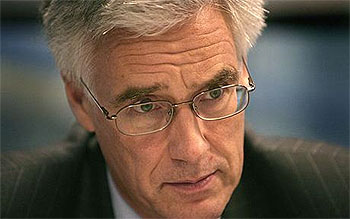
Now here's a bank regulator who's talking like he's found religion.  The Guardian glosses an interview in the British Prospect:

Lord Turner, chairman of the Financial Services Authority, warned bankers that he would support a new wave of taxes on the City to prevent excessive profiteering if they continue to take excessive risks.

In a searing critique of the industry, Lord Turner described much of the City's activities as "socially useless" and questioned whether it has grown too large...."The really fundamental question is whether the overall level of financial services pay is a consequence of the swollen financial sector which has resulted from oversimplistic financial deregulation. This is not a question that any of the politicians have focused on but I think it's an important and legitimate issue of public concern," he said.

....He told Prospect: "If you want to stop excessive pay in a swollen financial sector you have to reduce the size of that sector or apply special taxes to its pre-remuneration profit. Higher capital requirements against trading activities will be our most powerful tool to eliminate excessive activity and profits.

"And if increased capital requirements are insufficient I am happy to consider taxes on financial transactions — Tobin taxes."

Italics mine.  The FSA didn't exactly cover itself in glory during his predecessor's term, so maybe Turner is just talking tough because he wants to keep his job.  But if that's what it takes to turn a technocrat into a populist, then that's what it takes.  I sure wouldn't mind hearing a harangue like this from an American regulator once in a while.

As for the transaction tax, I don't know how practical that is.  But if it can be made to work, it's a good idea.  Not only would it raise some money, but it would put a crimp in some of the most highly leveraged investment schemes, which fundamentally depend on tiny returns multiplied by billions of dollars.  A transaction tax would make a lot of them unprofitable.  So it's a twofer.

Advertisement

Advertisement

Kevin Drum is a political blogger for Mother Jones. For more of his stories, click here.

Get Mother Jones by Email - Free. Like what you're reading? Get the best of MoJo three times a week.

Comments

Transaction tax

Transaction tax work out, it help to raise some money.

A financial transaction tax,

A financial transaction tax, unilaterally applied by the UK gov, would just send the trading houses (and all their investors) out of London. Perhaps to NYC, or maybe merely across the border as far as Calais, under an hour from central London on the Eurostar.

Its a great idea in the main, but would take coordinated US+EU implementation.

Yes, If We Don't Follow

the UK and France lead here, all it will mean is that these bankers will return more of their operations to the US, and they will destabilize us again. The likelihood of higher taxes here on their operations seems small, unfortunately.

tax transaction (1 cent per) now

Just why does a transaction tax HERE seem unlikely? This will instantly put an end to much of the quick trade BS that has really ruined our stock trading system for the benefit of the big houses. Oh yeah, the Money Party doesn't want transaction taxes here.

deficits?

Tax, fee, whatever - just do it.
There's no excuses any longer, at least insofar as technical complexity - otherwise there would be no means of high-speed trading a la Goldman-Sachs.

Frankly, we need to go a step further and implement a graduated scale on capital gains with escalating marginal rates.

I mean, we've got these enormous and scary deficits, right?
Well, here's a fix.

As the article points out,

As the article points out, implementing a transaction tax would be extremely difficult. If we get started now, it might happen in five years.

On the other hand, taxing profits before bonuses are paid out makes a lot of sense. I assume bonuses are counted as expenses, when they probably should be treated as profit distributions. I think most institutions now pay out total bonuses that are several times their profit figures.

What do they add?

To me, the "socially useless" label is a fine description for much of the financial sector. Much of what it does has no utility, and is only gaming the system.

Buying stocks because of what a computer thinks they will be worth in 30 seconds, instead of investing in companies because they have a solid business, only sets the stage for more bubbles.

The UK already has a transaction tax on foreigners

And it's simply evaded by engaging in delta-1 equity swaps instead of buying equities. These are derivatives that have precisely the same payout structure as an equity, less a financing fee. So basically the institutional investors end up paying some money to the really big houses (who receive fees for the equity swaps), and foreign retail investors pay money to the UK government. If the UK wants to be serious they should close that loophole first by banning equity swaps.

If the concern is systemic risk,it seems to me we should:
- Surtax firm assets above a specified level
- Surtax risk-weighted assets above a given ratio to underlying firm common equity
- Tighten position limits. Right now position limits exist in a few physically-settled commodity futures, but hardly exist at all in OTC derivatives, where they are sorely needed (and said derivatives should be forced onto exchanges with clearinghouses). Even in commodity futures, position limits are evaded by trading OTC versions of the same exchange-traded contracts.

Beyond that, though, I fail to understand to what end a small transaction tax helps. Big positions are market-destabilizing, not big trade volumes-- the instability comes from the possibility that the market is distorted by one individual position, or that in the case of a crisis for the position's holder, the position may need to be liquidated at once.

If I buy 1,000 shares of stock (or 10 oil futures, or whatever) and resell it once a second all day, that's not destabilizing-- the "real" supply of stock is still the same as before. If I go under, I just stop trading. I pose no systemic risk. But if I instead buy that stock consistently once a second all day, never selling, and start to own a large percentage of a market in a stock, (or outstanding futures for a commodity, or have billions in unhedged CDS exposures, or what have you), then I'm destabilizing- if I lose a lot of money on that or another position, I could crash the market as I try to liquidate it to raise capital. And if I'm not in stocks but derivatives, I'm in danger of failing and thus failing to pay my counterparties on my obligations-- and in turn risk causing them to fail as well.

Finance is not socially useless, only unregulated finance

Finance is not "socially useless". When finance works correctly the system provides capital and efficiently allocates resources. When finance exists with little in the way of regulation greed takes over and it becomes destructive.

A good example is the commodities market. A well regulated commodities market smooths out price swings and provides predictable prices for suppliers (like farmers) and consumers (like General Mills). In the US commodities market speculation is allowed beyond the actual physical supply of the commodity. That is, you can make a bet on a price move and it doesn't matter whether you actually own the underlying commodity. You either win the bet or pay off. A market that should provide better capital allocation now does little more than provide a casino for speculators. But this kind of speculation exists only because the market allows it.

"Finance is not "socially

"Finance is not "socially useless". When finance works correctly the system provides capital and efficiently allocates resources."

I think you mean "if finance would ever work correctly," not "when."

When, pray tell, can we expect such a magical solution given the fact that those who set the rules for the system are those who profit most from bubbles and from the system as it is today?

I mean yeah, if people were perfect then communism and Libertarianism would be great systems too.

Today the vast majority of us are screwed by the global financial system.

Tripp

Cheap UGG Classic Mini comes

Cheap UGG Classic Mini comes with 4" short shaft height.Also there are perfect details as durable rubber EVA outsole for extra comfort and sheepskin sock that wicks moisture away.Here we have Cheap UGG Boots Sale,including cheap classic cardy ugg boots, UGG Classic Cardy Boots and so on.

Cheap UGG Classic Mini comes

Cheap UGG Classic Mini comes with 4" short shaft height.Also there are perfect details as durable rubber EVA outsole for extra comfort and sheepskin sock that wicks moisture away.Here we have Cheap UGG Boots Sale,including cheap classic cardy ugg boots, UGG Classic Cardy Boots and so on.

Post new comment

Alternately, you may login to or register an account
The content of this field is kept private and will not be shown publicly.
  • Web page addresses and e-mail addresses turn into links automatically.
  • Allowed HTML tags: <a> <ul> <ol> <li> <blockquote>
  • Lines and paragraphs break automatically.

More information about formatting options

MoJo Comments: Send Us Your Feedback

We changed our spam software to better filter comments. Should you encounter any issues, please let us know.

Photo Essays

The chaos and humanity of war.
The craftspeople and musicians of Appalachia.
A selection of '70s ads depicting African-Americans.
As climate change melts the permafrost, native villages slip into the sea, taking a way of life with them.