Chart of the Day

| Wed Oct. 28, 2009 3:22 PM PDT

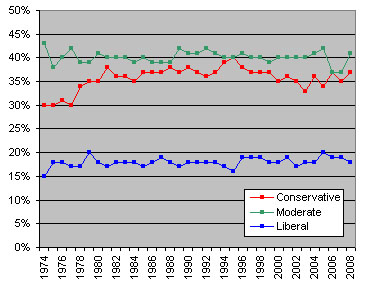
Gallup released a poll on Monday showing a slight blip in the number of Americans who identify themselves as conservatives.  Since this got a fair amount of attention, I figured it was time to update my chart of the Harris Poll version of this data, which goes back to the early 70s and consolidates the results from multiple polls throughout the year.

As you can see, nothing much has happened for the past three decades.  In the mid-70s a bunch of "not sure" respondents decided they were conservatives after all, and since then the numbers have remained remarkably steady: about 18% identify as liberals, 37% as conservatives, and 40% as moderates.  This hasn't varied by more than three or four points since 1980.  The most recent Harris data is for 2008, and breaks down 18% liberal, 37% conservative, and 41% moderate, right in line with the historical averages.  It's possible that something dramatic has happened since then, but Gallup aside, I wouldn't count on it.  Ten bucks says Harris gets pretty much the same results when they consolidate all the 2009 data at the end of the year.
Advertisement

Advertisement

Kevin Drum is a political blogger for Mother Jones. For more of his stories, click here.

Get Mother Jones by Email - Free. Like what you're reading? Get the best of MoJo three times a week.

Comments

Who Else?

Do they even as *radical*?

Self identification means nothing

Many of those people who call themselves "conservatives" are flaming liberals by cable TV standards.

Aha.

This explains the success conservative talk radio and the failure of liberal talk radio. Cool!

Just because you're in the minority

doesn't mean you're wrong.

So, how do we explain election results?

That chart would seem to imply that voting patters would be static, but clearely they are not (e,g, Mondale blowout), so what's really happening?

...

If you add the independents to either side, you get more than any blowout.

There are local variations in the theme, of course.

Ten bucks

I'm gonna go out on a limb and take you up on that bet. Am thinking the moderates will get a 5 point spike and liberals up 1 or 2. Conservatives will lose 5-7 points since lots of people won't want to identify with the Teabaggers. This isn't to say that it won't be back to the status quo in a year or two when memories blur.

Loaded labels

The terms, conservative and liberal, are so loaded I'm not sure the self-identification always matches the media perception. I made a cursory look at the polling data listed and didn't notice these terms matched with a definition of policy or ideology that would help describe them to the people polled.

Do they just ask, "do you consider yourself conservative, liberal, or moderate?" They then run through all the policy type questions and match the label to show changes for each type. I would think that there would be a very large variation in what each person polled think of as conservative or liberal.

Pretty much

That's about what happens. Though the general polls stay away from defining policy positions as conservative or liberal (wouldn't want conservatives to complain about being shafted, because they always do different than they say).

And 70% want health care

And 70% want health care reform.

I guess that makes HCR the "center right" position, huh?

Conservatives voting for Obama

I guess that this means that Obamamania wasn't a shift to the left, just a repudiation of Dubya.

Let's consider who has been

Let's consider who has been president over the time considered. In the mid-70s Nixon, at least temporarily, made it less appealing to be a conservative, but then Carter kind of blew it! On the other hand, for a reason I never could fathom, Reagan was able to "con" people to the right. People who were anti-Clinton were more likely to be conservative, but at least some number of them had the sense to be ashamed of W. It's early days yet for Obama.

Post new comment

Alternately, you may login to or register an account
The content of this field is kept private and will not be shown publicly.
  • Web page addresses and e-mail addresses turn into links automatically.
  • Allowed HTML tags: <a> <ul> <ol> <li> <blockquote>
  • Lines and paragraphs break automatically.

More information about formatting options

MoJo Comments: Send Us Your Feedback

We changed our spam software to better filter comments. Should you encounter any issues, please let us know.

Photo Essays

The chaos and humanity of war.
The craftspeople and musicians of Appalachia.
A selection of '70s ads depicting African-Americans.
As climate change melts the permafrost, native villages slip into the sea, taking a way of life with them.