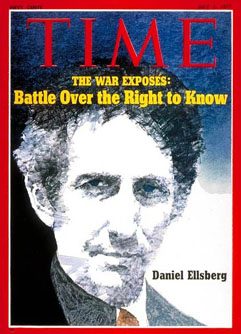
Daniel Ellsberg on the Limits of Knowledge
Jay Ackroyd went to a conference last week where he heard Daniel Ellsberg speak. He apparently recounted one of my favorite Ellsberg stories, and since it's one of my favorites I'm going to repeat it in
full below. It's from Ellsberg's book Secrets, and the setting is a meeting with Henry Kissinger in late 1968 when he was advising him about the Vietnam War. The idea of Kissinger seeking out Ellsberg for advice on Vietnam initially seems a bit unlikely, but in 1968 Ellsberg was a highly respected analyst on the war who had worked for both the Pentagon and Rand, and Kissinger was just entering the government for the first time. Here's what Ellsberg told him. Enjoy:
"Henry, there's something I would like to tell you, for what it's worth, something I wish I had been told years ago. You've been a consultant for a long time, and you've dealt a great deal with top secret information. But you're about to receive a whole slew of special clearances, maybe fifteen or twenty of them, that are higher than top secret.
"I've had a number of these myself, and I've known other people who have just acquired them, and I have a pretty good sense of what the effects of receiving these clearances are on a person who didn't previously know they even existed. And the effects of reading the information that they will make available to you.
"First, you'll be exhilarated by some of this new information, and by having it all — so much! incredible! — suddenly available to you. But second, almost as fast, you will feel like a fool for having studied, written, talked about these subjects, criticized and analyzed decisions made by presidents for years without having known of the existence of all this information, which presidents and others had and you didn't, and which must have influenced their decisions in ways you couldn't even guess. In particular, you'll feel foolish for having literally rubbed shoulders for over a decade with some officials and consultants who did have access to all this information you didn't know about and didn't know they had, and you'll be stunned that they kept that secret from you so well.
"You will feel like a fool, and that will last for about two weeks. Then, after you've started reading all this daily intelligence input and become used to using what amounts to whole libraries of hidden information, which is much more closely held than mere top secret data, you will forget there ever was a time when you didn't have it, and you'll be aware only of the fact that you have it now and most others don't....and that all those other people are fools.
"Over a longer period of time — not too long, but a matter of two or three years — you'll eventually become aware of the limitations of this information. There is a great deal that it doesn't tell you, it's often inaccurate, and it can lead you astray just as much as the New York Times can. But that takes a while to learn.
"In the meantime it will have become very hard for you to learn from anybody who doesn't have these clearances. Because you'll be thinking as you listen to them: 'What would this man be telling me if he knew what I know? Would he be giving me the same advice, or would it totally change his predictions and recommendations?' And that mental exercise is so torturous that after a while you give it up and just stop listening. I've seen this with my superiors, my colleagues....and with myself.
"You will deal with a person who doesn't have those clearances only from the point of view of what you want him to believe and what impression you want him to go away with, since you'll have to lie carefully to him about what you know. In effect, you will have to manipulate him. You'll give up trying to assess what he has to say. The danger is, you'll become something like a moron. You'll become incapable of learning from most people in the world, no matter how much experience they may have in their particular areas that may be much greater than yours."
....Kissinger hadn't interrupted this long warning. As I've said, he could be a good listener, and he listened soberly. He seemed to understand that it was heartfelt, and he didn't take it as patronizing, as I'd feared. But I knew it was too soon for him to appreciate fully what I was saying. He didn't have the clearances yet.
Comments
Very interesting, very good.
Very interesting, very good. I think it probably applies to many, many subjects not just war and foreign affairs. In fact if we knew the ' truth' as the insiders know about the financial crisis and even healthcare, we'd probably have very different opinions.
And those opinions wouldn't be anymore correct
The takeaway that I get here is that there is no "truth." There's just layers and layers and layers of information. The "truth" is based on perspective, rank, and synthesis and a simple change in security clearance will suddenly change both perspective and rank. Not the "truth" but the pursuit of "truth" which is constantly shifting and therefore a false goal.
Will the number of people who
Will the number of people who die of cancer this year be changed by my perspective on public health care, or whether I'm an insider or outsider? Is it true that there's snow in Boston right now? Is it a "fact" that you're a living person, or is that "truth" just an "opinion"? From my perspective I have an invisible dragon in my garage, would any amount of rank allow me to make that true for you?
Be careful with that postmodernism. It rots the brain, and more than any other one thing, is responsible for the current weakness of the left.
bits of money made denying coverage affects cancer mortalily
The oft repeated claim postmodern relativism is only a characteristic of the 'left' is not truth, but it is an opinion rotten post-industrial capitalist accumulations of wealth want instituted in those who cannot distinguish information from truth and opinion.
"Rank"?
> The "truth" is based on perspective, rank, and synthesis
> and a simple change in security clearance will suddenly
> change both perspective and rank.
What exactly do you mean by "rank"? If you refer to the efforts since WWI to reorient our society as a feudal military where each person has and knows "his place" and dares not get "out of line", then you might want to think a bit about what that implies. And consider that many of us American Citizens don't agree that such a social structure is a good idea.
Cranky
very good point
Wow, you made a great point! Thank you.
I think the point is the opposite...
...that there *is* truth, but that we often miss or dismiss it when we're too confident in our own current "knowledge".
I wouldn't assume that stuff
I wouldn't assume that stuff contained in above top-secret files is "the truth." At best, it is stuff more convenient for people who have that level of clearance. If only a select few have read access, I suppose even fewer have the ability to add stuff to those files. Judging by the intellectual quality and confused self-interest of these select people, I think we can safely assume this is crap.
So those folks are looking at crap and denying the reality of what is unfolding in the real world. Look back at all the major events of the last ten years. Which one of those really required high level secret knowledge to understand? We didn't have access to anything but commonsense to know that the Iraq was wrong, that the Afghan war war messed up (by Bush), that the big banks took unnecessary risks with OPM and got bailed out.
This "you are wiser because of access to secret info" is a way to delude themselves into believing a different reality than what we see with our own eyes.
http://huntingnarcissists.wordpress.com/facts/
PURPOSE
On the night of December 23, 1913, the U.S. Congress committed perhaps the greatest act of treason in history. It surrendered the nation's sovereignty and sold the American people into slavery to bankers who proceeded to plunder, bankrupt, and conquer the nation with a money swindle. The "money" the banks issue is merely bookkeeping entries. It cost them nothing and is not backed by their wealth, efforts, property, or risk. It is not redeemable except in more debt paper. The Federal Reserve Act forced us to pay compound interest on thin air. We now use worthless "notes" backed by our own credit that we cannot own. From 1913 until 1933 the U.S. paid the "interest" with more and more gold. The structured inevitability soon transpired; the Treasury was empty, the debt was greater than ever, and the U.S. declared bankruptcy. In exchange for using notes belonging to bankers who create them out of nothing on our own credit, we are forced to repay in substance (labor, property, land, businesses, resources) in ever-increasing amounts. When a government goes bankrupt, it looses its sovereignty. In 1933 the U.S. declared bankruptcy, as expressed in Roosevelt's Executive Orders 6073, 6102, 6111, and 6260, House Joint Resolution 192 of June 5, 1933 confirmed in Perry v. U.S. (1935) 294 U.S. 330-381, 79 LEd 912, as well as 31 United States Code (USC) 5112, 5119 and 12 USC 95a. The bankrupt U.S. went into receivership, reorganized in favor of its creditors and new owners. The goal was, and is, to absorb America into a one-world private commercial government, a "New World Order." With the Erie RR v. Thompkins case of 1938 the Supreme Court confirmed their success; we are now in an international private commercial jurisdiction in colorable admiralty-maritime under the Law Merchant.
Explains a lot
The "moron" part is persuasive.
Cool story. It's always
Cool story. It's always looked obvious to me that when a new president is elected, the Pentagon and CIA liars immediately confront him with, 'ok forget everything you thought you knew - here's the real truth and why we can't withdraw from Iraq' (for example).
I've been thinking the same
I've been thinking the same thing. And, frankly, it pisses me off that we peons aren't allowed to know. We pay for the damn information, why do we not have access to it?
The putative reason is that
The putative reason is that because if we know, everybody knows, including our so-called enemies. They'd know what we know and, perhaps more importantly, they'd know what we don't know.
I'm don't know that I think the tradeoff is worth it, but there you have it.
That's a valid point I hadn't
That's a valid point I hadn't considered.
Thanks.
democracies should have no state secrets
The biggest secret is the US has no enemies that can threaten its national security. All identified enemies are threats to imperial hegemonies that have no bearing on the sovereignty and governance of the American people. Democracies of, by and for the people should have no state secrets. The enemy is a postmodernist phantom of the right.
One problem...
"The putative reason is that because if we know, everybody knows, including our so-called enemies."
The problem with that is, not only do our enemies frequently know what the public isn't allowed to, it's sometimes required that our enemies know.
I'm thinking here of the Stealth Fighter which, when it was finally revealed, was acknowledged to be known by our enemies because it had already had a deterrent effect. The only ones not in the loop were the American people, and those members of Congress not on the right Select Committees.
No... 95+% of "secret" information has no strategic value whatsoever. It's all an exercise in posterior covering by bureaucrats. As, indeed, this rather self-serving anecdote by Ellsberg, for reasons of credibility and reliability already discussed.
You're right and
bear that fact in mind next time someone goes ballistic over presidential spouse Hillary Clinton's vote on the Iraq war authorization.
And both she and W were wrong
> bear that fact in mind next time someone goes ballistic
> over presidential spouse Hillary Clinton's vote on the Iraq
> war authorization.
Since both Dubya and Senator Clinton turned out to be dead wrong about Iraq, and the results of their actions utterly disastrous, whereas the dirty smelly hippies without any access to this "top secret sauce" (hold the yellowcake) were absolutely right, I'm not sure what your point is.
Cranky
Cheney... now him, I don't think was wrong. I think he got exactly what HE wanted. I just don't think he ever told Dubya what that was...
"Over a longer period of time
"Over a longer period of time — not too long, but a matter of two or three years — you'll eventually become aware of the limitations of this information. There is a great deal that it doesn't tell you, it's often inaccurate, and it can lead you astray just as much as the New York Times can. But that takes a while to learn.
<...>
The danger is, you'll become something like a moron. You'll become incapable of learning from most people in the world, no matter how much experience they may have in their particular areas that may be much greater than yours."
You seem to have missed the entire point of the warning. It's about not seeing the forest for the trees and discounting those that do because they don't have your distractions.
I don't get it. What sort of information? In 1968 I was right on Vietnam and all those people with all those clearances were wrong. My sources were public and easily available to anyone with minimal investigative skills. Three years earlier Marxist economist Paul Sweezy, the editor of "Monthly Review," said the war would last ten years before we gave up on it; and then he convincingly gave the reasons why.
Kissinger could have paid 50 cents for the magazine and gotten the same information. The only clearance I ever had was to be cleared as a definite subversive and placed on the FBI shit list and given my own file. Sweezy too—and all of his subscribers.
The idiots in our intelligence community knew no secrets that were worth knowing. They still don't.
That's right, you don't
get it. It's exactly the point of what Ellsberg was saying. Read it again more carefully.
Ellsberg
Ellsberg is a traitorous POS who not only betrayed his country but caused the death of innumerable foreign agents who had committed to our cause.
He should be executed.
Sauce for the goose
> Ellsberg is a traitorous POS who not only betrayed his country
> but caused the death of innumerable foreign agents who had
> committed to our cause.
>
> He should be executed.
I assume you would apply the same line of reasoning to Scooter Libby and Dick Cheney, right?
Cranky
Sec. McNamara and Gen.
Sec. McNamara and Gen. Westmoreland are the ones who should have been hanged.
Where are the examples?
It's hard to evaluate Ellsberg's claims regarding this matter.
I'd like to see an instance where various "layers" of information are set out.
Layer 1 would be general information on a country, say from the almanac, newspaper, or history book.
Layer 2 would be specialists' essays, but in the public realm. The sort of think you might read in Foreign Affairs.
Layer 3 would be low-level secret information.
Layer 4 would be this super-secret info.
I'm thinking of when I used to read Foreign Affairs in the 1980's. In that publication, there was no hint that the Soviet Union was going to collapse, even after Gorbachev took control. And we're led to believe the CIA missed on that as well. But a simple look at the USSR in the 1970's, with it's shoddy consumer goods and imbalanced economy (so much devoted to the military) - and an reading of history - would lead to the conclusion that it was destined to fail. And it did. In that case, specialist knowledge didn't seem to help.
But I'm willing to believe otherwise, if presented with some example where those in the know had a better assessment of the situation due to secret knowledge. By now there must be some issue that is old enough so that everything can be exposed and we can see what people knew at different levels. Is World War I a candidate? How about World War II?
Speaking of World War II, the Enigma sleuthing helped out, but even then, the anti-U-boat success was less the code breaking and more the development of long range bombers and 10cm radar. I don't doubt that Enigma shortened the war, but its absence wouldn't have changed the outcome. The Allies simply had a tremendous advantage in productive capability. That didn't take special knowledge to figure out.
Well when Condi Rice is your
Well when Condi Rice is your Soviet expert and the one 'telling the president everything he needs to knows about the Soviet Union' what do you expect?
it you read Garry Wills new
it you read Garry Wills new book "Bomb Power" he fleshes out the secrecy
problem that started with the invention of the bomb.
If Ellsberg is saying common
If Ellsberg is saying common sense is more important than "information", I agree.
Baloney cubed is just a lot of baloney
> "Over a longer period of time — not too long, but a matter of two or
> three years — you'll eventually become aware of the limitations of
> this information. There is a great deal that it doesn't tell you, it's often
> inaccurate, and it can lead you astray just as much as the New York
> Times can. But that takes a while to learn.
>
> "In the meantime it will have become very hard for you to learn
> from anybody who doesn't have these clearances.
I think this is the trap that Obama fell into.
It isn't just that there are "limitations" to the secret information. It is that not only is the secret information wrong as often as the non-secret information, but that there are people feeding you bullshyte on a platter marked "top secret" in hopes of controlling your viewpoint and your actions.
Cranky
Experts Who Actually Know Something
It's not that hard to figure something out. Ellsberg is basically saying stop listening to the noise and get back to basics.
I always think of the guy back in 2002 who talked about aluminum tubes and was full of shit. The first question that should have been asked is: who is this guy? Yeah, he worked around some of the stuff but he was no expert. Nobody in the Bush Administration or Congress or the media bothered to ask: just who are the experts and what to do they say? Uh, the tubes are not, repeat, are not part of a centrifuge program.
I fault Republicans far more than Democrats, but there are too many people on both sides willing to use noise as their intelligence source instead of making sure information and assessments are being properly vetted. When too many secrets are held by a small group of people, they can quickly manage to delude themselves.
FDR had a great system. He would listen to his generals and he would listen to State and so on but he always looked for people without an agenda and he would send them out to find out what was going on. He quickly learned that people like General Marshall knew what they were talking about because the guys FDR sent out on errands were reporting the same picture. It's not surprising that when FDR got into trouble, it was usually because he stopped listening.
""You will deal with a person
""You will deal with a person who doesn't have those clearances only from the point of view of what you want him to believe and what impression you want him to go away with, since you'll have to lie carefully to him about what you know. In effect, you will have to manipulate him. You'll give up trying to assess what he has to say. The danger is, you'll become something like a moron. You'll become incapable of learning from most people in the world, no matter how much experience they may have in their particular areas that may be much greater than yours."
-this is basically what Robert Anton Wilson called "the Snafu Principle" in the Illuminatus trilogy. Hierarchical systems screw up the flow of information and knowledge. People above only tell inferiors what will make them do what they want them to do. People below only tell superiors what won't get them in trouble. the result: SNAFU.
I am not sure what Ellsberg
I am not sure what Ellsberg said constitutes any major insight. One would have to be pretty naive to believe that what the government knows about Iran, for example, or Egypt, or Japan, or any country, is what it says in public.
And the inclusion of Kissinger in the story is superfluous. HK just listens and says nothing, and the implication that Ellsberg was telling him something he didn't know is just Ellsberg's conceit.
But maybe it's good to have some naive idealists with high clearance if you have a government has the habit of doing bad and stupid things, as occasionally they may blow the whistle in a way that helps, rather than hurts, the country.
but i think you miss the
but i think you miss the point, he's not talking about having some great insight. You can say " the government knows things that the people don't know" but that doesn't describe the experience of knowing those things and how that experience effects the people who know those things. That's what he's doing. And he's saying that knowing those things changes the way you listen to people, the way you process information, and not for the better.
So you "know more" but are effectively "dumber" because what you know (that other people don't) makes you a bad listener, makes you disregard other people's insights based more on their levels of security clearance than the actual content of what they're saying.
And then add in the fact that alot of the extra information is actually bad information, is just as unreliable as mainstream information, just for different reasons. But since it's stuff that _other people don't know_it's assumed to have extra importance. And basically, the people who have the most access, "know" the most and (ergo) have the most control over events are most likely to make the wrong call _because_ of all that access and information.
It's not idealistic at all, it's actually a very pragmatic point.
So you seriously believe that
So you seriously believe that Ellsberg was telling Kissinger something that Kissinger didn't know?
And Kissinger is there
And Kissinger is there because he had ultimate access, ultimate information and made ultimately terrible decisions with it, caused terrible harm. Kissinger being told this is kind of poignant, in a weird way.
I very much doubt you could
I very much doubt you could make that claim. As far as foreign-policy gymnastics went, Kissinger was unrivaled in post-war American diplomacy. His policy vis-a-vis China, and his temporary detent vis-a-vis Russia, was quite brilliant.
Greater knowledge of Iran? Seriously?
> I am not sure what Ellsberg said constitutes any major insight. One
> would have to be pretty naive to believe that what the government
> knows about Iran, for example, or Egypt, or Japan, or any country,
> is what it says in public.
Seriously? The US Government "knows more" about Iran than than people who have lived there, have family there, speak Persian, have studied Iran and Middle Eastern cultures their entire adult lives? Because the record shows that if the US Government knows anything at all about Iran it has used that knowledge to make piss-poor decisions for the last 20 years.
Cranky
And the record for the last 50 years indicates that US policy makers, with their lack of knowledge of language and other cultures, really know less than nothing about the Middle East and how people there think and act.
"Knows more about Iran" does
"Knows more about Iran" does not mean more about Iranian people, life, and customs. It means what Iranian politicians are saying to each other (via electronic and other intelligence), what Israel's plans are vis-a-vis Iran, what the Saudis are saying about Iran, etc. It also means knowing more about what the US objectives are, who in Iran is on the US intelligence payroll and what they are reporting, etc. Of course people with clearance in the US government know more about this stuff than people who merely live in Iran. Obviously, much of this "knowledge" is incomplete and even wrong, and yes, as my original post indicated, it is not necessarily used to make good decisions.
Sorry, no go
> "Knows more about Iran" does not mean more about Iranian people,
> life, and customs. It means what Iranian politicians are saying to each
> other (via electronic and other intelligence), what Israel's plans
> are vis-a-vis Iran, what the Saudis are saying about Iran, etc.
All of which require having a through, deep knowledge of the Iranian people, their life, and their customs in order to even have a hope of understanding their politics and what their politicians mean when they say things, whether in public or intercepted by the NSA. And understanding W, Bolton, and Co. clearly did NOT have, but I can't be too hard on them since that lack has been evident since 1976 or so.
> Of course people with clearance in the US government know more
> about this stuff than people who merely live in Iran.
That doesn't even get close to passing the laugh test. Tell me, what should people in Iran think about the Bush Administration hosting regular breakfasts of extreme Millenarians - people in literally think that the Apocalypse will occur within their lifetimes and will begin will a war against Israel - in the White House itself? Eh? You'll probably reply that that was just a matter of Republican politics and optics, and that such extremists had no actual sway even over an Administration as radical and aggressive as Bush's. Yet to make that statement would require very deep understanding of US politics and culture. Same thing in reverse going the other way, except that the US doesn't even pretend to study Iranian (or any other Middle Eastern) culture.
Cranky
Too many typos
Sorry - too many typos in that post. But I think the meaning is clear.
Cranky
Sorry Cranky you really don't
Sorry Cranky you really don't seem to know much about how the government works. The State Department, the CIA, and other parts of the government go to great lengths to gather that kind of information as well -- and each country "desk" at the State Department has lots of nationals of each country on the payroll so it can get information on political, religious, and ethnic undercurrents.
But when the neocons came in under W they essentially declared all of this unnecessary and proceeded to make policy from a much more narrow perspective. That's when the State Department was marginalized and the CIA was forced to report what the neocons wanted it to. But it wasn't that way in Ellsberg's time. Those were the days of the "Arabists", when the government was using specialists who were trying to understand Arab societies (something the neocons made fun of, and eventually were successful at uprooting).
Of course, even when the government is paying attention to internal cultural and religious factors in other countries, it doesn't mean that it is making the right decisions.
Remember, you can't keep
Remember, you can't keep secrets without telling lies. The existence of state secrets causes everyone in our society, from elected officials right down to you and me, to be legally required lie, and to conceal the truth. Currently, most of our state secrets have nothing to do with national security, rather those secrets exist to provide a pretext to tell lies 24/7/365, and to compell others to repeat those lies. Our current level of state secrecy is entirely incompatible with the functioning of representative government, and deliberately so. National security is not a suicide pact; the security of the nation's borders is an insignificant consideration if the American people are prisoners within them. Having a free country is more important than having a country; if your country isn't free, it isn't yours. The current levels of state secrecy must be abolished.
Pentagon Papers Study was Completed in 1968
and is the subtext that you should be aware of when reading those Ellsberg comments. URK and Cranky are totally right about Ellsberg's comments to Kissinger. There is a much larger truth than just the information in all the secret compartments. Information is one thing, but ultimately judgment and ethics are the most important.
Ellsberg was a contributor to those papers and knew that our leaders (who had all the supposed "real" SECRET "truth") were lying to us about the war. I got to spend 1970 in Vietnam because of those damn lies and I have immense respect for Dr. Ellsberg for releasing those papers in 1971. I just wish the'd been released earlier.
Because I had numerous clearances beyond top secret later in my career (not in the military), I think I have a pretty clear idea of the nature, clarity and pragmatism of what Ellsberg was talking about. If there was any justice in this universe there would be a lot more Ellsbergs now.
Ellsberg's point is very
Ellsberg's point is very straight forward. Other peoples thinking is the stone we use to sharpen our own.
Having to carry secrets, unfortunately, disconnects you from some of the best minds out there, simply because they are not allowed to carry these secrets. A corollary, some of the hardest critics may never be allowed to carry these secrets, because they are deemed unreliable. However, they can be the most useful to hear.
Such are the problems of societies that insist on secrets.
DWN
You can get the same
You can get the same information as the big guys here:
Thanks
Thank you very much, Kevin, for putting up the quotation. I was not entirely happy having to paraphrase from memory.
Ellsberg persective is BS cubed
Actually, what Ellsberg is saying is only relevant in the tiny, distorted world of the media-military-Foreign Policy groupthink.
There it matters whether 1) we didn't know if Diem was going to be executed, or 2)if we participated in the planning, or 3) it entirely a CIA project. Wow, 1,2 or 3, everything changes. Wow.
But the reality is that we should never have had significant troop levels in VietNam. In fact, the reality is that if we had guided Ho Chi Minh to a socialist and free Viet Nam 1945, rather than turning Viet Nam back to the French, we would have saved millions of lives and hundreds of billions of dollars.
Who cares about the Bay of Pigs and exploding cigars? Authors and spy enthusiasts. But the reality is that if we had provided Castro with financial support and legal support for his land redistribution scheme in 1959, we never would have faced Soviet missiles in Cuba in 1962.
Finally, who cares about the WMD in Iraq? If you analyzed the situation and objectively viewed US best interests, you simply never would have invaded Iraq. Ever.
The Ellsberg perspective only matters if you assume people can't see larger strategic choices. It's only in the constrained and limited Washington parlor game, supported by a national media that only wants to be dealt into the game, that escalating security clearances allows you to turn over little playing cards and feel like you have changed the way you play the game.
In the real world, smart people who have our nation's best interests at heart would insist that decisions be made on the basis of macro facts and common sense. And all those "secrets" are irrelevant to those decisions. But alas....Wolf Blitzer!!
Ellsberg Perspective
Don't forget that the information hoarded by the Above-Top-Secret set is digested in response to policy maker agendas. The likelihood of incurring a confirmation bias is great for the penalties meted unto those who combat it methodologically can be politically severe. For Iraq, President Bush got exactly the "darn good intelligence" that Cheney, Rumsfeld, and ultimately he wanted to hear. Those who have Above-Top-Secret clearances prefer to keep them.
"Dollared"'s comment,
"Dollared"'s comment, "Actually, what Ellsberg is saying is only relevant in the tiny, distorted world of the media-military-Foreign Policy groupthink.", and " The Ellsberg perspective only matters if you assume people can't see larger strategic choices. It's only in the constrained and limited Washington parlor game, supported by a national media that only wants to be dealt into the game, that escalating security clearances allows you to turn over little playing cards and feel like you have changed the way you play the game.", illustrates precisely the point Ellsberg is making here.
Many have made good, poignant points here, and have tried to frame this in the context of politics, media and policy decisions as they apply to our government. But it is a mistake, I think, to frame this in merely those perspectives and assume it only matters in politics and governmental decision making. His point applies to any situation, at any time, anywhere. It applies in government, business, religion, culture, personal relationships and one's own quest to further understanding, experience and knowledge (presumably to aid us in making better informed decisions).
It is an applicable and important point for all of us, especially anyone in a position of authority, power or positions to make decisions that affect a larger circle or group of people than one's self (i.e., business owners-employers, managers, teachers, educators, parents, law enforcement officers and officials, social workers, aide and charity workers, etc., and even those who do not make such decisions of import but whose choices affect others in an ever expanding circle of cause and effect relationships. In other words, his point can apply to virtually each and everyone of us in our daily lives and impact the world around us in either a negative or positive way.
As someone who has experience in government service (Military & Civilian service), education, corporate leadership, private business ownership and both corporate owned and Free Press media, I can assure you I have been in exactly the position Ellsberg describes here many times. His point is not relevant to merely government and intelligence related matters only, again,. it has applicability to virtually any situation confronting any of us anywhere at anytime, whether that be in employee-employer, spousal-partnerships, parent-child or other family relationships and all of our personal relationships with others, the world, and our own ability to continuously challenge ourselves and our assumptions (and presumptions) of "what we think we know" and our ability to adapt to ever changing realities.
Simply put, whenever we acquire any certain level of knowledge and experience that is beyond what others in our immediate environment or surroundings know or have experienced, it is very easy for the supposedly "informed" to become isolated within a bubble of arrogance, smugness and narcissistic nihilism that prevents us from being able to see beyond our own limited perspectives to see a larger picture (ironically, often gleaned from those with the least "knowledge" or lessor levels of "knowledge". I think "URK"'s point on this was right on the mark and well made.
Here are a couple of everyday, common persons, scenarios to consider.
Do most adult parents have general and specialized knowledge beyond that of their 4 or 5 year old children, that they do not disclose to or tell their children, thus, in effect, will lead them to lie to their children in an effort to wisely make decisions that aid in safely raise those children? Of course they do. Do all parents make good and wise decisions and choices for their children, all the time, regardless of whatever knowledge the parents hold that the children do not? Of course, they do not always, ... many attempt to do so, but regardless, everyone makes mistakes whether they have good information or bad information. Obviously, the more "good" information one has the greater the chances of reducing incidences of mistakes, versus relying upon merely bad information. But, the reality is for most parents, mistakes will be made, nonetheless. Who do you think would make the better parent, one who solely relies on a very narrow and select set of information, say, from a so called "parenting expert"s books, for instance, or the parent who may not have read any of the so called "expert"'s books, but who is willing to learn from their own parents, friends, neighbors and many others around them who do have actual experience raising children, coupled with their own innate instincts?
Obviously, one who has read every so called "expert child raising" book available would have a great deal of information, and much of it will often be conflicting. In fact, the more conflicting information one acquires, the greater the likelihood of fomenting confusion just as much is the likelihood of furthering understanding would be. As a consequence, were a parent to rely solely upon such "expert" guidance, and disregard the experience and wisdom of their own parents, grandparents, friends and others who have actual experience raising children in actuality, not theory, it is a very strong possibility that the children of such parents will grow up in one confused mess of a conflicted world of understanding (or lack of clear understanding, more accurately put).
Let us not forget that that knowledge and understanding are not the same thing. Which, I believe, is part of the essential point Ellsberg is making. Secular knowledge, removed from the realities of actual experience, most always leads to situations of self serving, self fulfilling, and generally bad decision making, if not outright arrogance and stupidity. Both secular knowledge and broader actual experience have their places of importance, but a balance must always be struck between the two for true wisdom to be exercised appropriately.
Another example.
I am a seasoned world traveler, having visited all four corners of the earth and over 75 different countries and 200 different cultures, thus far. I have also lived overseas in 8 different countries, at one time and another, for various periods. I pride myself on having a great degree of first hand experience and knowledge of other countries, peoples and cultures, gleaned from my experiences, each experience based upon differing perspectives of military duty and service to my country, corporate & business interests, that of a journalist, as well as that of a private citizen with residency and that of a mere tourist. I have been consulted, employed and paid as an "expert" on various topics or subjects related to those experiences by businesses, governments and private citizens by those who did not have such experiences (yet, nonetheless, did have the wisdom and foresight to seek more knowledge and, hopefully, better understanding, from those who did have such experiences).
My point is not that I am an expert of this or that, in spite of that designation by some for the sake of expediency, but, rather, that those who chose to hire me for my knowledge and breadth of experience in other nations and cultures, were exhibiting true wisdom. Why? Because, rather than merely relying upon the incredible breadth of so called "expert" travel guidebooks, papers and other purely secular or academic sources of information about these topics, those aforementioned entities had the wherewithal and openness to seek information from those who also have actual, real life, real world, experiences engaging in those areas of discussion. And, if they took the advice given them by me, they did not stop there, merely relying on my information and knowledge gleaned from my own experiences, but continued to seek out further sources of related firsthand information from others who have such to offer and share. This is how international business is always done, these days, if any given company in question has any halfway decent management and leadership that wishes to do successful business in various countries and cultures around the globe, ... few rely on merely secular sources of information or knowledge about any given country or culture. That is wisdom, when applied.
The same could apply to any would be world traveler, who has yet to have the those first hand experiences. Only a fool would depend solely upon one or two published "guidebooks" (secular) for accurate, as complete and thorough an understanding of the cultures and places they will be visiting (sorry, all you travelers who often do that very thing or even less), if they truly wish to have the most satisfying, immersive, safe and truly most rewarding and educational travel experiences. In other words, when one goes on a two week long packaged tour of Italy, for instance, armed with information gleaned from only the travel tour group, travel agency or similar single source, and one never veers from the packaged itinerary, one is experiencing Italy in a purely secular fashion, not in any really immersive fashion.
In such a case, one could hardly call themselves an "expert" on all things Italy or can say they really know Italy and the Italian people and culture in any real sense.
It is a far cry from actually living in Italy, say, for 5 years or more. At best, in such a case, perhaps one would have a greater understanding of Italy, than they may have once held, but they certainly couldn't truthfully say they totally know and understand Italy in any more than the most superficial and surface ways. The wise, and those truly wishing for better understanding, will always seek to immerse themselves within a culture and seek many sources of information, both secular and that based upon the broader perspectives and experiences of others who do have such firsthand experiences and knowledge. Knowledge can be power, true, only if real understanding is the target goal.
One last note here, related to my own military service. When I graduated as a junior officer from the academy, I thought I knew all there was to know about military culture, thinking, planning, execution, and so on. All that knowledge, I thought I knew and understood, I learned in the secular world of the Academy (college) and from my own family elders (5 generations of military service, 3 generations were Command Officers). In a real world sense, I learned nothing useful from the Academy regarding any of that, but learned a great deal from my elders who had direct experience leading men and women within that military culture and afterwards in civilian life, in business.
If I had relied merely upon my knowledge and understanding gained at the Academy to guide me as a career officer, my career would have ben very limited and likely a very miserable experience, at best. Instead, I had enough sense to couple that learned academic knowledge with the actual knowledge based upon experience from my elders who had walked that path before me. This served me very well during the course of my military career, as a result, garnering me not only a successful career, but also the respect and willing obeisance of the men and women under my commands. My grandfather, a highly decorated former Col. himself, had admonished me many times to always seek broader knowledge and understanding from as wide a range of sources as possible and to always guard against the arrogance of thinking that I "know" this or that. As important as always listening to my fellow same grade officers with more real world experience, and those of a higher grade as well, I was admonished to also listen to my junior officers and the enlisted men and women under my command.
Listen to the enlisted men and women? What? Some would say, usually those who served as enlisted personnel, that military culture doesn't allow for the low ranking, non commissioned, to have any say or input,... no one (command officers) ever listens to what the enlisted have to say. And, admittedly, due to the very nature of military command and control culture, from the perspective of the enlisted man or woman, that would appear to be the case. And, honestly, in many cases it is. But, it is not the true and real, full, picture or story,... i.e., it isn't actually the case. Not with really effective command officers it is not. The best officers know well that they do not know everything or always have the best judgement, and whenever possible, will seek out and listen to the input of anyone, including the enlisted personnel under their command. This is not always apparent, however, especially to the enlisted rank and file. And, of course, this is by design, part of the military culture, to some extent, as a necessary part of the whole command and control structure. However, the best officers will employ every possible source of information, if they are smart commanders.
That said, nonetheless, the reality of warfare and combat situations, as well as command and leadership, dictates that both officers and enlisted, are given only the information they need to know to do their assigned tasks effectively. In critical operational situations, too much information is often counter-productive. For instance, should I order my men into an operational combat zone to achieve a specific goal, target or objective, am I doing them a service or disservice by giving them all the information I may have at my own disposal, say, including all the details of how operations planners came to the determinations they had in orchestrating a plan for the mission or action in question.
The short answer is, I would be doing them a disservice.
Having such information at their disposal will not make a soldier a better fighter or achieve their mission objective more effectively. In fact, just the opposite is true, experience has shown that too much superfluous information actually serves to confuse, distract and, often times, demoralizes a solider, rather than spur them on to fight harder or achieve any specific objective. Later on,after the operations are completed, such superfluous information may help a given solider put an overall experience into perspective, help understanding as to why certain things were done under certain conditions, etc. But, in terms of battlefield effectiveness, it serves no valid usefulness to overburden personnel with too much extraneous or superfluous information not immediately pertinent to the completion of their assigned tasks.
In all cases, however, it is always a judgement call, hopefully made by those exercising the full breadth of their own knowledge and experiences, and those of others they seek out for consul, in attempting to make the wisest and most effective decisions.
Ellsberg is basically warning against the pitfalls of arrogance derived from exclusive, but almost always secularized, information and knowledge, that limits and blinds us to seeing or seeking larger perspectives. His warning is applicable in all sectors and to all people in life, in general, not just governance.
Does our government lie to us? Of course, it does, about some things. Did our parents lie to us? Of course, they did, about some things (Santa Claus, tooth fairy, etc., among the most innocuous and what most believe to be harmless white lies ...I disagree on that, however, it merely teaches and reinforces the idea of duplicity from an early age, both to expect to be lied to, as well as how to lie, or that some lies are harmless and therefore, "okay".)
The issues of who has what knowledge and who should have that knowledge, in other words, "National Security secrets", is beside the point. On that point, like it or not, as long as we live in a competitive world, there is always going to be the need to guard some information from public disclosure, for the sake of national self preservation. Just as most parents will continue to tell their children harmless little white lies or fairy tales, or lie by omission. While the majority of the world's citizens may be people of good will and basically honest, there are a significant number of those who are not so honest and of negative intent that they will always dictate the needs for being guarded and selectively disclosing certain vital information.
If I approach you and ask you for your bank account number so I can transfer all your money into my own bank account, would you honestly give it to me? I think not. Most people will rightly refuse and say something like, "it's none of my business", or "why would I be so stupid as to do that?", or what have you. But, there you are, keeping secrets, telling lies by omission, for your own self preservation and interests. Where's the lie? It's in the presumption that it is "none of my business", ... it is my business if my business is transferring money from others bank accounts into my own. My point being here, why should you expect to have the right to keep your bank account numbers secret from most everyone else, but all the while expect that your government is supposed to reveal every little secret it knows or has at it's disposal at any given time?
Yes, in an ideal world, there would be no need for anyone to lie or keep secrets. But that world doesn't exist. At least, not on this planet we call "Earth", it doesn't. We live in a world full of liars and the lies they tell, we are all liars to one extent or another, if nothing more than in self deceit. It is the nature of life as a human being. Most lie for one of two reasons, either self preservation or to gain something, or both. Governments, being made up of people, are no different and only the blind or foolish would expect them to be any different.
The main point Ellsberg is trying to make, I believe, is not who knows what, who has a right to know what, but that regardless of what we know or think we know, the reality is we don't really know squat and we can and should always be open to seeking more, to learning more, to balance the needs of discretion with the very real world needs of disclosure and honesty. We must always guard against becoming arrogant in our so called "knowledge" and thereby isolating and preventing ourselves from acquiring the broadest possible understandings and awareness, which leads to making bad decisions.
As it has been in the past, and will be in the future, now we could really apply some of what Ellsberg is lamenting us to do, ... in this age of polarized and very secularized politics, there is far more to the story on every side than what most people believe or think there is, regardless of the issues. The "truth" is always a mobile and flexible target, it is never pat and absolute on any issue.
Critical thinking is always crucial in any situation, we just need to do more of it.
Post new comment
MoJo Comments: Send Us Your Feedback
We changed our spam software to better filter comments. Should you encounter any issues, please let us know.