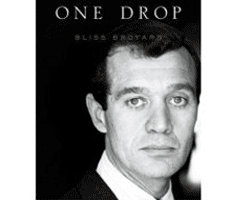
The Autobiography of an Ex-White Woman: Bliss Broyard's One Drop

Suddenly, white people are fascinated by race. Good for them. Good for all of us?
If you haven't read Bliss Broyard's One Drop: My Father's Hidden Life-A Story of Race and Family Secrets, you must. No matter how well you thought you understood, this book makes you realize just how relentlessly integral race is to American life and just how crucial it is to move beyond it. A complex book on a complex issue, it's hard to know where to begin (good reviews here, here and here).
Here's the easy part: One Drop is about having a semi-famous father who gave you all the insulated, WASPy pampering any white girl could want but who turns out, on his deathbed, to have in fact been black, then backtracking to figure out why and how he did so. And where that leaves you in a nation where boxes must be checked and sides must be taken. Only in America could a strained conversation in your dying father's sickroom change your race. This just in: you're black.
Advertisement
Advertisement
Pere Broyard, Anatole, was a New Orleans Creole, as it turned out, who helped create a post-war, bohemian-intellectual Manhattan where he and his friends "didn't know where books stopped and they began." But the world did. The only way for the cerebral, wavy-haired Negro to claim a place in that rarified atmosphere, seduce numberless white girls, or even get a decent job, was to stop being black. The price of doing so for two generations left Broyard a twisted soul, self-eliminated from family and culture, adrift in a world which existed mostly in the minds of the trendy Communist sympathizers and slumming trust-funders who fed on each other until it was time to marry and move to Connecticut. "Our tribe of four made us seem alternately special and forsaken," Bliss writes, "the last survivors of a dying colony or the founding members of an exclusive club."She and her brother had almost no interaction with either side of the family, so deeply 'incognegro'was Anatole. So were they black now? If they're not, is it because it's too late or because it's too easy?
It was often gruesome watching Broyard try to figure out what to do with whatever blackness she might possess; someone should have persuaded her to resist exulting in her belief that she can dance "like a black girl." As she must be to deserve cashing in on her family's hideous conundrum, however, she's painfully honest, as when forcing herself to relive instances of her own racism, post-revelation. But what keeps you slogging through the tedium of her 'am I black?' essentializations is her seamless vivification of racial history through a family that lived in a special world at a special time and faced a very special temptation. Few writers have the tenacious luck to unearth ancestors who played such we-were-there roles in history without being in the least famous (the Broyards' slavery and Civil War histories take on a surreality which screams screenplay). You can't put this book down – it works best as a mystery – until she's tenaciously, followed all those foolish, foolish breadcrumbs (like looking for some black Broyards in slum New Orleans who were likely low-lifes). Black people will often dislike her for this book; many will have to fight their own spite throughout, sputtering with remembrances of all the tragic-by-choice exotic multi-breeds they've known who expect nappy headed ho's to sympathize with their inability to grow afros. More than hair follicles block that connection. Bliss figured that out eventually, one exhaustively researched book later, one massive act of penance for ancestors she can never understand. There's no getting to the bottom of race or becoming black by revelation. 'Race' is how the world reacts to you, not your genetic code. When asked, and in America you will be, Bliss answers: "My father was part black but I was raised white. "She's described race perfectly: she told you everything and nothing.
Now, the hard part: why are white people suddenly so interested in race and how should blacks feel about them bumrushing the racial microphone?
Broyard's joins a growing canon of books about whites finally interrogating their family's role in America's original sin. Edward Ball's Slaves in the Family, and Cynthia Carr's Our Town: A Heartland Lynching, a Haunted Town, and the Hidden History of White America are among the best. Too damnably good, like Broyard's, to dwell on their cashing in on racism on both the front and back ends.
In the first, a descendant of South Carolina's slave-owning, diary- and genealogy-obsessed aristocracy set out to unearth the black Balls so scrupulously obscured in his family's voluminous records, a journey which he doggedly followed across America and to Africa. The second (which I reviewed) is by the granddaughter of a man who may have joined in an infamous 1930 lynching in Marion, Indiana. Just as Ball grew to adulthood before wondering why he knew nothing about the humans his family owned, Carr did so without knowing she'd grown up in a Klan stronghold where her kindly old neighbors may well have participated in an unfathomably evil event they later airbrushed from the town's memory.
Clutching a gruesome trophy photo typical of lynchings , Carr, like Ball with his family's slave registries in hand, undertakes a journey of racial discovery that is by turns, both heroic and unavoidably self-aggrandizing.
White interest in racial history proceeds as did the history itself: slavery (Ball), then the domestic terror campaign that kept free blacks in their place (Carr). Now, with One Drop, we enter the phase of whites owning up to the rapes and miscegenations that tell the truth on America's hypocrisy but which also implicate everyone. No group's hands are clean but it is mainly blacks, due to their all but marginal absence from the historical record, who are prevented from sallying forth equally well armed, documents in hand, to turn over history's rocks. Screwed again.
Still, these works do what America never will; participate in all the truth and reconciliation we're ever going to have—piecemeal, caveated, hazy, statute of limitations-expired but more than blacks knew before. More than whites could bear to admit to before. Leave it to white narcissism to do for us what the urgings of conscience never will: put white perpetrators center stage. Now that it's safe. Given that America won't hold its breath until a black person goes digging for the ancestor who narc'd on Denmark Vesey, maybe blacks should cut whites some slack on their long overdue introspection. There's no denying that blacks desperately want to know what the hell happened and how and only whites can tell us that.
Lucky bastards.

Comments
No, I think instead America is interested in *whites* who discover some black past (perhaps a poorly hidden panic of their own) but very very few, maybe just one, tell the story of someone "raised as a black person" who discovers some white lineage. It's not much different from when whites write about blacks (Studs Terkel, Tim Tyson) the books become best sellers. But blacks writing about race? These are books for the library shelves. I think this interest of America reveals an investment in what whites think about blacks (unless it is the Cos, as in your previous post, railing on his people). PS I agree with you on that description of the Duke prof's book. I read it too. BookMarks is a lovely book.
Maybe race is how you think of the world, not just how the world thinks of you.As a Taoist I see this reversal of stereotypes as a natural cosmic force. No Black I know is waiting for some white to tell them what happened or who they are -- as if there is a black consciousness and white consciousness and the twain shall never meet. Sounds like Christian dualism, good versus evil, George Bush vs. the middle class.
As long as people ask "and what are you" it seems to me more about what people think they need to know about race or ethnicity. This is why all this foolishness about Obama's lineage. If we weren't so focused on phenotype (skin color) then maybe we could focus on character. It's almost as if someone cannot just be human, because of our nation's need to know race, in order to what? I don't know what information race gives you. But apparently Broyard found a way to make it matter--bet the publishers are happy.
Interesting! I agree with the opening paragraph. America needs to grow up and get beyond the folly of physically exhibited aesthetics of sought perfection. Humanity is a single race of many tribes, nations, and ethnicities. That such an ethnic hybrid as a Louisiana Creole can exist in a predominantly European setting is a testament to the reality that all people are ONE group. Instead of perpetuating the idiocy of segregation based on myths of superior blood. There are four common blood types shared by every person alive on the planet. Though we are all unique and differ one from another, none is special. We are all HUMAN, and members of HUMANITY.
Once knew a southern couple who were among the most racist I've every encountered. Seemed like nearly every other word they uttered was the N-word. If anything, the wife was more vociferous that the husband, perhaps because he was a part-time evangelical preacher.
Came the day, however, when the wife discovered through her daughter that she was at least 25% black, as these things are measured. For them, it was an A-bomb. A measure of their deep investment in the racist myth they'd been living was the depth of their chagrin and despair.
At least they stopped using the N-word.
I wouldn't be surprised if a majority of White Americans have African blood.miscegenation was first outlawed in colonial Virginia, I believe, in the mid to late 17th century, after the first Bantu slaves had gained freedom and some had married European woman. Even if it were only a dozen or two mixed couples, and I'll bet it was more, think of how many offspring that is. We're all mixed up! Blood does not confer authenticity except as a social construct meant subjugate one people to the will of another.
I understand that Tiger Woods lists himself as "Asian". I have no problem with that because his mother was Filipino (50% Asian vs 50% other). It's just that no one wants to be "black". "African-American" is a PC cop-out that separates us again from each other as NOT American but -American.
So few blacks are black. And so few african americans are from africa. How ridiculous that americans can't even speak their own language properly but instead drape it in falsehoods. That's why they are always confused on simple issues. Blacks were sold by their black "brothers"- other african tribes. You want to blame someone- go to the source.
Blacks are convinced they are black when they are really brown, mullatto, or just plain ol hi yellow. That's why real africans piss on the american black as inferior. It's magical the way they speak the truth to each other, but suddenly become african jet black when they don't get what they wanted out of life.
I wish white people had a stupid race card they play every time THEY [deleted]ed up their life beyond all repair- we could blame Mr Charley.
Fact is racism is just a tool used by the elites to cause the middle class to fight with the lower class so they don't kill the elites- like they should have a long time ago.
Until people wise up and realize there is a race issue only for as long as you make it one- we will continue to be the most confused nation when it comes to race issues. And the same goes for male versus female- another convenient useless game of we should all have the same thing even though we are wildly different tar baby to play with while the elites rob both of you blind.
Wow, you take three books published over the course of almost a decade and say that white people are suddenly interested in race. Half breeds and WASP girls, even though you admit that her father was a bohemian and so not exactly a Connecticut banker. Oh my.
You're out of touch with American intellectual life and are trying to spin three books into conforming with what you want it to be like.
And I'll no doubt be labeled a racist for pointing it out.
Right on "Race is lost". I can't really add to your adroit statements but I do find it humorous that whites are so afraid to reveal any percentage of African blood in their lineage although most of them have it knowingly or otherwise. We hear about how much Indian blood whites have or Hispanic blood or the different flavors of Europe from Irish to German to French and so on. It's almost as if whites are bored with their own skin and the lack of culture created by pooling themselves in American for the sake of white privilege. The entitlement guaranteed by white privilege has taken all of the excitement out of life for many whites. It's why they get so excited when they have a nonwhite friend. It validates them as a nonracist and they love to see someone that operates under no pretense and is completely "real" because their lives lack the cultural authenticity they crave as a whole. I think the tanning phenomenon is just another expression of this Anglo angst whites are trying to vent. Whatever happens reparations is only part of the solution in America. White introspection is key but how long will it take? I know I'll be dead before it happens and I'm only 37.
Debra, the world reacts to you in part according to how you present yourself to it. The creation and maintenance of racial identity is itself racism. It's just a form of it apparently considered so sacrosanct no one will say so. If a group-- for example, Jewish people-- holds itself apart as separate, as different, then people will treat it that way. Just not always in the ways the members of that group would like. The more black people pull together, and especially those who define themselves by turning away from whatever white people are seen to be (these are the ones who accuse other black people of "acting white"), the more they pull away from the rest of the country. The gulf then existing cannot be entirely attributed to the actions of white people-- cannot be considered the racism only of white people.
To put it another way, racism everywhere is supported by racism anywhere. And black identity is a form of racism, despite being considered good.
Now I have read some absurd s*%# in my time, but this really has to be the most creative bit of victim blaming I've ever in my LIFE read. Let me see if I've got this right. Blacks and Jews are to blame for their own plight present themselves improperly to the world? Forget about all that shared culture/experiences that make them enjoy spending time in other's company. If they spent more time with white people instead of "pulling away" we could all link hands, sing kumbaya and be one country! You're kidding, right. I guess nobody in your family ever gave you the definition of the term "common sense"--as in it's only COMMON SENSE to avoid people who have proven they mean you harm. I won't bore you with the black folks in chains stuff, cuz it's old hat. Let me tell you my personal story/history. Part of my inheritance is my great-great-great grandmother's slave papers. The ones that show her being purchased for $1,400 by a man who held her as a concubine from 1858 to 1865 and to whom she bore three children. Lest you think this is a love story, she ran away as soon as emancipation came and was never seen again by anyone in my family. Oh, and he went right out and got another black woman, listed in the census as a housekeeper, and had a second family of mulatto babies. He died rich but none of his black children profited--he left his land to his white sister's son. So we were not only enslaved and born of coercion but disinherited, too. Thanks for the memories, granddad! The Klan was a reality during my childhood--and they weren't the pamphlet-distributing marching-down-Main-street Klan of today. They were the folks who shot down black folks in the street like dogs when they tried to vote. This story is not a myth. It happened in my mother's home town and it's in the South Carolina history books. The personal indignities to which I've been subjected in my 45 years include being ejected from a restaurant in the seventies, watching my father threatened with loss of his job when he decided to run for political office, then learning that my family's phones were tapped by the FBI after he got elected. In the last 10 years in my hometown in South Carolina, I've been denied service in an antique store and use of a public restroom in a national chain by people who made it crystal clear that they were doing so because I was black. I've also been called [deleted] with tiresome frequency--both by people intending to insult me and by people who liked me and habitually used the term and forgot who they were talking to. I have every advantage of education, good raising, and a strong Christian faith--so I'm successful and happy and relatively well adjusted despite all this. But I have to be conscious of where I go, what I do, and with whom because I never know if the perfectly nice seeming white person in the cubicle or on the street or in the grocery store will suddenly--upon being offended by some aspect of my blackness--grow horns and a tail and begin behaving like the very devil is in them. So don't tell me that black people (and Jews--interesting choices on your part) are responsible for white racism cuz we pull away from your funky asses. You're lucky that's all we do.
If White racsism is the basis of Black Americans problems,as a group, and at this time in history; why do most middle-class Blacks move to predominantly White areas and pray it doesn't turn too dark? Blacks could make real progress if they listened to Bill Cosby and not Jesse Jackson. Maybe they could gain the moral high ground they've p***ed away since the sixties and have been trying desperately to reclaim with their recent and pathetic attempts in the art of victimology. Sometimes I think Jackson, Sharpton are just tools of the elite to keep the people divided and more easily enslaved. I see no hope for a country that models itself on the Latim American model instead of the European one. Everybody keep fighting each other and in time we can make this whole country a ghetto.
In a grey scale of 1 to 10 is any degree within that scale blatantly white or black? of course not, it is rated as grey degrees from 2, 3, 4 or whatever from white to black but neither white nor black. The moment white is added to black it ceases being white or black but grey. When black is added to white the same occurs. Why is it in human society that when "white" blood is infused with "black" blood society determines the mixture to be outrightly "black"? What about degrees? How is it innately different between blood degrees and degrees of the grey scale? Of course the answer is human racism. Institutionalized, dogmatic racism that exists underlying every facet of human relationships.
Anatole Broyard was not "black" or a wavy-haired "Negro." He did not have to "stop being black" because he never was. He simply refused to sing the "one drop" lie. His family of origin wasn't "black" either, but Creole. Why is it that blacks like Dickerson are very tolerant and silent about the Hispanic and Arab-American rejection of THEIR "black blood" and refusal to identify with blacks, but apparently think that they own Creoles and Anglos who are "tarbrushed" in any way. I would also point out to Dickerson that the "one drop" lie she respects is based on the assumption that HER 'race" is super-inferior. Black ancestry in whites should be treated like American Indian ancestry. Unfortunately, blacks love the "one drop" myth and are the main obstacle to progress on this issue.
If you LOOK white, you ARE white. Read "Passing" for Who You Really Are: Essays in Support of Multiracial Whiteness.
I take issue with this statement made by Dickerson:
"'Race' is how the world reacts to you, not your genetic code"
That may be what SHE perceives race to be but millions of people would beg to disagree with such a notion. Dickerson's very personal opinion is NOT fact and certainly cannot be taken as such. Race is not STRICTLY how the "world reacts" to you--race is also a matter of how we are raised, what culture we feel comfortable being a part of, what community we strongly place ourselves in, and YES--what a person's GENETIC heritage is. These are people's ancestries here, and most of us appreciate them.
With a statment like that, does that mean that the millions of light skinned, white looking Blacks, American and international, who the world might not 'react' to automatically as Black, are suddenly not who they are anymore? Are they to discount their cultural upbringings, family backgrounds, and personal experiences because the "world" does not react to them, necessarily, as Black people? What if they have been raised all their LIVES as Black people, regardless of what the "world" reacts to them as? Very light people of color like myself, Adam Clayton Powell Jr., author Pearl Cleage, actress Lonette McKee--we are all BLACKS who the world might not react to as Black, but most of us certainly do not care. Our heritage is our heritage is our heritage! Simple as that.
I for one, applaud Bliss Broyard for getting so involved and interested with her Black family. She is of Black ancestry, this is her heritage and it's absolutely wonderful that she seems so proud to be of it!
A.D. Some people don't have issues with their African ancestry. If Anatole Broyard wasn't black, he certainly would have been considered to be black. I know you have issues with anyone who is of mixed race and desires to define themselves as Black, but get over yourself, no matter what we are still all African under the skin, no matter how much mutations have made us fade!
I have to agree with "If we weren't so focused on phenotype (skin color) then maybe we could focus on character." Why can't we "just be human?" and I sincerely agree that it is because of our nation's obsession with race the need to place everyone in a category.
How does finding you have some black descendants later in life suddenly make you black? How inane and idiotic. If your brought up white, you look white and treated as white , odds are your just white with some black descendants. You DO not become black. This book is considered good? Now if she was raised black and treated black and looked black and was told her father was actually white, she would not suddenly become white now would she? I am amazed at what people think is open and intelligent reading when doltish books like this are made to be of some sort of revelation about race, its about a white person looking to cash in on having black ancestry. Doesn't make her Black just well off from the book sales.
Edward Ball's other book "The Sweet Hell Inside" also is about his Black family, with little of the White family history. Also "Cane River" is a great book that deals with the issue of Black slave holders. I personally feel when a White person, whose lived life as a White person, as Broyard did, reveals their Black ties it is an amazing moment. This is a person who knows the privilage of being White and chooses to reveal their Blackness. That person has to know what is in the mind of friends and associates. She had to know, just in the admission, there are those who will view her differently.
Oh, come on, de de, or Debra, or whatever your name is. Calling him a New Orleans Creole is half accurate; calling him a wavy-haired Negro is her inner slaveholder talking. And note how she tries to red bait him even through half his friends on the anti-Stalinist left were already anti-Communist by that time.
Anatole Broyard's ancestors do not include any people enslaved in the US. He was the descendant of, among others: a soldier in the French Army who arrived in New Orleans in 1753, Cuban- and Hatian-born mulatto refugees from the Haitian revolution and other New Orleans creoles, including those of part Native-American ancestry and one Creole daughter of an ex-slave, but no slaves in the family, going back to the mid-18th century.
Therefore he doesn't fit Debra Dickerson's own criteria for inclusion:
"Black," in our political and social reality, means those descended from West African slaves. Voluntary immigrants of African descent (even those descended from West Indian slaves) are just that, voluntary immigrants of African descent with markedly different outlooks on the role of race in their lives and in politics.
The first two generations of white Broyards (Bliss's 5X- and 4X-great grandfathers) owned one and at least three slaves respectively. The only other slaveowners in the family were the Cuban- and Hatian-born mulatto immigrant couple from Haiti who owned two slaves.
Her (white) 3X-great grandfather had 5 children with his mistress, a free woman of color. When that ancestor's (white) son (Bliss's 2X-great grandfather) crossed the color-line to marry a free woman of color, the Broyard line became gens de couleur libre. I don't remember reading about any enslaved gens de couleur in the family, nor of Bliss coming to terms with rape or forcible miscegenation, something I have read about in other biographies, most recently Graham's biography of Blanche Kelso Bruce. The relationship between the white 3X-great grandfather and his mistress sounds like more like an example of placage than say, Legree's relationship to his slave concubine Cassy in Uncle Tom's Cabin.
The color-line shifted in 1880 with the Louisiana Jim Crow law which designated that anyone of any African ancestry was Negro (overturning the caste position and legal status of free people of color that had existed in some form since the Code Noir of Louis XV in 1724). Anatole may have been the first Broyard homme de couleur to marry across the color-line, but not until his second marriage since the first marriage was to a Puerto Rican woman. I don't understand why Bliss should be burdened with the collective guilt of her white ancestors' slaveholding while her "incognegro" father would be guilty of desertion? What about her white 3X-great grandfather who married across the color-line and became "colored," would he be passing for Creole?
Well, Jane this is a shot in the dark, so to speak. This is nothing directly about race. I was born and raised in Chicago. I visited my parents on Michigan Avenue on weekends. I played with two little girls: Millie who was black and beautiful and Jane, was was "white" and beautiful. The three of us wre and are the same age (62 now). Would that be you?
To answer her question "Why" her father chose to ID white, I think the author only needs to look in the mirror. She, herself, admitted that she had to rethink her own ideas concerning race inferiority (personally, I feel she didn't, really). In the 1940s, whites were even more convinced of black inferiority than they (including herself) are in 2008. Lord have mercy, the po chile still don't get it!
Affectionately,
A black woman in NC
Bliss is a descendant of my family .. I reside in St. Tammany Parish ... Our family came here in the very early years of the 1800's .. It is ironic that this was brought to my attention as it relates to her family living another life away from his family here in Louisiana .. If bliss were to do the family history she would find that she is related to the Laurent's, Cousin, and Pichon's of St. Tammany Parish of Louisiana
Goodness but you're dense Debora, don't seem to be gettin it at all. Try one more time to follow the bouncing ball of logic: 'white people' are not suddenly fascinated by race. A few people who happen to be white are. Like you. See, you do share characteristics with some 'white people'. Wow. Who knew?
Broyard indicated in her website that her book ONE DROP was not indicative of the percentage of black/white blood an individual possessed, but rather the life experience and knowledge an individual had about his or her family ancestry and in her case the lack of knowledge about her father's African ancestry until his death when she was 24 years old. In that case the ONE DROP rule may have metaphorically applied to her at that time, however using the term ONE DROP is ingeniously misleading. Her father's parents both had varying degrees of African ancestry going back in time to many African branches and countless African ancestors. Understandably while she and her brother were growing up in their relatively racially isolated community she didn't have the ability to recognize the mixed black/white appearance of her father, however it is not hard to see and in fact is very obvious to many people and would certainly not be classified as ONE DROP--probably 1/3rd to 2/5ths black with all the variation of black/white mixture the family produced throughout the past 200+ years. Broyard's acknowledgment and search for information about her father's ancestry may appear admirably, however the tone of her book appears to mainly seek and highlight individuals that for their time and place in society were above their contemporaries in position, money, accomplishment or public standing--which may be because more information could be found out about them in more records, however much can be gleaned from "lesser" family members in following their progress in census records. Broyard's writing seemed to imply her father's African ancestors were never enslaved; more likely they were at some point in the past if not in America, then in St. Domingue. Yes, many of the St. Domingue refugees were considered FREE PEOPLE OF COLOR when they arrived in Louisiana, but most of their ancestors were brought to the Caribbean as slaves. It is hard to properly critique Broyard's book because she found out about her father's African ancestry when she was a grown woman and could decide what she wanted to think or do about it if at all. Many people with a similar experience to Broyard find out about their mixed ancestry as children or teenager's at a time when they don't have the life experience, knowledge or maturity to understand or handle any problems they may encounter from the revelation. Broyard's WASP upbringing gets in the way--she tries to be magnanimous, but comes across as subtly elitist.
ابحث عن زوجه أمريكية الجنسيه أود أن أعيش في أمريكا أنا مقيم بال أمارات العربيه المتحده سوري الجنسية عمري خمسه وعشرين سنه أرجو مراسلتي أو الأتصال بي 0504838068 أو samer083@hotmail.com
Post new comment
MoJo Comments: Send Us Your Feedback
We changed our spam software to better filter comments. Should you encounter any issues, please let us know.