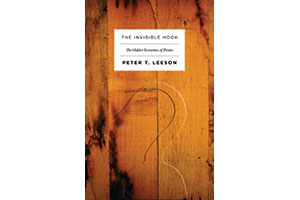
Books: The Invisible Hook of Pirate Finance

the-invisible-hook-300x200.jpg

Peter T. Leeson takes on the hidden economics of piracy, Somali or otherwise.

You know that our economy is rudderless when the captains of industry seem to have less fiscal discipline than 18th-century pirates. In The Invisible Hook, Leeson, a professor of economics at George Mason University, offers an engaging and thorough portrait of high seas banditry that goes beyond the pop-culture stereotypes to argue that though often brutal and always mercenary, pirates were ahead of their time when it came to matters of economic fairness and progressive labor practices.

For a start, pirates (not to be confused with the French "protopirates" known as buccaneers, or privateers, who were marauders for hire) often democratically elected their bosses; leaders who tried to amass booty at the expense of the rank and file usually stepped down (or else). When they plundered another ship, pirates were known to parcel out their take evenly, unwittingly acting in accordance with what Adam Smith would later define as the invisible hand. Pirates also drafted extensive codes of conduct and payment, even setting up what Leeson describes as an early form of workers' comp. For instance, one vessel instituted the following bylaw: "He that shall have the Misfortune to lose a Limb, in Time of Engagement, shall have the Sum of one hundred and fifty Pounds Sterling" for an indefinite period of time. And with the introduction of the skull and crossbones, pirates perfected an early form of corporate branding. By intimidating their targets with the mere display of the Jolly Roger, pirates saved time, resources, and lives. Not that maintaining market share didn't require its share of violence: "Woe to the few who resisted nonetheless," writes Leeson.

The Horn of Africa has recently seen its share of piracy, but oddly, Leeson thinks tanker-raiding Somalis have less to teach us about social organization. He argues that modern pirates have little in common with their predecessors, who lived together at sea and formed miniature, self-regulating "floating societies." Perhaps with enough time, the Somali pirates will also be recognized as managerial antiheroes—or at least worthy of their own Disney franchise.

Slideshow photo used under a Creative Commons license by flickr user faytandfayth13.
Get Mother Jones by Email - Free. Like what you're reading? Get the best of MoJo three times a week.

Comments

Piracy

Why should we worry about African pirates who steal a few million here and there. AIG, GM, the banks, big pharma and many others are stealing billions from us. And we let them do it.

Pete Leeson=Hilarious

Seriously, this guy has got to be the world's most hilarious economist. Don't miss this book even if you don't love pirates and economists as much as yours truly.

Revolutionaries

Most 18th-century pirates were mutineers - men who had overthrown the brutal dictatorship of some tyrannical seacaptain. Having deposed an authoritarian regime, it was only natural they would adopt its opposite - democracy. The man elected captain knew that his men had gotten rid of a captain they didn't like once already, so he was very unlikely to try to abuse his authority - and unlikely to live long if he did. The fact that they would all hang if caught did wonders to maintain discipline.

Very helpful article for

Very helpful article for writing term papers and dissertations on finance topics.
how to write a good finance term paper | finance term papers | finance dissertation

It is interesting and much

It is interesting and much appreciated as well. specially For a start, pirates (not to be confused with the French "protopirates" known as buccaneers, or privateers, who were marauders for hire) often democratically elected their bosses; leaders who tried to amass booty at the expense of the rank and file usually stepped down (or else). When they plundered another ship, pirates were known to parcel out their take evenly, unwittingly acting in accordance with what Adam Smith would later define as the invisible hand. Pirates also drafted extensive codes of conduct and payment, even setting up what Leeson describes as an early form of workers' comp. Any one experienced with cheap web hosting or dedicated hosting packages. I might go for any good search engine marketing firm.

He that shall have the

He that shall have the Misfortune to lose a Limb in Time of Engagement shall have the Sum of one hundred and fifty Pounds Sterling.
business management degree | online adult education degree | online early childhood education degree

The man elected captain knew

The man elected captain knew that his men had gotten rid of a captain they didn't like once already.
online multimedia degree | software engineering online

Review

Informative article indeed, would love to see further posts from you

Post new comment

Alternately, you may login to or register an account
The content of this field is kept private and will not be shown publicly.
  • Web page addresses and e-mail addresses turn into links automatically.
  • Allowed HTML tags: <a> <ul> <ol> <li> <blockquote>
  • Lines and paragraphs break automatically.

More information about formatting options

MoJo Comments: Send Us Your Feedback

We changed our spam software to better filter comments. Should you encounter any issues, please let us know.

Photo Essays

The chaos and humanity of war.
A selection of '70s ads depicting African-Americans.
As climate change melts the permafrost, native villages slip into the sea, taking a way of life with them.
Colombia's first environmental film fest.