A Primer on the All-Important Role of Delegates

| Sun Feb. 3, 2008 12:07 PM PST

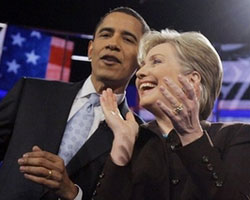
obama-clinton-happy250.jpg In the early states such as Iowa and New Hampshire, the presidential candidates pushed hard for victories that would yield few delegates but garner them momentum and media buzz, and separate them from the rest of the pack. But now that Barack Obama and Hillary Clinton have reached February 5's almost-nationwide primary, they've adopted a new strategy: pushing for "close enough."

It's a product of the all-powerful but little-understood role of delegates in deciding primary elections. In this historic and unique election, the technical details of how delegates are awarded may have more to do with choosing a Democratic nominee than all the media buys, GOTV operations, and newspaper endorsements put together.

Under Democratic Party rules, states divide their delegates proportionally according to vote totals at the state and district level. The rules for awarding delegates are very complex and vary from state to state (which will make figuring out the true results of Super Duper Tuesday a challenging task for the media). But in most places, the system works like this: say four delegates are up for grabs in a congressional district; if one candidate wins 30,000 votes in that district and the other wins 20,000, both will take home two delegates.

In the example, one candidate won 60 percent to 40 percent—a very substantial victory. But in order to give three delegates to the winner and a single delegate to the loser, the final vote would have had to be closer to 75/25. The less unfair but still imperfect way to divide the district's four delegates is to give two to the winner and two to the loser.

This creates a focus on districts that have an odd number of delegates. Districts which, through the quirks of state party rules, have five delegates will give three to the winner and two to the loser in even a 51/49 split of the popular vote.

Continues Below

Continued From Above

This also creates a powerful incentive for the candidates to do what they can to come close even in states and districts they expect to lose. Consequently, Obama is running ads in New York and campaigning in the tri-state area, Hillary Clinton's backyard, and Bill Clinton is campaigning in Illinois, where Obama should win big. As a general rule of thumb, the second-place candidate only has to draw a meager 30-40 percent of the vote in a state to be guaranteed roughly half the state's delegates.

This means that if there is no blowout on February 5, and no one is currently expecting one, all of these state contests could produce a close delegate count that propels the race into late February and March—if not beyond. In fact, it is possible that Hillary Clinton could win the popular vote by small margins across the country (and have what looks like a sweep on Wolf Blitzer's giant electronic map) and yet be tied in or behind in the delegate count.

"The reality is we really are in a delegate-by-delegate battle," Guy Cecil, Clinton's national political and field director, has said. "At the end of the day, this is a delegate contest," says David Plouffe, Obama's campaign manager.

For Obama, who is trailing in the polls in most February 5 states, this means he does not have to come out the winner. He need only survive. After February 5, the primary schedule returns to normal—that is, it stretches out—and candidates will have the opportunity to focus on individual states and work voters thoroughly before they go to the polls.

This is a format that benefits Obama. The early states all showed the same pattern: Obama trailed Clinton in the polls for months, presumably due to "low-information voters" identifying their preference to pollsters based primarily on name recognition and loyalty to the Clinton brand. But when Obama had weeks to campaign in a state (sometimes just days), he closed the gap rather quickly, either winning the state or finishing a close second. Moreover, Obama has been tallying endorsements and building on-the-ground machines recently that match or surpass Clinton's impressive operation.

After February 5, Obama will have four days to campaign in Louisiana and Nebraska. (Delegate-poor Maine, voting a day later, will likely receive only token interest.) Then he'll have three days to devote to the Potomac Primary of Maryland, Virginia, and the District of Columbia. Next, he'll have five days to campaign in Washington and Wisconsin (Hawaii, voting the same day, is where Obama grew up and likely won't require much of his face time). After that, if Obama still has a fighting chance at the nomination, he has two weeks before the bonanza primaries on March 4 in Ohio and Texas (Rhode Island and Vermont also vote that day). For the rest of March, only Wyoming and Mississippi hold primaries, meaning the April 22 Pennsylvania primary could be decisive.

The schedule might well help Obama, but it probably helps the Republican nominee more than anyone. That's because the Republican Party has winner-take-all rules in many large February 5 states. So if John McCain beats Mitt Romney by 1 percent in New York state (though he is expected to win by much more than that there), he gets all of New York's 101 delegates. In all likelihood, the Republican race will be decided by February 6 or shortly thereafter. The Republican nominee will then have weeks, if not months, to hone his message, raise money, and rest up before the Democratic nominee emerges.

These rules put Romney at a severe disadvantage, primarily because Mike Huckabee is expected to contend strongly in the South. If Romney takes a close second to McCain in New York and New Jersey and takes a close second to Huckabee in Missouri and West Virginia, he will get zero delegates. Under the Democratic rules, he'd still be very much in the game.

In the Democratic race, there is a possibility that the delegate count will be so close going into the convention that super delegates will matter. Super delegates are Democratic governors, members of Congress, and other party luminaries who each have single vote. There are 796 of these super delegates, and they compose about 20 percent of the total delegates. Exact counts vary, but Hillary Clinton has the support of roughly 200 super delegates, and Barack Obama has the support of about 100. Super delegates are not technically bound to vote for anyone, and can switch their support at any time, including at the convention.

If the Democrats reach that point, they'll be entering uncharted territory. John Edwards will be under intense pressure to instruct his small handful of delegates to support a candidate, and the delegates will be under intense pressure from the campaign that doesn't get Edwards' endorsement to disregard the former Senator's instructions (which they are allowed to do). Clinton will likely make a major push for seating the delegates she won in Michigan, where her only competition was "uncommitted," and in Florida, where campaigning was banned.

And delegates pledged for Obama and Clinton will come under pressure to defect. When an individual seeks to become a delegate, he or she is usually a very active member of a candidate's campaign at the state or local level. The candidates essentially hand-pick their delegates. But once the delegates get to the convention, they are only required, under Democratic Party rules, to "in good conscience reflect the sentiments of those who elected them." That means they can cast a ballot for any candidate they choose. In this year's Democratic convention, they may actually have more than one option.
Get Mother Jones by Email - Free. Like what you're reading? Get the best of MoJo three times a week.

Comments

I agree with "MoJo reader" and disagree with the conventional wisdom (regarding early nomination wrap-up) reflected in the article. Although history suggests winning your party's nomination early is an advantage in the general election, that will not be true this year for several reasons. First of all, the early Republican shakeout gives Democrats a chance to decide their candidate according to who can best confront McCain. Second, both candidates can aim their attacks at McCain (if they are smart) while McCain has no one to focus on, as "reader" writes. The free media focus is another plus, but most importantly, the Republican primary process has been fundamentally undemocratic and has left major divisions in the party. They have had a process that ultimately rammed McCain down their throats, so there is no unity in the party. McCain will need to campaign to the Republicans until the summer at least. Differences have been papered over, even if the candidate has been decided early on. It was too fast, in fact. For the Democrats, although there may appear to be a split, most voters are perfectly happy to support either candidate. Being unable to decide until the convention could work out to be an advantage, considering the intense media focus and confusion in the Republican camp, assuming Hill-Rod and Obama can keep it cool on the name-calling (slumlord punk lawyer, Wal-mart whore, etc) and focus on "excellent" John McCain and his proposal to "bomb bomb bomb Iran", "lighten up, and get a life".
McCain a an early advantage with his catchy satanic campaign slogan: "To the gates of Hell!"
Older! Stubborner! Crankier! ?My friend!

I agree with "MoJo reader" and disagree with the conventional wisdom (regarding early nomination wrap-up) reflected in the article. Although history suggests winning your party's nomination early is an advantage in the general election, that will not be true this year for several reasons. First of all, the early Republican shakeout gives Democrats a chance to decide their candidate according to who can best confront McCain. Second, both candidates can aim their attacks at McCain (if they are smart) while McCain has no one to focus on, as "reader" writes. The free media focus is another plus, but most importantly, the Republican primary process has been fundamentally undemocratic and has left major divisions in the party. They have had a process that ultimately rammed McCain down their throats, so there is no unity in the party. McCain will need to campaign to the Republicans until the summer at least. Differences have been papered over, even if the candidate has been decided early on. It was too fast, in fact. For the Democrats, although there may appear to be a split, most voters are perfectly happy to support either candidate. Being unable to decide until the convention could work out to be an advantage, considering the intense media focus and confusion in the Republican camp, assuming Hill-Rod and Obama can keep it cool on the name-calling (slumlord punk lawyer, Wal-mart whore, etc) and focus on "excellent" John McCain and his proposal to "bomb bomb bomb Iran", "lighten up, and get a life".
McCain a an early advantage with his catchy satanic campaign slogan: "To the gates of Hell!"
Older! Stubborner! Crankier! ?My friend!

A confusing topic made more understandable.

Thanks

Thanks. Now that I understand the mechanics of the Democratic primaries a little more it gives me a clear reason to vote.

This is more confusing than cricket.
Is there anything less democratic than "Super delegates"?

This is such an informative blog. Thank you. Watching the Dem. and Rep. primaries are so exciting I'm glued to the TV. It is such a refreshing and wonderful time to see people of all walks "Happy" with smiling faces for a change supporting their canditate.

Ooops..I spelled " Candidate " wrong.

I object to the following assumption from the article: "The schedule might well help Obama, but it probably helps the Republican nominee more than anyone. ... The Republican nominee will then have weeks, if not months, to hone his message, raise money, and rest up before the Democratic nominee emerges."

I dispute the conventional wisdom that the nominee will be better off if he/she wraps up the nomination early. If McCain wraps up the nomination tomorrow while the Democrats have a protracted primary season, wouldn't the Democratic candidates benefit from all of the free media coverage of the race, while McCain twiddles his thumbs wondering who his opponent will be? Moreover, the Republican attack machine wouldn't know where to direct its fire.

I think they should do away with the primary system as we have it now.

I would like to see no campaining until Feb of the election year,

Then a nation wide primary vote in May.

The two top candidates from each party, go to the convention of their party and convince the people there that they are the best choice.

Independents get 5percent of the vote nation wide and are on all 50 ballots.

No one can hold a different office than what they are running for. (Senators, Congressman, ect must resign before running for President)

Primaries are not fair to all states since the early primaries can cause good candidates to leave the field early in the game.

www.pafundi.com
~~~~~~~~~~~~~~~~~~~~~~~~~~~~~
Number of Operations Iraq Freedom and Enduring Freedom casualties as confirmed by U.S. Central Command: 4406

I agree with "MoJo reader" and disagree with the conventional wisdom (regarding early nomination wrap-up) reflected in the article. Although history suggests winning your party's nomination early is an advantage in the general election, that will not be true this year for several reasons. First of all, the early Republican shakeout gives Democrats a chance to decide their candidate according to who can best confront McCain. Second, both candidates can aim their attacks at McCain (if they are smart) while McCain has no one to focus on, as "reader" writes. The free media focus is another plus, but most importantly, the Republican primary process has been fundamentally undemocratic and has left major divisions in the party. They have had a process that ultimately rammed McCain down their throats, so there is no unity in the party. McCain will need to campaign to the Republicans until the summer at least. Differences have been papered over, even if the candidate has been decided early on. It was too fast, in fact. For the Democrats, although there may appear to be a split, most voters are perfectly happy to support either candidate. Being unable to decide until the convention could work out to be an advantage, considering the intense media focus and confusion in the Republican camp, assuming Hill-Rod and Obama can keep it cool on the name-calling (slumlord punk lawyer, Wal-mart whore, etc) and focus on "excellent" John McCain and his proposal to "bomb bomb bomb Iran", "lighten up, and get a life".
McCain a an early advantage with his catchy satanic campaign slogan: "To the gates of Hell!"
Older! Stubborner! Crankier! …My friend!

Although you seem to think Maine doesn't matter, there is campaigning going on here right now.

To clear up something about Washington State, Democrats here pick most of their delegates in the caucuses and none in the primary. Our caucus event is this Saturday FEb. 9 at 1pm. If candidates plan on visiting here they better head here soon, although I know Obama has been to Seattle numerous times and has raised a decent amount of money in Washington State.

And Romeny gets hosed even more because the one huge state he might win, California, is one of the few GOP states that is not winner take all.

Why do we need delegates at all -primary or general elections?

Isn't it about time the U.S. became like the "democracy" were "spreading"?

bloody hell, I have been trying to figure out this confusing delegate situation for so long. Thank you for your informative article. However, as an Obama supporter I am a little concerned about the 100 super delegates that Obama has to Clinton's 200. Does anyone have any further thoughts on this?

If the Democratic Party gives Hillary the Michigan and the Florida delegates, as she thinks they should, that would be no better than the Supremes giving Bush his first victory. She should stand by the agreement all the candidates made. If she can't be trusted to do that, then what can we trust her to do?

The DNC should abolish the delegate contingent. Simply put, it is non-representative of the party votes. A single national primary would be more inclusive, empowering every member equally.

Excellent and much needed article. Why are we hearing so much about delegates and super delegates and the differences in each party this year? Everyone I've spoken with is shocked to hear about differences in our two party systems.

Whatever happened to an honest, direct vote of the people? No wonder we are consumed by corruption in politics. And it's different state to state. I agree with the writer who says it is time to demand changes and achieve a more direct democratic election.

In the absence of specific law, complicated policies and procedures often exist to protect the "Democracy" from majority rule.

岡山 不動産

国際協力

出会い系

出会いサイト

出会い系サイト

RMT

障害者

不動産 広島,岡山/四国

出会い

インプラント

派遣情報サイトには

外国為替証拠金取引の比較サイト

利用料完全無料の出会い系サイト。男性も女性も出会いたい人はセンターに決まり。安全対策も万全出会い系サイトトラブル対処法
大人なら引っかかりたくない出会い系サイトのトラブル対処法を紹介します。大人出会い系サイト。出会い系サイトのトラブル対処法い希望者が集まるサイト。エッチなユーザー多数なので気軽な出会いを求めている人にオススメ。

結婚式

FX

為替o one to focus on, as "reader" writes. The free media focus is another plus, but most importantly, the Republican primary process has been fundamentally為替 undemocratic and has left major divisions in the party. They have had a process that ultimately rammed McCain down their throats, so there is no unity in the party. McCain will need to campaign to the Republicans until the summer at least. Differences have been pa

復縁

転職They have had a process that ultimately rammed McCain down their throats, so there is no unity in the party. McCain will need to campaign to the Republicans

不動産

zc

xcv

sf

sdf

簡単ダイエット

jldvんぁn

Post new comment

Alternately, you may login to or register an account
The content of this field is kept private and will not be shown publicly.
  • Web page addresses and e-mail addresses turn into links automatically.
  • Allowed HTML tags: <a> <ul> <ol> <li> <blockquote> <img>
  • Lines and paragraphs break automatically.

More information about formatting options

Photo Essays

When you dial a 1-900 number, who picks up the phone?
Meet the KKK's seamstress of hate couture.
The other side of Gitmo.
A photographer’s year at Angola Prison.