Do Ezra Klein and Matt Yglesias Want A Revolution?

| Wed Jul. 29, 2009 10:14 AM PDT

The Economist's Democracy in America blog has a fascinating post on the shift that seems to be happening in the thinking of the moderate, lefty blogosphere from process-oriented gradualism towards what you might describe as a kind of revolutionary cynicism. In a different era, if you were less kind, you might even describe Ezra Klein's and Matt Yglesias's recent claims—that our political system is irrevocably broken, that we won't do anything about health care costs or global warming—as "shrill." DiA compares Klein and Yglesias to Rolling Stone's Matt Taibbi, which is another way of saying the same thing. The (anonymous) DiA blogger points to this post by Klein as evidence of a near-total loss of faith in the system:

The country, and the system, will continue to whistle while our wages get eaten up and our government tumbles further into debt and our interest rates rise and other priorities get squeezed out and a serious and painful fiscal reckoning inches ever closer.

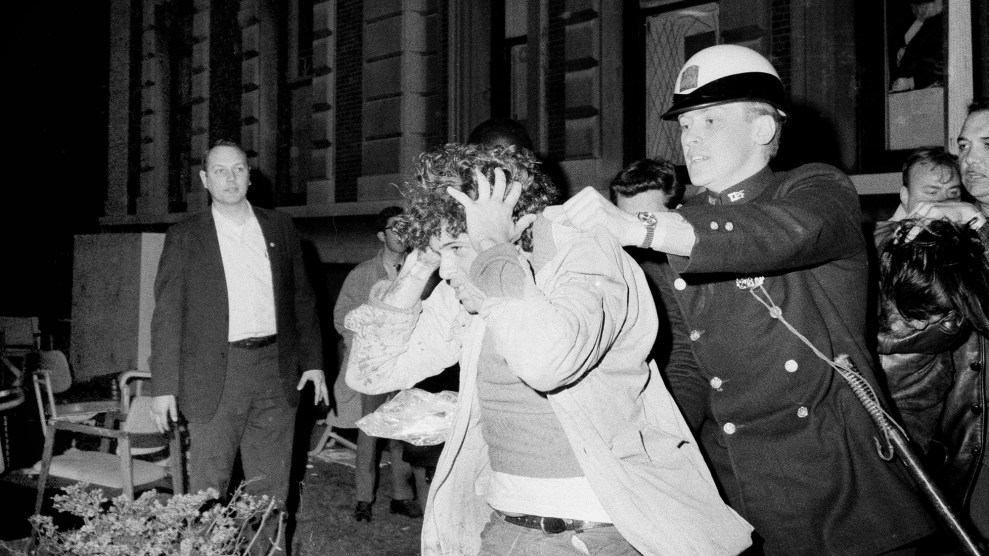
Meanwhile, as DiA notes, Yglesias has been calling for the abolition of the US Senate. That's not moderate wonkery. It's radicalism. (That doesn't mean Yglesias is wrong.) DiA thinks "there's something going on with these guys," and it could lead to "the kind of thing you saw happen to those clean-cut moderate liberal kids who wrote the Port Huron Statement."

So I say to the Juicebox Mafia et. al.: Why not? Sure, no one appointed you or elected you. But that didn't stop the kids at Port Huron (or in Sharon, Connecticut, for the matter). You're in leadership positions whether you like it or not. I'm serious. Set up a wiki and get to work. I'm sure the wider lefty blogosphere would be happy to help. Get some sort of statement together, and let DiA and others know for sure exactly how radical (or not) this generation of young liberals really is.

Advertisement

Advertisement

Nick Baumann covers national politics for Mother Jones' DC Bureau. For more of his stories, click here. He can also be found on twitter.

Get Mother Jones by Email - Free. Like what you're reading? Get the best of MoJo three times a week.

Comments

Despondence

So what if they're unreasonably despondent, or pessimistic, or even cynical. It doesn't mean they're wrong about the problems they point out even though, looking at the linked posts, I don't agree with them completely. I think the problems are more beatable than they admit right now, but are nonetheless real. Even the complaint about the Senate is accurate. Though liberals have blocked obnoxious appointees and legislation through the Senate's means of stalling, history shows justice is more blocked than blocking. The compromise in 1787 to create the two houses doesn't make as much sense now, and pointing that out isn't being a cynic, pessimist, radical, or revolutionary.
http://www.ravensblog.net

*cough* Miami '72 *cough*

From Miami and the Seeds of Port Huron by Tom Geoghegan in TNR 9/2/72: http://tinyurl.com/bl64f3

The danger of the Democratic platform (and its socalled "populist" rhetoric) is that by its explicit promise of social reintegration, it exploits the political potential of the "new anxieties" of private identity. It wants ordinary people to take more responsibility for complex social crises—without having any more power than they did before. Even if more politics were the cure for the distresses in our lives, the Democrats don't seem to have the stomach to give real power to the people. The logic of participatory democracy, as the Wallace Democrats know, requires, for instance, a reshuffling of the judiciary to give the majority of people control over the root-and-branch issue in American politics — race — which David Broder has called the single issue with enough emotional punch to realign the parties.

But the courts are only one stumbling block to participatory democracy. The huge federal leviathan, which survived unscathed at Miami, is sure to compromise any new populist attack on economic privilege and corporate conspiracy. In our economy, the people's government is not another policeman on the block but the air which all big business must breathe. After a century of progressive effort, Washington is regulating and subsidizing and even drawing up the entire demand curve of many large firms. "Consumers, citizens and taxpayers constitute too diffuse and amorphous a group to compete in this league," Richard Posner wrote last fall in Public Interest. "The larger the role of government in the economy . . . the worse the problem of public powers employed for private ends will become." Though calling for tougher antitrust laws against big-business establishment, the Democratic platform accepts a federal establishment already too mammoth to work properly. Thus, the New Democrats are caught between Hayden's world, where politics is expected to deal with the whole man and his sense of helplessness, and the Great Society, where a faceless bureaucracy indemnifies anyone or any group big enough to make trouble for it. The Democrats can't promise, like Wallace, to throw briefcases into the Potomac, nor will they tear down the ancien re'gime in the name of Port Huron. In place of genuine participation, then, the Democrats are left only with cant about truth-in-government, inspired by the Pentagon papers, and a cult of "sincere-ness" inspired by Ellsberg and McGovern himself. More than the war itself, the Pentagon papers have deflected radical Democrats into conspiracy theories and image politics. A bread-and-butter issue like tax reform now figures in their rhetoric as just a particularly good example of hypocrisy in high places.

Same as it ever was.

Post new comment

Alternately, you may login to or register an account
The content of this field is kept private and will not be shown publicly.
  • Web page addresses and e-mail addresses turn into links automatically.
  • Allowed HTML tags: <a> <ul> <ol> <li> <blockquote>
  • Lines and paragraphs break automatically.

More information about formatting options

MoJo Comments: Send Us Your Feedback

We changed our spam software to better filter comments. Should you encounter any issues, please let us know.

Photo Essays

The chaos and humanity of war.
The craftspeople and musicians of Appalachia.
A selection of '70s ads depicting African-Americans.
As climate change melts the permafrost, native villages slip into the sea, taking a way of life with them.