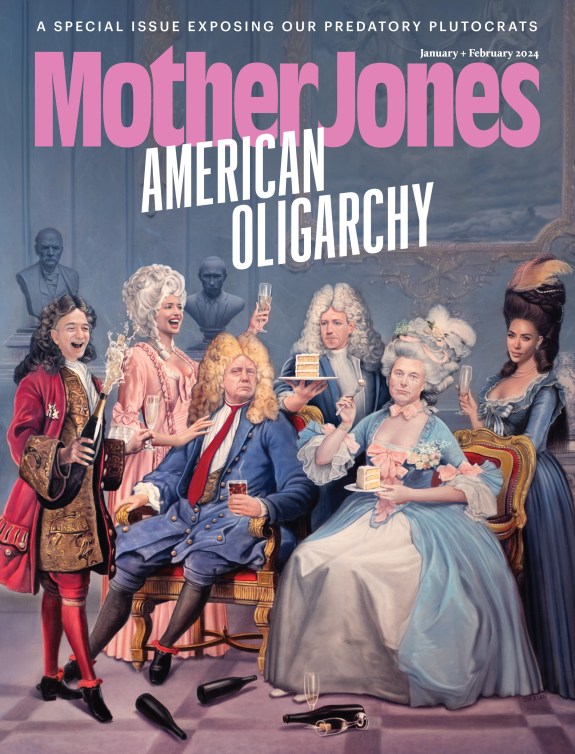
Illustration: Jason Holley
WHEN NOVELIST MICHAEL CRICHTON took the stage before a lunchtime crowd in Washington, D.C., one Friday in late January, the event might have seemed, at first, like one more unremarkable appearance by a popular author with a book to sell. Indeed, Crichton had just such a book, his new thriller, State of Fear. But the content of the novel, the setting of the talk, and the audience who came to listen transformed the Crichton event into something closer to a hybrid of campaign rally and undergraduate seminar. State of Fear is an anti-environmentalist page-turner in which shady ecoterrorists plot catastrophic weather disruptions to stoke unfounded fears about global climate change. However fantastical the book’s story line, its author was received as an expert by the sharply dressed policy wonks crowding into the plush Wohlstetter Conference Center of the American Enterprise Institute for Public Policy Research (AEI). In his introduction, AEI president and former Reagan budget official Christopher DeMuth praised the author for conveying “serious science with a sense of drama to a popular audience.” The title of the lecture was “Science Policy in the 21st Century.”
Crichton is an M.D. with a basketball player’s stature (he’s 6 feet 9 inches), and his bearing and his background exude authority. He describes himself as “contrarian by nature,” but his words on this day did not run counter to the sentiment of his AEI listeners. “I spent the last several years exploring environmental issues, particularly global warming,” Crichton told them solemnly. “I’ve been deeply disturbed by what I found, largely because the evidence for so many environmental issues is, from my point of view, shockingy flawed and unsubstantiated.” Crichton then turned to bashing a 1998 study of historic temperature change that has been repeatedly singled out for attack by conservatives.
There is overwhelming scientific consensus that greenhouse gases emitted by human activity are causing global average temperatures to rise. Conservative think tanks are trying to undermine this conclusion with a disinformation campaign employing “reports” designed to look like a counterbalance to peer-reviewed studies, skeptic propaganda masquerading as journalism, and events like the AEI luncheon that Crichton addressed. The think tanks provide both intellectual cover for those who reject what the best science currently tells us, and ammunition for conservative policymakers like Senator James Inhofe (R-Okla.), the chair of the Environment and Public Works Committee, who calls global warming “a hoax.”
This concerted effort reflects the shared convictions of free-market, and thus antiregulatory, conservatives. But there’s another factor at play. In addition to being supported by like-minded individuals and ideologically sympathetic foundations, these groups are funded by ExxonMobil, the world’s largest oil company. Mother Jones has tallied some 40 ExxonMobil-funded organizations that either have sought to undermine mainstream scientific findings on global climate change or have maintained affiliations with a small group of “skeptic” scientists who continue to do so. Beyond think tanks, the count also includes quasi-journalistic outlets like Tech CentralStation.com (a website providing “news, analysis, research, and commentary” that received $95,000 from ExxonMobil in 2003), a FoxNews.com columnist, and even religious and civil rights groups. In total, these organizations received more than $8 million between 2000 and 2003 (the last year for which records are available; all figures below are for that range unless otherwise noted). ExxonMobil chairman and CEO Lee Raymond serves as vice chairman of the board of trustees for the AEI, which received $960,000 in funding from ExxonMobil. The AEI-Brookings Institution Joint Center for Regulatory Studies, which officially hosted Crichton, received another $55,000. When asked about the event, the center’s executive director, Robert Hahn—who’s a fellow with the AEI—defended it, saying, “Climate science is a field in which reasonable experts can disagree.” (By contrast, on the day of the event, the Brookings Institution posted a scathing critique of Crichton’s book.)
During the question-and-answer period following his speech, Crichton drew an analogy between believers in global warming and Nazi eugenicists. “Auschwitz exists because of politicized science,” Crichton asserted, to gasps from some in the crowd. There was no acknowledgment that the AEI event was part of an attempt to do just that: politicize science. The audience at hand was certainly full of partisans. Listening attentively was Myron Ebell, a man recently censured by the British House of Commons for “unfounded and insulting criticism of Sir David King, the Government’s Chief Scientist.” Ebell is the global warming and international policy director of the Competitive Enterprise Institute (CEI), which has received a whopping $1,380,000 from ExxonMobil. Sitting in the back of the room was Christopher Horner, the silver-haired counsel to the Cooler Heads Coalition who’s also a CEI senior fellow. Present also was Paul Driessen, a senior fellow with the Committee for a Constructive Tomorrow ($252,000) and the Center for the Defense of Free Enterprise ($40,000 in 2003). Saying he’s “heartened that ExxonMobil and a couple of other groups have stood up and said, ‘this is not science,’” Driessen, who is white, has made it his mission to portray Kyoto-style emissions regulations as an attack on people of color—his recent book is entitled Eco-Imperialism: Green Power, Black Death (see “Black Gold?”). Driessen has also written about the role that think tanks can play in helping corporations achieve their objectives. Such outlets “can provide research, present credible independent voices on a host of issues, indirectly influence opinion and political leaders, and promote responsible social and economic agendas,” he advised companies in a 2001 essay published in Capital PR News. “They have extensive networks among scholars, academics, scientists, journalists, community leaders and politicians…. You will be amazed at how much they do with so little.”
THIRTY YEARS AGO, the notion that corporations ought to sponsor think tanks that directly support their own political goals—rather than merely fund disinterested research—was far more controversial. But then, in 1977, an associate of the AEI (which was founded as a business association in 1943) came to industry’s rescue. In an essay published in the Wall Street Journal, the influential neoconservative Irving Kristol memorably counseled that “corporate philanthropy should not be, and cannot be, disinterested,” but should serve as a means “to shape or reshape the climate of public opinion.”
Kristol’s advice was heeded, and today many businesses give to public policy groups that support a laissez-faire, antiregulatory agenda. In its giving report, ExxonMobil says it supports public policy groups that are “dedicated to researching free market solutions to policy problems.” What the company doesn’t say is that beyond merely challenging the Kyoto Protocol or the McCain-Lieberman Climate Stewardship Act on economic grounds, many of these groups explicitly dispute the science of climate change. Generally eschewing peer-reviewed journals, these groups make their challenges in far less stringent arenas, such as the media and public forums.
Pressed on this point, spokeswoman Lauren Kerr says that “ExxonMobil has been quite transparent and vocal regarding the fact that we, as do multiple organizations and respected institutions and researchers, believe that the scientific evidence on greenhouse gas emissions remains inconclusive and that studies must continue.” She also hastens to point out that ExxonMobil generously supports university research programs—for example, the company plans to donate $100 million to Stanford University’s Global Climate and Energy Project. It even funds the hallowed National Academy of Sciences.
Nevertheless, no company appears to be working harder to support those who debunk global warming. “Many corporations have funded, you know, dribs and drabs here and there, but I would be surprised to learn that there was a bigger one than Exxon,” explains Ebell of the Competitive Enterprise Institute, which, in 2000 and again in 2003, sued the government to stop the dissemination of a Clinton-era report showing the impact of climate change in the United States. Attorney Christopher Horner—whom you’ll recall from Crichton’s audience—was the lead attorney in both lawsuits and is paid a $60,000 annual consulting fee by the CEI. In 2002, ExxonMobil explicitly earmarked $60,000 for the CEI for “legal activities.”
Ebell denies the sum indicates any sort of quid pro quo. He’s proud of ExxonMobil’s funding and wishes “we could attract more from other companies.” He stresses that the CEI solicits funding for general project areas rather than to carry out specific sponsor requests, but admits being steered (as other public policy groups are steered) to the topics that garner grant money. While noting that the CEI is “adamantly opposed” to the Endangered Species Act, Ebell adds that “we are only working on it in a limited way now, because we couldn’t attract funding.”
EXXONMOBIL’S FUNDING OF THINK TANKS hardly compares with its lobbying expenditures—$55 million over the past six years, according to the Center for Public Integrity. And neither figure takes much of a bite out of the company’s net earnings—$25.3 billion last year. Nevertheless, “ideas lobbying” can have a powerful public policy effect.
Consider attacks by friends of ExxonMobil on the Arctic Climate Impact Assessment (ACIA). A landmark international study that combined the work of some 300 scientists, the ACIA, released last November, had been four years in the making. Commissioned by the Arctic Council, an intergovernmental forum that includes the United States, the study warned that the Arctic is warming “at almost twice the rate as that of the rest of the world,” and that early impacts of climate change, such as melting sea ice and glaciers, are already apparent and “will drastically shrink marine habitat for polar bears, ice-inhabiting seals, and some seabirds, pushing some species toward extinction.” Senator John McCain (R-Ariz.) was so troubled by the report that he called for a Senate hearing.
Industry defenders shelled the study, and, with a dearth of science to marshal to their side, used opinion pieces and press releases instead. “Polar Bear Scare on Thin Ice,” blared FoxNews.com columnist Steven Milloy, an adjunct scholar at the libertarian Cato Institute ($75,000 from ExxonMobil) who also publishes the website JunkScience.com. Two days later the conservative Washington Times published the same column. Neither outlet disclosed that Milloy, who debunks global warming concerns regularly, runs two organizations that receive money from ExxonMobil. Between 2000 and 2003, the company gave $40,000 to the Advancement of Sound Science Center, which is registered to Milloy’s home address in Potomac, Maryland, according to IRS documents. ExxonMobil gave another $50,000 to the Free Enterprise Action Institute—also registered to Milloy’s residence. Under the auspices of the intriguingly like-named Free Enterprise Education Institute, Milloy publishes CSRWatch.com, a site that attacks the corporate social responsibility movement. Milloy did not respond to repeated requests for comment for this article; a Fox News spokesman stated that Milloy is “affiliated with several not-for-profit groups that possibly may receive funding from Exxon, but he certainly does not receive funding directly from Exxon.”
Setting aside any questions about Milloy’s journalistic ethics, on a purely scientific level, his attack on the ACIA was comically inept. Citing a single graph from a 146-page overview of a 1,200-plus- page, fully referenced report, Milloy claimed that the document “pretty much debunks itself” because high Arctic temperatures “around 1940” suggest that the current temperature spike could be chalked up to natural variability. “In order to take that position,” counters Harvard biological oceanographer James McCarthy, a lead author of the report, “you have to refute what are hundreds of scientific papers that reconstruct various pieces of this climate puzzle.”
Nevertheless, Milloy’s charges were quickly echoed by other groups. TechCentralStation.com published a letter to Senator McCain from 11 “climate experts,” who asserted that recent Arctic warming was not at all unusual in comparison to “natural variability in centuries past.” Meanwhile, the conservative George C. Marshall Institute ($310,000) issued a press release asserting that the Arctic report was based on “unvalidated climate models and scenarios…that bear little resemblance to reality and how the future is likely to evolve.” In response, McCain said, “General Marshall was a great American. I think he might be very embarrassed to know that his name was being used in this disgraceful fashion.”
The day of McCain’s hearing, the Competitive Enterprise Institute put out its own press release, citing the aforementioned critiques as if they should be considered on a par with the massive, exhaustively reviewed Arctic report: “The Arctic Climate Impact Assessment, despite its recent release, has already generated analysis pointing out numerous flaws and distortions.” The Vancouver-based Fraser Institute ($60,000 from ExxonMobil in 2003) also weighed in, calling the Arctic warming report “an excellent example of the favoured scare technique of the anti-energy activists: pumping largely unjustifiable assumptions about the future into simplified computer models to conjure up a laundry list of scary projections.” In the same release, the Fraser Institute declared that “2004 has been one of the cooler years in recent history.” A month later the United Nations’ World Meteorological Organization would pronounce 2004 to be “the fourth warmest year in the temperature record since 1861.”
Frank O’Donnell, of Clean Air Watch, likens ExxonMobil’s strategy to that of “a football quarterback who doesn’t want to throw to one receiver, but rather wants to spread it around to a number of different receivers.” In the case of the ACIA, this echo-chamber offense had the effect of creating an appearance of scientific controversy. Senator Inhofe—who received nearly $290,000 from oil and gas companies, including ExxonMobil, for his 2002 reelection campaign—prominently cited the Marshall Institute’s work in his own critique of the latest science.
TO BE SURE, that science wasn’t always as strong as it is today. And until fairly recently, virtually the entire fossil fuels industry—automakers, utilities, coal companies, even railroads—joined ExxonMobil in challenging it.
The concept of global warming didn’t enter the public consciousness until the 1980s. During a sweltering summer in 1988, pioneering NASA climatologist James Hansen famously told Congress he believed with “99 percent confidence” that a long-term warming trend had begun, probably caused by the greenhouse effect. As environmentalists and some in Congress began to call for reduced emissions from the burning of fossil fuels, industry fought back.
In 1989, the petroleum and automotive industries and the National Association of Manufacturers forged the Global Climate Coalition to oppose mandatory actions to address global warming. Exxon—later ExxonMobil—was a leading member, as was the American Petroleum Institute, a trade organization for which Exxon’s CEO Lee Raymond has twice served as chairman. “They were a strong player in the Global Climate Coalition, as were many other sectors of the economy,” says former GCC spokesman Frank Maisano.
Drawing upon a cadre of skeptic scientists, during the early and mid-1990s the GCC sought to emphasize the uncertainties of climate science and attack the mathematical models used to project future climate changes. The group and its proxies challenged the need for action on global warming, called the phenomenon natural rather than man-made, and even flatly denied it was happening. Maisano insists, how ever, that after the Kyoto Protocol emerged in 1997, the group focused its energies on making economic arguments rather than challenging science.
Even as industry mobilized the forces of skepticism, however, an international scientific collaboration emerged that would change the terms of the debate forever. In 1988, under the auspices of the United Nations, scientists and government officials inaugurated the Intergovernmental Panel on Climate Change (IPCC), a global scientific body that would eventually pull together thousands of experts to evaluate the issue, becoming the gold standard of climate science. In the IPCC’s first assessment report, published in 1990, the science remained open to reasonable doubt. But the IPCC’s second report, completed in 1995, concluded that amid purely natural factors shaping the climate, humankind’s distinctive fingerprint was evident. And with the release of the IPCC’s third assessment in 2001, a strong consensus had emerged: Notwithstanding some role for natural variability, human-created greenhouse gas emissions could, if left unchecked, ramp up global average temperatures by as much as 5.8 degrees Celsius (or 10.4 degrees Fahrenheit) by the year 2100. “Consensus as strong as the one that has developed around this topic is rare in science,” wrote Science Editor-in-Chief Donald Kennedy in a 2001 editorial.
Even some leading corporations that had previously supported “skepticism” were converted. Major oil companies like Shell, Texaco, and British Petroleum, as well as automobile manufacturers like Ford, General Motors, and DaimlerChrysler, abandoned the Global Climate Coalition, which itself became inactive after 2002.
Yet some forces of denial—most notably ExxonMobil and the American Petroleum Institute, of which ExxonMobil is a leading member—remained recalcitrant. In 1998, the New York Times exposed an API memo outlining a strategy to invest millions to “maximize the impact of scientific views consistent with ours with Congress, the media and other key audiences.” The document stated: “Victory will be achieved when…recognition of uncertainty becomes part of the ‘conventional wisdom.’” It’s hard to resist a comparison with a famous Brown and Williamson tobacco company memo from the late 1960s, which observed: “Doubt is our product since it is the best means of competing with the ‘body of fact’ that exists in the mind of the general public. It is also the means of establishing a controversy.”
Though ExxonMobil’s Lauren Kerr says she doesn’t know the “status of this reported plan” and an API spokesman says he could “find no evidence” that it was ever implemented, many of the players involved have continued to dispute mainstream climate science with funding from ExxonMobil. According to the memo, Jeffrey Salmon, then executive director of the George C. Marshall Institute, helped develop the plan, as did Steven Milloy, now a FoxNews.com columnist. Other participants included David Rothbard of the Committee for a Constructive Tomorrow ($252,000) and the Competitive Enterprise Institute’s Myron Ebell, then with Frontiers of Freedom ($612,000). Ebell says the plan was never implemented because “the envisioned funding never got close to being realized.”
Another contributor was ExxonMobil lobbyist Randy Randol, who recently retired but who seems to have plied his trade effectively during George W. Bush’s first term. Less than a month after Bush took office, Randol sent a memo to the White House Council on Environmental Quality (CEQ). The memo denounced the then chairman of the IPCC, Robert Watson, a leading atmospheric scientist, as someone “handpicked by Al Gore” whose real objective was to “get media coverage for his views.” (When the memo’s existence was reported, ExxonMobil took the curious position that Randol did forward it to the CEQ, but neither he nor anyone else at the company wrote it.) “Can Watson be replaced now at the request of the U.S.?” the memo asked. It went on to single out other Clinton administration climate experts, asking whether they had been “removed from their positions of influence.”
It was, in short, an industry hit list of climate scientists attached to the U.S. government. A year later the Bush administration blocked Watson’s reelection to the post of IPCC chairman.
PERHAPS THE MOST SURPRISING aspect of ExxonMobil’s support of the think tanks waging the disinformation campaign is that, given its close ties to the Bush administration (which cited “incomplete” science as justification to pull out of the Kyoto Protocol), it’s hard to see why the company would even need such pseudo-scientific cover. In 1998, Dick Cheney, then CEO of Halliburton, signed a letter to the Clinton administration challenging its approach to Kyoto. Less than three weeks after Cheney assumed the vice presidency, he met with ExxonMobil CEO Lee Raymond for a half-hour. Officials of the corporation also met with Cheney’s notorious energy task force.
ExxonMobil’s connections to the current administration go much deeper, filtering down into lower but crucially important tiers of policymaking. For example, the memo forwarded by Randy Randol recommended that Harlan Watson, a Republican staffer with the House Committee on Science, help the United States’ diplomatic efforts regarding climate change. Watson is now the State Department’s “senior climate negotiator.” Similarly, the Bush administration appointed former American Petroleum Institute attorney Philip Cooney—who headed the institute’s “climate team” and opposed the Kyoto Protocol—as chief of staff of the White House Council on Environmental Quality. In June 2003 the New York Times reported that the CEQ had watered down an Environmental Protection Agency report’s discussion of climate change, leading EPA scientists to charge that the document “no longer accurately represents scientific consensus.”
Then there are the sisters Dobriansky. Larisa Dobriansky, currently the deputy assistant secretary for national energy policy at the Department of Energy—in which capacity she’s charged with managing the department’s Office of Climate Change Policy—was previously a lobbyist with the firm Akin Gump, where she worked on climate change for ExxonMobil. Her sister, Paula Dobriansky, currently serves as undersecretary for global affairs in the State Department. In that role, Paula Dobriansky recently headed the U.S. delegation to a United Nations meeting on the Kyoto Protocol in Buenos Aires, where she charged that “science tells us that we cannot say with any certainty what constitutes a dangerous level of warming, and therefore what level must be avoided.”
Indeed, the rhetoric of scientific uncertainty has been Paula Dobriansky’s stock-in-trade. At a November 2003 panel sponsored by the AEI, she declared, “the extent to which the man-made portion of greenhouse gases is causing temperatures to rise is still unknown, as are the long-term effects of this trend. Predicting what will happen 50 or 100 years in the future is difficult.”
Given Paula Dobriansky’s approach to climate change, it will come as little surprise that memos uncovered by Greenpeace show that in 2001, within months of being confirmed by the Senate, Dobriansky met with ExxonMobil lobbyist Randy Randol and the Global Climate Coalition. For her meeting with the latter group, one of Dobriansky’s prepared talking points was “POTUS [President Bush in Secret Service parlance] rejected Kyoto, in part, based on input from you.” The documents also show that Dobriansky met with ExxonMobil executives to discuss climate policy just days after September 11, 2001. A State Department official confirmed that these meetings took place, but adds that Dobriansky “meets with pro-Kyoto groups as well.”
RECENTLY, NAOMI ORESKES, a science historian at the University of California at San Diego, reviewed nearly a thousand scientific papers on global climate change published between 1993 and 2003, and was unable to find one that explicitly disagreed with the consensus view that humans are contributing to the phenomenon. As Oreskes hastens to add, that doesn’t mean no such studies exist. But given the size of her sample, about 10 percent of the papers published on the topic, she thinks it’s safe to assume that the number is “vanishingly small.”
What do the conservative think tanks do when faced with such an obstacle? For one, they tend to puff up debates far beyond their scientific significance. A case study is the “controversy” over the work of University of Virginia climate scientist Michael Mann. Drawing upon the work of several independent teams of scientists, including Mann and his colleagues, the Intergovernmental Panel on Climate Change’s 2001 report asserted that “the increase in temperature in the 20th century is likely to have been the largest of any century during the past 1,000 years.” This statement was followed by a graph, based on one of the Mann group’s studies, showing relatively modest temperature variations over the past thousand years and a dramatic spike upward in the 20th century. Due to its appearance, this famous graph has been dubbed the “hockey stick.”
During his talk at the AEI, Michael Crichton attacked the “hockey stick,” calling it “sloppy work.” He’s hardly the first to have done so. A whole cottage industry has sprung up to criticize this analysis, much of it linked to ExxonMobil-funded think tanks. At a recent congressional briefing sponsored by the Marshall Institute, Senator Inhofe described Mann’s work as the “primary sci- entific data” on which the IPCC’s 2001 conclusions were based. That is simply incorrect. Mann points out that he’s hardly the only scientist to produce a “hockey stick” graph—other teams of scientists have come up with similar reconstructions of past temperatures. And even if Mann’s work and all of the other studies that served as the basis for the IPCC’s statement on the temperature record are wrong, that would not in any way invalidate the conclusion that humans are currently causing rising temperatures. “There’s a whole independent line of evidence, some of it very basic physics,” explains Mann.
Nevertheless, the ideological allies of ExxonMobil virulently attack Mann’s work, as if discrediting him would somehow put global warming concerns to rest. This idée fixe seems to have begun with Willie Soon and Sallie Baliunas of the Harvard-Smithsonian Center for Astrophysics. Both have been “senior scientists” with the Marshall Institute. Soon serves as “science director” to TechCentralStation.com, is an adjunct scholar with Frontiers of Freedom, and wrote (with Baliunas) the Fraser Institute’s pamphlet “Global Warming: A Guide to the Science.” Baliunas, meanwhile, is “enviro-sci host” of TechCentral, and is on science advisory boards of the Committee for a Constructive Tomorrow and the Annapolis Center for Science-based Public Policy ($427,500 from ExxonMobil), and has given speeches on climate science before the AEI and the Heritage Foundation ($340,000). (Neither Soon nor Baliunas would provide comment for this article.)
In 2003, Soon and Baliunas published an article, partly funded by the American Petroleum Institute, in a small journal called Climate Research. Presenting a review of existing literature rather than new research, the two concluded “the 20th century is probably not the warmest nor a uniquely extreme climatic period of the last millennium.” They had, in effect, challenged both Mann and the IPCC, and in so doing presented global warming skeptics with a cause to rally around. Another version of the paper was quickly published with three additional authors: David Legates of the University of Delaware, and longtime skeptics Craig and Sherwood Idso of the Center for the Study of Carbon Dioxide and Global Change in Tempe, Arizona. All have ExxonMobil connections: the Idsos received $40,000 from ExxonMobil for their center in the year the study was published, while Legates is an adjunct scholar at the Dallas-based National Center for Policy Analysis (which got $205,000 between 2000 and 2003).
Calling the paper “a powerful new work of science” that would “shiver the timbers of the adrift Chicken Little crowd,” Senator Inhofe devoted half of a Senate hearing to it, bringing in both Soon and Legates to testify against Mann. The day before, Hans Von Storch, the editor-in-chief of Climate Research—where the Soon and Baliunas paper originally appeared—resigned to protest deficiencies in the review process that led to its publication; two editors soon joined him. Von Storch later told the Chronicle of Higher Education that climate science skeptics “had identified Climate Research as a journal where some editors were not as rigorous in the review process as is otherwise common.” Meanwhile, Mann and 12 other leading climate scientists wrote a blistering critique of Soon and Baliunas’ paper in the American Geophysical Union publication Eos, noting, among other flaws, that they’d used historic precipitation records to reconstruct past temperatures—an approach Mann told Congress was “fundamentally unsound.”
ON FEBRUARY 16, 2005, 140 nations celebrated the ratification of the Kyoto Protocol. In the weeks prior, as the friends of ExxonMobil scrambled to inoculate the Bush administration from the bad press that would inevitably result from America’s failure to sign this international agreement to curb global warming, a congressional briefing was organized. Held in a somber, wood-paneled Senate hearing room, the event could not help but have an air of authority. Like the Crichton talk, however, it was hardly objective. Sponsored by the George C. Marshall Institute and the Cooler Heads Coalition, the briefing’s panel of experts featured Myron Ebell, attorney Christopher Horner, and Marshall’s CEO William O’Keefe, formerly an executive at the American Petroleum Institute and chairman of the Global Climate Coalition.
But it was the emcee, Senator Inhofe, who best represented the spirit of the event. Stating that Crichton’s novel should be “required reading,” the ruddy-faced senator asked for a show of hands to see who had finished it. He attacked the “hockey stick” graph and damned the Arctic Climate Impact Assessment for having “no footnotes or citations,” as indeed the ACIA “overview” report—designed to be a “plain language synthesis” of the fully referenced scientific report—does not. But never mind, Inhofe had done his own research. He whipped out a 1974 issue of Time magazine and, in mocking tones, read from a 30-year-old article that expressed concerns over cooler global temperatures. In a folksy summation, Inhofe again called the notion that humans are causing global warming “a hoax,” and said that those who believe otherwise are “hysterical people, they love hysteria. We’re dealing with religion.” Having thus dismissed some 2,000 scientists, their data sets and temperature records, and evidence of melting glaciers, shrinking islands, and vanishing habitats as so many hysterics, totems, and myths, Inhofe vowed to stick up for the truth, as he sees it, and “fight the battle out on the Senate floor.”
Seated in the front row of the audience, former ExxonMobil lobbyist Randy Randol looked on approvingly.