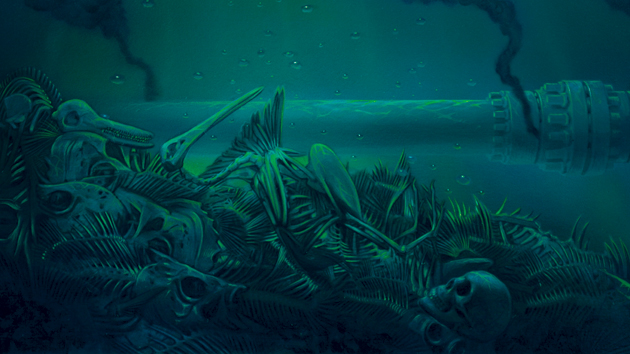
Illustration: Yuko Shimizu
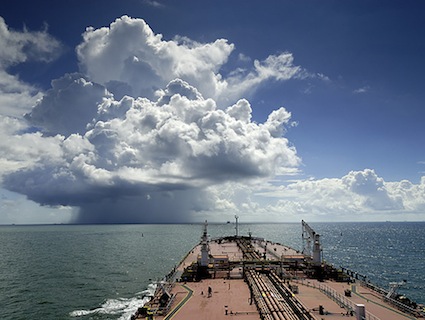
WE’RE IN FOR A WILD RIDE, say Oceanus’ 13-person crew, salts old and young, most of them Cape Codders with lifelong careers on the water. Consequently, many of the 12 members of the scientific team—oceanographers, science technicians, and graduate students, along with this observer—scatter across the ship’s three decks in the moments before we sail, seeking privacy for our last cell phone calls home, backs turned to the rain, shouting against the wind. At 177 feet and more than 1,000 tons, R/V (research vessel) Oceanus is the smallest ship in the long-range fleet of the Woods Hole Oceanographic Institution on Cape Cod, Massachusetts, and I suspect there’s not one of us aboard this morning who doesn’t wish we were sailing on one of the larger vessels.
Bad weather at sea is exponentially worse than bad weather ashore. The liquid world reacts in a pyrotechnical way to blowing air, exploding into the marine equivalent of a firestorm at winds that onshore might only make you button your coat. We’re headed into a Force 9 (strong gale) on the 12-point Beaufort scale. Before we make landfall, one week hence, we’ll have dabbled in Force 10 (storm) and skirted Force 11 (violent storm) conditions. Force 12 is a hurricane.
Outside of Buzzards Bay, we’re slammed with 20-foot seas ripped white by wind and careening unpredictably on the shallow waters of the continental shelf. The swell is abeam of us, and Oceanus wallows with the corkscrew motion sailors despise. One by one, those of us not on watch disappear below to set the storm rails on our bunks, wedge our life jackets under the edges of our mattresses, climb in, wait, and hope for intestinal fortitude and good seamanship from Captain Lawrence Bearse’s crew on the bridge. The only way to avoid being flung from our bunks by the violent motion is to hold on and hug the wall, which is essentially the outer skin of the vessel. It’s a strangely intimate experience, below waterline, feeling the ship bowing and flexing against our backs, and absorbing into our bones the deafening thunder of steel as the largest waves drive Oceanus nearly to a shuddering stop before her single propeller fights back with the power of 3,000 horses. I’m torn between staying awake and worried in a fascinated kind of way, or falling into oblivious sleep.
A cold front from the north, fueled by the remnants of Tropical Storm Tammy, and Subtropical Depression 22 are merging and birthing a midlatitude cyclonic monster destined to grow 1,100 miles in diameter. Twenty inches of rain have already fallen over parts of New England, the region’s weightiest rain event since 1999’s Hurricane Floyd. A day earlier, en route to Woods Hole and stuck in Chicago by weather so bad it closed down Boston’s Logan Airport, I called Ruth Curry, the expedition’s chief scientist, to ask what she made of the forecast. “Science doesn’t stop for the weather,” was her cheery reply.
Concerns about weather are part of what’s sending us to sea in the first place. By studying the ocean’s chemistry, which affects currents and, in turn, weather, Curry hopes to better understand how we humans might be affecting the critical elements of our own life-support system. Data from physical oceanography, marine biology, meteorology, fisheries science, glaciology, and other disciplines reveal that the ocean, for which our planet should be named, is changing in every parameter, in all dimensions, in every way we know how to measure it.
The 25 years I’ve spent at sea filming nature documentaries have provided a brief yet definitive window into these changes. Oceanic problems once encountered on a local scale have gone pandemic, and these pandemics now merge to birth new monsters. Tinkering with the atmosphere, we change the ocean’s chemistry radically enough to threaten life on earth as we know it. Making tens of thousands of chemical compounds each year, we poison marine creatures who sponge up plastics and PCBs, becoming toxic waste dumps in the process. Carrying everything from nuclear waste to running shoes across the world ocean, shipping fleets spew as much greenhouse gases into the atmosphere as the entire profligate United States. Protecting strawberry farmers and their pesticide methyl bromide, we guarantee that the ozone hole will persist at least until 2065, threatening the larval life of the sea. Fishing harder, faster, and more ruthlessly than ever before, we drive large predatory fish toward global extinction, even though fish is the primary source of protein for one in six people on earth. Filling, dredging, and polluting the coastal nurseries of the sea, we decimate coral reefs and kelp forests, while fostering dead zones.
I’m alarmed by what I’m seeing. Although we carry the ocean within ourselves, in our blood and in our eyes, so that we essentially see through seawater, we appear blind to its fate. Many scientists speak only to each other and studiously avoid educating the press. The media seems unwilling to report environmental news, and caters to a public stalled by sloth, fear, or greed and generally confused by science. Overall, we seem unable to recognize that the proofs so many politicians demand already exist in the form of hindsight. Written into the long history of our planet, in one form or another, is the record of what is coming our way.
“The root cause of this crisis is a failure of both perspective and governance,” concludes the seminal Pew Oceans Commission’s 2003 report to the nation. “We have failed to conceive of the oceans as our largest public domain, to be managed holistically for the greater public good in perpetuity.” Instead, we have roiled the waters, compromising the equilibrium that allowed our species to flourish in the first place, and providing ourselves with a host of challenges that will test our clever brains and our opposable thumbs as never before. Afloat on arks of dry land, we sail toward a stormy future.
THE GOAL OF EXPEDITION OC 417 is to sail from Cape Cod two-thirds of the way to Bermuda along a 321-mile-long line known as a transect. We are scheduled to sail outbound nonstop for 36 hours until, 385 miles to the southeast, we’ll begin to work our way back, sampling waters from the surface to the abyss at 22 predetermined stations, identifiable only by their latitude and longitude. In the course of a week, we’ll measure temperature, oxygen, salinity, and chlorofluorocarbons in the water column—the equivalent of taking the ocean’s pulse, listening to its lungs, looking at its tongue, and making it say “ah.”
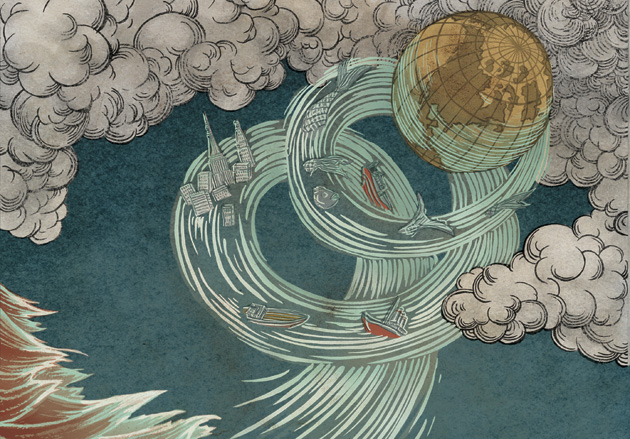
According to the charts, we are sailing the North Atlantic. But this is a relatively arbitrary marker. In fact, there is only one ocean on Earth: a world ocean encompassing 70.78 percent of our planet. The ancient Greeks sensed the ocean was one and portrayed their water god Okeanos (Oceanus) as a river circling the world. Three thousand years later, modern oceanographers confirm the world ocean is connected in riverlike fashion; using a sche- matic known as the ocean conveyor belt, they portray Okeanos as a Möbiuslike ribbon winding through all the ocean basins, rising and falling, and stirring the waters of the world. In this manner, the surface waters we sail in the North Atlantic are destined to flow to the Arctic, to grow colder and sink, and, once at the bottom, to reverse flow southward through the Atlantic, eventually converging with the Antarctic Circumpolar Current, before surfacing in the Northeast Pacific 1,200 years from now. Centuries later, they will arrive back in the North Atlantic, having truly traveled the seven seas.
Or maybe they won’t. Things are changing.
In 2005, researchers from the Scripps Institution of Oceanography and the Lawrence Livermore National Laboratory found the first clear evidence that the world ocean is growing warmer. In a novel study combining computer modeling and field observations, and screening for natural weather effects and the impact of volcanic gases, they discovered the top half-mile of the ocean has warmed dramatically in the past 40 years as a result, clearly and simply, of human-induced, rising greenhouse gases. “The statistical significance of these results is far too strong to be merely dismissed and should wipe out much of the uncertainty about the reality of global warming,” reported researcher Tim Barnett of Scripps, who suggests the Bush administration convene a Manhattan-style Project to figure out what mitigations might still be possible.
One symptom already manifesting is the melting of the Arctic. Last year set a fourth consecutive record low for ice cover in the Arctic, and scientists now predict the summertime Arctic will be ice-free before the end of this century—a course likely exacerbated by the simultaneous decrease of wintertime Arctic ice. Consequently, the world’s 22,000 polar bears, along with their primary prey, the ringed seals who likewise den on sea ice, are likely to suffer localized or even overall extinction [see “On Thin Ice” by Marla Cone]. Yet the eight nations surrounding the Arctic are rushing to capitalize on the resources emerging from the ice, grabbing for a quarter of the world’s undiscovered oil and natural gas; a trove of gold, diamonds, copper, and zinc; the earth’s last pristine fishing grounds, which are shifting north as fish follow colder waters; and the fabled Northwest Passage and other Arctic travel routes. Even as some governments deny the existence of global warming, they are racing to map the Arctic seafloor and bolster their territorial claims for exclusive economic zones no one cared about 15 years ago.
Reinforcing these entrepreneurial dreams is the reality of a feedback loop already in motion. Compact sea ice, with its high albedo (whiteness), reflects 80 percent of the sun’s heat back into space, while seawater, with a low albedo, absorbs 80 percent. The reduction in the ratio of ice to water further increases the warming of the ocean, which rises from thermal expansion, creating an even greater surface area of water, which promotes further warming and further melting, nibbling away at even more sea ice. In other words, the melting will be difficult if not impossible to reverse anytime soon.
Along with thermal expansion, melting ice also adds freshwater to the ocean. Until recently, many researchers believed this freshening would have a negligible impact on sea levels or ocean chemistry. But the effects are proving unpredictable. In the Antarctic Peninsula, lubricated by summer temperatures registering 3.6 degrees Fahrenheit warmer than 40 years ago, ancient ice shelves are disintegrating, enabling the glaciers behind them to surge into the sea with a rapidity startling to scientists. Consequently, fears are growing that if the West Antarctic Ice Sheet, currently contained by the Ronne and Ross ice shelves, ever surges, it would raise sea levels by as much as 23 feet worldwide.
Curry’s work aboard Oceanus is part of a five-year study monitoring the ocean conveyor belt and its reaction to the freshening ocean. In a 2005 paper published in Science, she calculates that 4,558 cubic miles of freshwater from rivers and ice melt have been added to the cold waters between Labrador and northern Europe since 1965. Based on the trends of the past 40 years, it would take another 100 years of similar freshening to shut down a critical element of the ocean conveyor belt known as the Atlantic meridional overturning circulation (MOC), the primary heat-transport mechanism that awards northern Europe a climate more like that of New England than Alaska—Europe’s latitudinal counterpart.
Add enough warming, evaporation, and freshwater, however, and there is potential for enormous change on an accelerated schedule, including the possibility that the Atlantic MOC could shut down faster than expected, which would make Europe colder, possibly cold enough to grow new glaciers. Hollywood sensationalized this scenario in the film The Day After Tomorrow and was widely accused of scaremongering. Yet John Schellnhuber, research director of the Tyndall Centre for Climate Change Research in the United Kingdom, calls the Atlantic MOC one of the earth’s most critical tipping points, which, if triggered, could initiate rapid changes across the entire planet.
No one knows if we’re instigating another ice age. But what we do know is that the tropical ocean is saltier than it was 40 years ago, and the polar ocean fresher. Furthermore, this salinity differential accelerates the earth’s freshwater cycle—creating faster rates of evaporation and precipitation, which release more water vapor into the atmosphere, thereby increasing the greenhouse effect and invigorating the global warming that caused the whole problem in the first place.
CURRY AND I SHARE THE TWO BUNKS in the chief scientist’s cabin, distinct from the other berths aboard by the presence of a private head and shower. She has refreshed our tiny corner of the ship with a cheerful string of white Christmas lights, an antidote to the overhead fluorescents. Curry doesn’t spend much time below, however, even though most of the science team, when not on their 12-hour watches, are bunked out, hoping for unconsciousness. Curry is usually on station in the dry lab, a space kept water-free to protect sensitive scientific equipment, where she straddles a chair strapped to the counter while working on a laptop secured with a rope tied in half hitches.
She will celebrate her 48th birthday aboard during this trip, though she looks years younger. Fit, with a runner’s frame, long blond hair, and steady blue eyes, she is the Hollywood ideal of a female scientist, yet she possesses the keen mind the movies never capture, and she bears the weight of responsibility of managing a $300,000 research cruise in bad weather. Already she has been forced to reverse the order in which Oceanus normally visits each of the 22 stations on the transect. And already she’s suspended deck operations for one critical night, when huge waves washed aboard in the darkness, swamping her to her waist and knocking her off her feet, nearly sweeping her overboard. When I ask why she doesn’t use lifelines on deck, she says the risk of entanglement in the equipment is greater than the benefit of staying tethered to the ship.
“If we can’t do deck ops, there’s not much else to do out here. I can’t write code aboard,” she tells me almost apologetically, as she crawls into her bunk. “I’m too brain dead at sea for that.” She is asleep within seconds.
In fact, we’re all dullards out here, drugged, sleep-deprived, exhausted by the constant bodily compensations of pitch, roll, and yaw. I’ve combined two powerful seasickness meds, something no doctor would recommend, a strategy that awarded me an hour or two in a strange quaaludelike realm where I had to remind myself to breathe. But I’m on my feet now, or rather on my backside, wedged into a stuffed chair in Oceanus’ library and chuckling helplessly at cartoons in The Prehistory of the Far Side.
“Do you want to work?” Curry prompts. “I’m short crew.” Suddenly, I’m on deck ops, geared up with hard hat, foul-weather gear, life vest, and steel-toed rubber deck boots, crouched on the starboard deck, where unpredictable waves wash over the rail and swamp us to our ankles, knees, or waists.
We are tending the workhorse of oceanography, a 5.5-foot-tall contraption known as a CTD, or conductivity-temperature-depth profiler, a collection of 21 four-liter Niskin bottles made from sewer- grade PVC, arranged in a rosette and mounted to a stainless steel circular frame. The package also contains an LADCP, or lowered acoustic Doppler current profiler, which records water velocity. At each of our 22 stops, the package is launched overboard and sent to the bottom, transmitting data to onboard computers 11 times a second along its route. On its return, a science tech commands the winch operator to halt the ascent so she can trigger each of the Niskin bottles to open and close their lids, capturing water samples from a variety of predetermined depths.
Dry, the entire CTD rig weighs about 700 pounds; wet and fully loaded, up to 1,800 pounds. To manage it, Oceanus carries a hydrographic boom amidships, complete with 30,000 feet of coaxial cable. Launching and retrieving in heavy seas requires phenomenal skill and coordination among crews working on three different decks: the bridge crew up top, the winch operator on the middle deck, and the bosun and whatever science crew are manning the gaffs and lines to steady the CTD as it comes and goes on the main deck. Using only Oceanus’ single screw and a bow thruster, the bridge must hold the ship steady in 20-plus-foot seas while assuring the streaming cable does not contact, and thereby slice through, the steel hull. The work requires finesse and boldness, and Curry, a fearless pro in a seagoing world largely ruled by men, clearly thrives on its rewards.
Warmer Waters, Stronger Storms
Adding to these perils is the fact that as the CTD descends, it enters a series of water masses of different density gradients. These are the underwater layers of the ocean conveyor belt, each flowing like a powerful river with its own direction and velocity—a reality made obvious topside when suddenly the cable whips through the water as if hooked to a giant fighting fish.
Curry calls it blue-collar oceanography, and the basics of it—big ships, GPS, depth finders, gyrocompasses, winches, cranes, and miles of cable—are the stuff of modern seafaring, whether for science, transport, harvest, or plunder. Technology drives human effort in the sea the way the wind once did, allowing us to access remote realms for extended periods with such proficiency that in the course of one human lifetime we have learned to pirate every molecule of the sea’s supposedly inexhaustible worth.
THE TECHNOLOGIES WE USE ABOARD Oceanus are the same employed by at least some of the 4 million commercial fishing vessels plying the ocean at any given moment. Not long ago, the growth of seagoing technologies paralleled the growth in the annual global fish harvest. But 2000 marked a decisive turning point when the global wild fish catch, which grew 500 percent between 1950 and 1997, peaked at 96 million tons despite better technologies and intensified efforts by fishers. Thereafter it has fallen by more than 3 percent per capita a year, declining to 31 pounds per capita in 2003, a rate last seen 40 years ago. Even more alarming, a 2001 reassessment published in Nature suggests the annual catch has actually been falling far longer, about 400,000 tons a year since 1988, a fact concealed by China’s misreporting of its annual catch.
Paradoxically, fishing has become so efficient as to be supremely inefficient. One of the biggest culprits is long-lining, in which a single boat sets monofilament line across 60 or more miles of ocean, each bearing vertical gangion lines that dangle at different depths, baited with up to 10,000 hooks designed to catch a variety of pelagic (open ocean) species. Each year, an estimated 2 billion longline hooks are set worldwide primarily for tuna and swordfish—though long-liners inadvertently kill far more other species that take the bait, including some 40,000 sea turtles, 300,000 seabirds, and millions of sharks annually. Thrown dead or dying back into the ocean, these unwanted species (bycatch) make up at least 25 percent of the global catch, perhaps as much as 88 billion pounds of life a year.
All told, pelagic longlines are the most widely used fishing gear on earth, and are deployed in all the oceans except the circum- polar seas. But whereas they once caught 10 fish per 100 hooks set, today they are lucky to catch one, evidence the seas are running dry. Abetting their destructiveness are the trawl fisheries, which drag nets across every square inch of the bottom of the continental shelves every two years, trawling some regions many times a season. By razing vital benthic (seafloor) ecosystems, trawlers—the brutal equivalent of fishing the seafloor with bulldozers—level an area 150 times larger than the total area of forests clearcut on land each year.
Adding to longlines and trawlers is the technology of drift nets, the nearly invisible curtains of monofilament blindsiding the life of the ocean. In the North Atlantic, shark and monkfish nets up to 150 miles long are set 1,600 feet below the surface, then left untended to sail and randomly ensnare life. In the course of operations in stormy seas, many nets are lost or abandoned—though they continue to fill with prey, which attracts predators, which likewise become trapped, die, and decay, attracting more predators. Composed of nonbiodegradable synthetics, deepwater ghostnets fish with nightmarish efficiency for years.
Fishing provides a vivid illustration of the differences in our attitudes toward the land and the sea. Nowadays we refrain from indiscriminately mowing down wildlife for food; imagine slaughtering lions by the hundreds or bears by the hundredweight, along with all the antelope, deer, wolves, raccoons, and wildebeest around them, in government-funded operations, no less. Yet that’s what we do at sea, with the world’s nations subsidizing 25 to 40 percent of total global fishing revenues. The National Marine Fisheries Service estimates that $8 billion in revenue and 300,000 jobs could be created simply by better management of U.S. fish stocks, not by continuing subsidies of fishers, their boats, and their gear.
Despite its promise, aquaculture is no better, since three pounds of wild fish are caught to feed every pound of farmed salmon sent to market—creating entirely new fisheries, which deplete hitherto unscathed wild fish populations, including krill, a critical corner-stone of the marine food web and essential to the survival of Antarctic species such as penguins. Furthermore, farmed salmon become severely contaminated by pollutants in their feed chow; some European aquacultured salmon is so badly tainted that people have been advised to consume it only once every five months [for more on which seafood is safe to eat, see here.].
The truth is that the full consequences of modern fishing methods are brutal and far-reaching, and they were not really understood before the release of a seminal study published in 2003, detailing how industrialized fisheries, in a manner akin to virulent pathogens, typically reduce the community of large fish by 80 percent within the first 15 years of exploitation. Co-authors Boris Worm and Ransom Myers of Dalhousie University in Nova Scotia concluded that in the wake of decades of such onslaughts, only 10 percent of all large fish (tuna, swordfish, marlin) and groundfish (cod, halibut, skate, and flounder) are left anywhere in the ocean. Their study was based on factors modern fisheries managers ignore: historical data; in this case, the catch reports from Japanese long-liners dating from the 1950s, when the global tuna catch was less than 500,000 tons, compared with 3.7 million tons today.
Apparently no one really remembers how many big fish used to inhabit the sea or how big they got. “The few blue marlin left today,” says Myers, “reach one-fifth of the weight they once had. In many cases, the fish caught today are under such intense fishing pressure, they never even have the chance to reproduce.” The pressure stems from a combination of economics (a single large bluefin tuna can command $100,000 on the Tokyo fish market) and ever-evolving technologies, and this scenario plagues the oceans: The more rare and endangered a species, the more money it generates and the more people who are willing to pursue it. While rich fishers pursue dwindling species with the aid of technology, poor fishers do it through brutal ingenuity, including using poison and explosives, leading to what’s known as Malthusian overfishing—when a fishery is overwhelmed yet fishing continues anyway, in ever more destructive and desperate ways, until the complete decimation of species and their ecosystems. Poor fishers do this largely to meet the demand of rich nations—to supply aquarium fish for the United States and live food fish for Hong Kong. Since demand grows in direct relationship to a species’ decline, many fish are targeted during their spawning aggregations, thus wiping out entire adult populations along with all their potential progeny. In this way, some coral reef species have been locally extinguished in the course of only one or two spawning events.
The past has much to teach us about what we’ve forgotten. By analyzing 10,000 historical restaurant menus from Boston to San Francisco, a project called the History of Marine Animal Populations, out of the University of Southern Denmark, finds that lobster was so abundant in the 19th century that middle-class Americans snubbed it as food for the poor. Likewise, the day may be near when Hemingway’s The Old Man and the Sea is seen less as a story of Santiago’s plight than of a mighty fish that once roamed the seas and no longer does.
IT USED TO BE, in the heyday of wildlife filmmaking, that you could chum off the California coast for a few hours or a day or two and attract dozens of full-size (eight-foot) blue sharks, along with a gaggle of youngsters and the occasional, powerful (10-foot) mako or two. But the last time I tried this, only two baby blue sharks, all of four feet long, appeared after days of chumming. In the interval between 1980, when cameramen were forced to work with safety divers to fend off more sharks than they knew what to do with, and 1991, when we were obliged to film the baby sharks close-up with wide-angle lenses to make them look bigger, long-liners, trawlers, and drift netters came to the west coast.
Sharks are killed incidentally in large numbers by all three forms of industrial fishing, but they are also targeted by their own fishery, primarily for soup. Once a rarefied foodstuff of the elite, today sharkfin soup is an affordable luxury for the Chinese nouveau riche who wish to prove their wealth by ordering a $100 bowl of glutinous cartilage flavored with chicken broth. At expensive eateries across Asia, middle-class diners slurp this pricey food, even as the World Conservation Union adds ever more shark species to its Red List of Threatened Species.
Fishing fleets kill an estimated 100 million sharks per year across the globe. In the Gulf of Mexico, the number of oceanic whitetip sharks has plunged 99 percent since the 1950s, driving this once common pelagic species into virtual extinction. A study of the North Atlantic found that overall shark populations have declined more than 50 percent since 1986. Sadly, sharks are slow breeders, with most delivering small litters (some only twins) after reaching a late sexual maturity (some at 25 years old), after which they typically deliver litters at three-year intervals. The results of such slow reproduction make recovery from overfishing notoriously difficult. When porbeagle sharks were overfished by Europeans in the 1960s, the species struggled for the next 30 years, finally achieving some semblance of health in the 1990s, only to become the target of U.S. and Canadian fleets that fished it into commercial extinction in three short years.
The end of big fish in the sea is more than an aesthetic loss. Marine ecologist Mark Hixon of Oregon State University has published widely on coral reef ecosystems, and his work illustrates how biodiversity and community stability thrive in the presence of predators and competitors. The removal of either or both destabilizes the remaining species. Hence big sharks, tuna, swordfish, and halibut are more than picturesque giants; they are keystone species that play greater roles in maintaining ecosystem function than seems obvious based on the size of their population.
Hixon also argues that not all spawners are created equal, and that the most valuable members of fish populations are what he and his colleagues call the Big Old Fat Female Fish (BOFFFs), who produce better-quality and -quantity eggs than younger females. Yet fisheries managers continue to promote the targeting of older fish, followed by younger fish, until none can grow old. “This means that BOFFFs are disappearing,” says Hixon. “Here on the West Coast, 7 out of 17 well-assessed species of rockfish have been declared overfished since 1999, and we believe that at least part of the explanation for these stock collapses is the result of our failure to appreciate the value of Big Old Fat Female Fish.”
Hixon tells me that we need a Kuhnian paradigm shift in fisheries management. “Current managers learned single-species management, and they’re resistant to changing that, even though it seldom works.” A scientific consensus signed by him and 218 other scientists and policy experts pleads for an updated approach: “From a scientific perspective, we now know enough to improve dramatically the conservation and management of marine systems through the implementation of ecosystem-based approaches.”
As on land, protecting places is the best way to preserve life. In 2003, the World Conservation Union listed 102,102 protected areas on earth. But only 4,116 of these were protected marine areas, preserving less than 0.5 percent of the world ocean, whereas 11.5 percent of the land surface has been granted some form of sanctuary. To reach parity, we need to add 23 times as many marine reserves and offshore national parks, or 10 times more total area—and perhaps even more, since the liquid medium of the ocean is more in-terconnected, and the fate of its disparate realms more intertwined than here.
RACHEL CARSON wrote of the sea that “in its mysterious past it encompasses all the dim origins of life and receives in the end, after, it may be, many transmutations, the dead husks of that same life. For all at last return to the sea—to Oceanus, the ocean river.” We return to the sea, too, in various husks, including in the form of atmospheric emissions. Sweden, for example, calculates that its populace of 8.9 million carries 2.8 tons of mercury fillings in their mouths, most of which is destined eventually to go airborne in crematoriums.
Crematory emissions are a small but growing percentage of the total global mercury pollution, the vast majority of which enters the foodweb as a biologically active derivative of the inorganic mercury released by the smokestacks of the coal and chlorine industries. Oxidized in the atmosphere and piggybacking on raindrops, this form of mercury eventually settles to the bottom of oceans and lakes, where it is converted to dangerous methylmercury by aquatic bacteria, which are eaten by plankton, which are eaten by fish, and bigger fish—with each subsequent meal bioaccumulating in higher levels until apex predators such as tuna and whales carry mercury levels as much as 1 million times higher than the waters around them.
As do we. Epidemiological studies show that mercury levels among Arctic peoples are high enough to cause neurobehavioral effects, while a Hong Kong study revealed that 10 percent of the region’s high school students suffer mercury poisoning from eating tuna and swordfish. The European Union warns pregnant women to limit their consumption of both tuna and swordfish because of brain damage to their unborn children, and the U.S. Food and Drug Administration warns pregnant women, lactating women, and young children not to eat swordfish, shark, tilefish, or king mackerel, though the powerful tuna lobby succeeded in keeping tuna off that list. The EPA now estimates at least one in eight American women of childbearing age has unsafe levels of mercury in her blood, and as many as 600,000 of the 4 million babies born in the United States in 2000 were exposed to unacceptable levels because their mothers ate a diet rich in fish (in a continuation of bioaccumulation, the level of mercury in a fetus’ blood can be 70 percent higher than its mother’s). Yet the Bush administration, circumventing the Clean Air Act, has enabled coal-fired power plants to delay curtailing significant mercury emissions until 2018.
IT’S MIDNIGHT OVER THE GULF OF MEXICO, the skies stripped of clouds and glittering with stars as 25-knot winds blow down from the north. For most of the residents of the bayou country of southern Louisiana, these are welcome winds; only a month has passed since Hurricane Katrina made landfall, and 11 days since Hurricane Rita, and these northerlies are cold and dry enough to dismantle any additional tropical storms from the top down. It’s also blowing sufficiently hard that Captain Craig LeBoeuf decides to sail R/V Pelican through the Intracoastal Waterway and out into the Gulf at Morgan City, so that dawn will light our way along the shallow shelf where more than 100 hurricane-broken oil rigs and drilling structures foul the waters.
This once was one of the most prolific bodies of water on earth, a place where the outflow from the Mississippi River introduced freshwater nutrients into a deepwater environment. But long before Katrina, the Gulf had become one of the world’s most polluted marine ecosystems, with mercury loads among the highest ever recorded, including levels in blue marlin 30 times above what the EPA deems safe for human consumption. An average of 10 tons of mercury comes down the Mississippi every year, with close to another ton added by the offshore drilling industry. Equally alarming, a sizable portion of the Gulf is so biologically dysfunctional on a seasonal basis that it’s known as a dead zone—the largest such area in the United States and the second largest on the planet, measuring nearly 8,000 square miles in 2001, an area larger than New Jersey.
Dead zones occur wherever oceanic oxygen is depleted below the level necessary to sustain marine life, a result of eutrophication, or the release of excess nutrients into the sea, usually from agricultural fertilizers. Fifty years ago no one imagined that the Green Revolution would prove so lethal to the world ocean. But now we know that chemical fertilizers cause plants to bloom in the sea as miraculously as they do on land, with deadly consequence. It’s no coincidence that almost all of the nearly 150 (and counting) dead zones on earth lie at the mouths of rivers.
The Gulf of Mexico suffers the downstream effects of the mighty Mississippi, which drains 41 percent of the contiguous United States, including all the intensively farmed breadbasket. This outflow delivers enough nitrogen to stimulate explosions of plankton and microalgae, some of which form the red tides that produce major fish kills and dolphin or manatee die-offs. At even higher densities, as these plankton die en masse and settle to the bottom, they fuel a bloom of bacterial decomposers, which consume all the available oxygen in the water. The resulting condition, known as hypoxia, strikes the Gulf whenever oxygen levels fall below two milligrams per liter—an annual summertime event in the warming waters of the Gulf since the 1970s. For sea life, it’s as if all the air were suddenly sucked out of the world. Those creatures that can swim or walk away fast enough may survive. Those that can’t, die.
Nancy Rabalais shows me around Pelican’s home in Cocodrie, in far southern Louisiana. Three months ago, as the newly appointed executive director of Louisiana Universities Marine Consortium (LUMCON), she took the helm of this 75,000-square-foot complex of laboratories, teaching facilities, apartments, offices, and seagoing vessels. So far her tenure has been largely spent digging out of the mud, repairing the wind damage, and casting an eye to the weather. “This used to be a beautiful place,” she says of the striking waterfront facility built on stilts. Now it’s boarded up with storm shutters and surrounded by bulldozers, piles of garbage, stacks of dismantled roofing, stripped palm trees, and muck. Only the estuarine wetlands all around seem untouched, lovely, given that hurricanes are a familiar part of their evolutionary world.
Rabalais is weary. It’s late. She still has a two-hour drive ahead of her to Baton Rouge, where she teaches at Louisiana State University— though I suspect she would rather board Pelican for a couple of days and leave her worries behind. Instead, she’s relying on her research associates and graduate students to conduct the scientific cruise she normally looks forward to each month. A Texan by birth and schooling, she has been diving these waters since it was a fun thing to do; nowadays, it requires a certain courage. A week earlier, while diving in zero visibility on a research station 26 miles offshore, Rabalais encountered an alligator at the surface blown out to sea by one or both of the hurricanes. Diving to the bottom, she “felt something bump against my ankle. But I figured a gator wasn’t diving 65 feet deep, so it must have been something else.”
Rabalais calls the Gulf of Mexico hypoxic zone the poster child of dead zones because it’s been so well documented by herself and others over the past 20 years. Oddly, it acts like a living thing: growing in spring, thriving in summer, decaying in fall, gaining in size almost every year. Core sediment samples and computer hindcasting pinpoint its birth date to the aftermath of World War II, when a surplus of nitrogen destined for TNT was redeployed as agricultural fertilizer.
By one o’clock the next afternoon, we’ve already visited four of the seven stations on the day’s transect, launching and retrieving the CTD in quick time because water depths here are rarely more than 180 feet. Along with collecting conductivity, temperature, and depth data, Rabalais’ crew aboard the Pelican is also conducting HPLC (high performance liquid chromatography) analysis: quantifying and separating pigments, which indicate chlorophyll and hence phytoplankton abundance. The six young men and women work efficiently, hurrying back to the mess deck between workstations, where the satellite TV plays back-to-back college football games.
But for a first-time visitor to the northern Gulf of Mexico, this is far too fascinating a world, in a futuristic kind of way, to ignore. The horizon in all directions is dotted with what from a distance look like small mangrove islands. Only these are oil and liquid natural gas rigs, with all their attendant satellites. At any given time, at least 50 structures punctuate the horizon, and often more than 100. When we draw close, they prove enormous. Servicing them are countless powerful and speedy crew boats, most bigger and faster than Pelican, along with a constant fleet of helicopters in flight between rigs. Although we’re out of sight of land, there is no silence and no hint of wilderness anywhere. This is an urban ocean, the first I’ve ever seen.
Even more strange is the lack of visible sea life. Generally, in waters this far from shore yet still atop the productive continental shelf, we’d be seeing feeding aggregations of seabirds, fish, billfish, sharks, and marine mammals. But here there is only emptiness and the occasional bobbing flight of a laughing gull. It’s the same underwater, apparently, only there’s not enough visibility to actually see it; sometimes, according to Rabalais, when the water is clear and the hypoxia is in full swing, the bottom is full of decaying sea life.
And this is only one of many dead zones. Robert Diaz, a hypoxia expert from the Virginia Institute of Marine Science, calculates the global number is doubling every decade. Furthermore, he suggests that at least in some areas hypoxia is rapidly becoming a greater threat to fish stocks than overfishing, since it disperses them off their feeding, spawning, and maturation grounds. And he predicts that hypoxic zones will only increase as the ocean warms further, citing a modeling study predicting that a doubling of atmospheric carbon dioxide will double rainfall across the Mississippi River Basin, increasing runoff by 20 percent and decreasing dissolved oxygen in the northern Gulf by up to 60 percent.
Close to 50 hypoxic zones fester on the coasts of the continental United States, affecting half of all our estuaries. The situation is worse in Europe, with 14 persistent dead zones that never go away, and almost 40 others occurring annually, the biggest and worst being the 27,000-square-mile persistent dead zone in the Baltic Sea, which is nearly the size of South Carolina. Not all of these are caused by riverborne nitrogen. Fossil fuel-burning plants along the Ohio River loft airborne emissions that help create hypoxic conditions in the Chesapeake Bay and Long Island Sound. Excess phosphorus from human sewage, as well as nitrogen emissions from automobile exhaust, impact Tampa Bay. Other dead zones suffer from the nitrogen fixation produced by leguminous crops.
Interestingly, we know how to solve these problems. Rabalais and others have engineered an action plan that calls for the reduction of the Gulf hypoxic zone to just under 2,000 square miles by 2015. “There are modeling studies that show if you reduce nitrogen fertil-izer applications by 12 to 14 percent, you can reach the target without losing crop production. And there are lots of ways to reduce,” she says, listing best management practices such as a reduction in fossil fuel use, cleaner municipal wastewater discharge, restoring wetlands, regulating pen-feed operations, and banning wintertime fertilizer applications.
The problem is, most of these changes need to take place 600 or more miles upstream and be agreed upon by dozens of headstrong states. “We’re moving slowly,” Rabalais admits. “Five years into the process, we’re finding that we haven’t really done a whole lot, and there’s a lot of resistance from the large agricultural and fertilizer corporations.” At best, it will take years to revitalize the dead zone. Meanwhile, as we dither, the target drifts further away; European studies of fallow fields show that leaching of nitrogen continues decades after cropping and fertilizing have ceased.
IN THE LIQUID REALM offshore, change is more fluid than here on the land. I got a sense of this years ago, while diving the pristine reefs along the edge of the Gulf Stream in the Bahamas, where I began to notice the corals strangling under the spread of gauzy marine plants. With each passing year, the reefs became more populated with filamentous algae and contained fewer live corals, fish, and invertebrates. Today I can date the film footage in my library by the obvious decline of biodiversity on those reefs.
These changes coincided with the unprecedented die-off of the once-populous sea urchin Diadema antillarum. Beginning in 1983 in Panama, these pincushionlike creatures began to succumb to an unidentified pathogen, dying within days of exposure. Over the next 13 months, following surface currents, the mortality spread eastward and northward, encompassing the entire Gulf of Mexico, the Caribbean, and the tropical Atlantic to Bermuda, 2,500 miles from onset. No known New World population was left intact, and up to 99 percent of these sea urchins died in the worst marine invertebrate epidemic ever seen—possibly due to infection by spore-bearing bacteria traveling through the Panama Canal from the Pacific.
In the wake of the epidemic, filamentous algae, which the sea urchins ate, exploded across the reefs. St. Croix saw a 27 percent increase in algal biomass within five days of the sea urchin die-off. In the course of two years, Jamaica’s reefs increased in algal cover from 1 percent up to 95 percent. More algae left less room for new coral colonies to recruit; 23 years later, the reefs of the region still echo with the effects, appearing so radically redesigned that many no longer exist as coral-dominated systems at all but as seaweed-dominant systems akin to farms of undersea lettuce. Even more significant, these changes appear to be permanent, since the primary surviving predators of the filamentous algae—herbivorous fishes—have been, and continue to be, extensively overfished by humans in the region. Diadema antillarum has not recovered either, a victim apparently of too few animals scattered over too wide an area to effectively spawn.
Across the world ocean, marine diseases are on the rise, fueled by, among other things, the desertification of Africa, which raises huge volumes of dust that off-loads bacterial and fungal spores into the weakened seas. Many coral diseases have appeared more frequently in the past 10 years, including white-band disease, black-band disease, dark-spots disease, red-band disease, white plague, white pox, yellow blotch disease, and so on. Photographs of reefs from the 1930s show little or none of these infestations.
With or without pestilences, coral reefs are under assault, and the exhaustive 2004 Status of Coral Reefs of the World warns that global warming is the single greatest threat to corals, with 20 percent of the world’s reefs so badly damaged they are unlikely to recover and another 50 percent teetering on the edge. Within the next 50 years, massive coral bleaching events on the order of the 1998 El Niño, which damaged or destroyed 16 percent of the world’s reefs, will become regular, possibly annual, occurrences. Sadly, most of the so-called nurseries of the sea face similar prognoses. Fifteen percent of the world’s seagrass beds have disappeared in the past 10 years alone, depriving marine species—from juvenile fish and invertebrates to dugongs, manatees, and sea turtles—of critical habitats. Likewise, kelp beds are dying at alarming rates; 75 percent are gone from Southern California alone—victims of, among other things, the demise of sea otters that regulate populations of kelp-eating sea urchins.
Among the most frightening news for coral reefs is the increasing acidity of the ocean as a result of rising levels of carbon dioxide. Scientists at the National Oceanic and Atmospheric Administration recently estimated the ocean has absorbed 118 billion metric tons of CO2 since the onset of the Industrial Revolution—about half of the total we’ve released into the atmosphere—with 20 to 25 million more tons being added daily. This mitigation of CO2 is good for our atmosphere but bad for our ocean, since it changes the pH. Studies indicate that the shells and skeletons possessed by everything from reef-building corals to mollusks to plankton begin to dissolve within 48 hours of exposure to the acidity expected in the ocean by 2050.
Coral reefs, buffeted by so many stressors, will almost certainly disappear. But the loss of plankton is even more worrisome. Collectively, marine phytoplankton have influenced life on earth more than any other organism, since they are significant alleviators of greenhouse gases, major manufacturers of oxygen, and the primary producers of the marine food web. Yet because many phytoplankton produce minute aragonite shells, these pastures of the sea may not survive changing pH levels. Zooplankton, meanwhile, are largely composed of the larval forms of all the ocean’s other life-forms—from fish to squid to shellfish—whose calcium carbonate constructions are also unlikely to survive changed pH levels*. By facilitating radical changes in these, the immense populations of the very small, we might as well erase the world as we know it, one bone, one seashell at a time.
YEARS AGO, WHILE I WAS FILMING aboard a small sailboat in the Turks and Caicos Islands, someone on the crew found a message in a bottle floating miles from any land. Since we did not readily have the means to open the barnacle-encrusted cap, the skipper took it to the stern of the boat, steadied his aim against the rocking of the waves, and with one blow from a hammer knocked the glass neck off. Four of us crowded close, yet none could catch the paper as it accidentally slipped overboard. Four of us dove in, but none could find the note in the currents swirling underwater.
As matters stand, we miss many messages, even those that wash ashore. Walk any beach these days and you’ll likely find miniature SOS signals littering the tide line: seabirds drowned in fishing nets, plastic flotsam, globules of oil, castaway cargo from containers lost overboard. Seek in the waters just offshore and you may well find male fish bearing eggs or ovary tissue, the unfortunate results of living near sewage outflows, where chemicals, including the copious quantities of pharmaceuticals inhabiting our bodies, flow to the sea. Despite the ocean’s fetch, there is no place on it where our impact is not seen, felt, or heard.
Noise is our newest assault, including the low-frequency active (LFA) sonar used by the military to detect submarines and by the oil and gas industry to search for fossil fuels. The loudest sound ever put into the seas, LFA sonar could soon be deployed across 80 percent of the world ocean, at an amplitude of 230 decibels, strident enough to kill whales and dolphins and already causing mass strandings and deaths in areas where navies conduct exercises [see “Collateral Damage”]. A few people, misfortunate enough to be in the water near LFA sonar tests, have suffered lung vibrations, seizures, disorientation, and nausea. No one knows what effects these extreme noises have on the majority of marine life that “see” underwater with their acoustical senses.
Meanwhile, plastic pollutants masquerade as familiar marine objects. David Barnes of the British Antarctic Survey finds that invertebrates that normally hitch rides on floating wood or pumice are increasingly grabbing lifts on floating plastics; the presence of so many new “boats” has doubled the spread of exotic species in the subtropics and more than tripled it at high latitudes, threatening biodiversity worldwide. Furthermore, fish and invertebrates commonly mistake the ubiquitous pellets of partially degraded plastic, known as nurdles, for zooplankton, and ingest them, poisoning themselves and all who eat them, while sea turtles and marine mammals perish from consuming plastic bags, which resemble jellyfish.
Increasingly, persistent organic pollutants (POPs) such as DDT and PCBs are being found in such high levels in marine animals that some living creatures meet our definitions of toxic waste, including many whales, dolphins, and seals. Female mammals off-load POPs in their breast milk, lessening their own toxic load while poisoning their children. Perhaps consequently, killer whale calves from Puget Sound and the Canadian Southwest are dying in the first year; adult male orca, which have no off-loading capabilities, are also dying off. In 2005, the National Marine Fisheries Service listed this population as endangered. Currently, there is no such listing for the people who rely on marine mammal meat, even though the accumulation of POPs in the tissues of Greenland Inuits has nearly reached levels known to suppress the immune system.
The problems facing the world ocean are virtually all human-induced, and many are beginning to cross-pollinate. Jellyfish populations expand in response to red tides and hypoxia, as well as to the depletion of their competitors, such as menhaden [see “Net Losses,”]. This, combined with the virtual extinction of jellyfish-eating sea turtles (leatherbacks have declined 97 percent in 22 years), leaves more food for those jellies that prey mostly upon other jellyfish. Thus the nearly independent jelly web is expanding—and increasing its impact on human fishers, including forcing the closure of the Gulf of Mexico shrimp fishery in 2000, when 25-pound jellyfish native to Australia swarmed so heavily that shrimpers were unable to retrieve their nets.
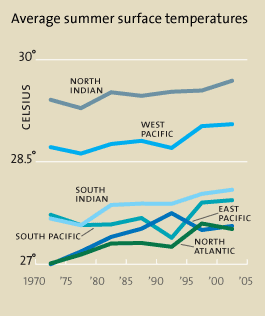
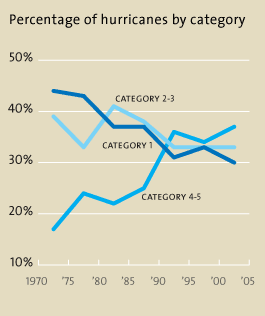
In a similar vortex of cause and effect, researchers from NASA and the U.S. Geological Survey forecast that Alaskan earthquakes will increase in the wake of retreating glaciers, triggering more tsunamis, as happened dramatically in similar warmer epochs of the past. Freed of the immense weight of these rivers of ice, tectonic stresses are released, sometimes for the first time in millennia. Many scientists also believe that a warmer ocean is making hurricanes bigger, faster growing, and stronger, with 2005’s Hurricane Wilma prompting a call for a new Category 6 on the Saffir-Simpson scale, or a new scale altogether. And because bigger storms destroy more coastal wetlands and mangrove forests, they also incidentally reduce the land’s natural buffering against storms and earthquake-generated tsunamis.
Even as we spend millions looking to space for dangerous asteroids that might threaten all life on earth, we are the asteroid that has already landed. A modeling study from the National Center for Atmospheric Research in Colorado suggests that global warming, not an asteroid strike, triggered the earth’s most severe extinction event 251 million years ago during the Permian-Triassic era, long before the dinosaur die-off. Atmospheric CO2, fueled by massive earth-building volcanic eruptions in Siberia, warmed the ocean to depths of 10,000 feet, increasing salinity, shutting down the ocean conveyor belt, and trapping oxygen and nutrients so deep that most of the world ocean became a hypoxic dead zone. With hardly any sea life left to scrub the atmosphere of carbon dioxide, global warming accelerated. In the end, the Great Dying came close to destroying all life on earth, precipitating the demise of 95 percent of all marine species and 70 percent of all terrestrial vertebrates, leaving fungi to rule the world for many an eon.
AT NO TIME IN HUMAN HISTORY has so much scientific inquiry been focused so intensively in one direction: on the anthropogenic changes in our world. As a result, we are learning more, and more quickly than ever before, about how the life-support systems of earth work. Science now recognizes that the ocean is not just a pretty vista or a distant horizon but the vital circulatory, respiratory, and reproductive organs of our planet, and that these biological systems are suffering. Much effective treatment is suggested by computer-modeling studies, which the Bush administration, with its fear of science, negates—even though computer models are the same powerful tools that enable us to put men into space, to run wars, and to forecast financial trends.
Back aboard Oceanus in the stormy North Atlantic, we’ve reached the Gulf Stream at last, where the seas have stretched out with the increased depth, easing our ride a little. Surrounded on every horizon by menacing black skies, complete with downpours and bolts of lightning, we bask for an hour or two in a spotlight of sunshine that illuminates the endless cobalt of the deep, the platinum spray of the surface. Three of us—Ruth Curry, Guy Mathieu, and I—are out on deck tending the CTD, which has just returned from its four-hour journey to the bottom of the ocean. Mathieu, a retired scientist with the Lamont-Doherty Earth Observatory, is collecting samples from the Niskin bottles for analysis of their chlorofluorocarbons—those synthetic chemicals in refrigerants and aerosols so damaging to the Earth’s ozone layer, yet so useful as tracers for measuring the timescale of movements within the ocean conveyor belt.
Curry taps the bottles for oxygen analysis, and I follow up collecting salinity samples. Although conditions are wet, rough, and slippery, we smile, enjoying our time on deck. Five hundred miles from land, we are deep inside the embrace of the ocean, and as we work, we are touching water that an hour or two ago rode the Deep Western Boundary Current 17,000 feet deep, headed for Antarctica. The sea, always a place of awe, is made even more awe inspiring by the feel of its cold, buried tides.
In late 2005 a British oceanographic team, conducting research similar to Curry’s, announced findings that the Atlantic MOC—the critical factor keeping the North Atlantic warm—has slowed by 30 percent. Although the surface Gulf Stream apparently still flows as usual, the deeper waters are undergoing massive, silent changes, with virtually all of these shifts rapidly taking place since 1998.
But aboard Oceanus, this news is still six weeks in the future, and we are happy, at least in this moment, to be at sea in bad conditions collecting good data that may well lead to bad news. The tempest around us is beautiful yet seemingly manageable—that is, until the winds, whistling steadily at 40 knots, increase sharply, ripping off the whole surface of the sea, not just the tops of the swells. The whistling grows ominously louder and splits into harmonics of deeper- and higher-pitched voices. Literally over our heads, the low-pressure storm systems have merged, and within the hour we’re running south as fast as Oceanus will go.
No one who survives time at sea is ever less than humbled by its powers over life.