Probation Profiteers
NEWS: In Georgia's outsourced justice system, a traffic ticket can land you deep in the hole.
|
|
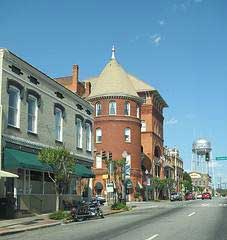
Welcome to Americus, Georgia. Located 10 miles east of the peanut farm where Jimmy Carter was raised, the town has a charming city center with broad streets, a diner that still sells hot dogs for 95 cents, a Confederate flag that flies conspicuously on the outskirts of town, railroad tracks that divide white and black neighborhoods, chain gangs that labor along the roadways, and, on South Lee Street, right across from the courthouse, its very own private probation office. Middle Georgia Community Probation Services is one of 37 companies to whom local governments have outsourced the supervision of misdemeanor and traffic offenders. It's been billed as a way to save millions of dollars for Georgia and at least nine other states where private probation is used. But to its critics, the system looks more like a way to milk scarce dollars from the poorest of the poor.
Here's how it works: If you have enough money to pay your fine the day you go to court for, say, a speeding ticket, you can usually avoid probation. But those who can't scrape up a few hundred dollars—and nearly 28 percent of Americus residents live below the poverty line—must pay their fine, as well as at least $35 in monthly supervision fees to a private company, in weekly or biweekly installments over a period of three months to a year. By the time their term is over, they may have paid more than twice what the judge ordered.
In his courtroom, which doubles as the Americus City Council's chambers, Judge J. Michael Greene issues a rehearsed warning about these additional charges, though he doesn't point out that they go to a private company; instead, he compares them to "taxes we all pay at the grocery store." When I was there in April, he admonished the African American defendants before him, "Don't fuss at the court clerks. If you do, you are going to jail. They have no more power over it than the nice lady at the checkout counter."
Carla, a 25-year-old single mother who lives in public housing, has been on probation for more than three years. "I never see myself getting off of it," she told me. "I could get off of it this year if they let the fines stay what they is and don't increase them. But every week and every month, they go up."
LOCKED OUT
Nearly 800,000 Americans are on parole. Add in those on probation, and the total is more than 5 million.
48 states prohibit prisoners from voting. 30 states also exclude felons on probation. In Alabama, Arizona, Florida, Kentucky, Mississippi, Nevada, Tennessee, and Virginia, certain ex-felons lose their voting privileges for life.
13% of black men currently have no voting privileges.
5.3 million Americans will not have the right to vote this November due to felony convictions.
In 2000, 614,000 ex-felons lived in Florida. The state went to Bush by 537 votes.
Ex-felons can be prohibited from becoming bus drivers, exterminators, dental hygienists, bartenders, cemetery managers, and nursing-care attendants.
In the 2003-04 school year, 29,000 former drug felons were denied student loans. But robbers and rapists were still eligible.
Drug felons in 18 states are permanently banned from receiving welfare.
Public housing programs can evict an entire family based on one member's past drug felony conviction.
Because the 2000 census counted Americans based on where they "live and sleep most of the time," 44,326 New York City residents were tallied as living in parts of the state where they were imprisoned. —Justine Sharrock
Carla's current case is a traffic violation, issued after she rolled through two stop signs. Judge Greene placed her on probation and ordered her to pay a $200 fine plus Middle Georgia's supervision fees. In January, she prematurely gave birth to her second child. The staples from her cesarean ripped, and she was placed on bed rest. "I couldn't even take my baby to the doctor," she says. Carla called her probation officer every Tuesday trying to report. "After a while I received a letter saying I ain't reporting or calling or doing nothing I was supposed to do. And she issued a warrant." One letter she got from Middle Georgia read, "Probation is a priviledge [sic] not a right. Probation did not levy a fine—the courts did." She was, the letter said, $245 behind. Two months later, thanks to various penalties, that amount had shot up to $525, and her total remaining balance was $690, more than three times the original fine.
By the time I met Carla, her sister had helped her get a minimum-wage job at the local dollar store. But she'd stopped contacting Middle Georgia because she feared going to jail (and losing her kids) if she showed her face. Her friend Erica, who also has a warrant out because of probation fees, told me she worries every time she goes outside. "You be scared to walk to your mailbox, because that's what the law do—they ride around and try to find you. You're scared to look for a job. But unless you get a job you can't pay your fine. So either way, you're just stuck."
IDENTITY THEFT
A MISSING ID IS OFTEN A TICKET BACK TO THE PEN.
for new parolees hoping to stay out of prison for good, scoring public assistance is crucial. But few consider this obstacle: "You can't get ID in this society anymore if you don't have ID," says Amy Blank, a researcher at Rutgers University. "If you want a birth certificate, you need a driver's license. If you want a driver's license, you have to have a birth certificate and a Social Security card. And to get a Social Security card, you have to have a driver's license. It's this crazy cycle."
While studying a Philadelphia program that helped mentally ill ex-inmates transition back into the community, Blank found that virtually none of the 60 ex-cons she followed had IDs—the cards were either ditched during arrest or simply lost in the system. As a result, they had to wait weeks, sometimes months, for welfare checks, food stamps, and Medicaid benefits as they were bounced between government offices—a "brutalizing process" mentally ill parolees would be hard-pressed to negotiate alone, Blank says.
It's not getting easier: In May, provisions of the Real ID Act set stricter documentation requirements for state-issued IDs, and Medicaid enrollees must now prove identity and citizenship. Prison authorities could create IDs for ex-offenders, Blank says, but some are wary since inmates can be booked under false identities. As a result, "these people are going back to using drugs, living on the street, engaging in prostitution—crimes that are about their survival—because it just took too long." —Michael Mechanic
No one at Middle Georgia returned my calls, so I stopped by the company's Americus office; there, I watched a female probation officer instruct a toothless man about the additional fees he needed to pay for improperly storing scrap tires at his auto shop. "Y'all know this ain't right," he shouted. "You railroading me!" Eventually, another Middle Georgia employee noticed me. I told her I was a reporter. "We don't talk to reporters," she said coolly.
Middle Georgia, along with the rest of the state's private probation industry, owes much of its business to Bobby Whitworth, who was Georgia's commissioner of corrections until 1993, when a sex-abuse scandal involving female inmates forced him out. Gov. Zell Miller promptly reassigned him to the Board of Pardons and Paroles, which positioned him nicely for a side job consulting with a private probation company called Detention Management Services. Three years later, in December 2003, a jury found Whitworth guilty of public corruption for accepting $75,000 from the company to draft and lobby for legislation that dramatically expanded the role of private probation companies. Whitworth was sent to prison for six months, but the law remains on the books, and the private probation industry—led by Georgia's two most powerful Republican lobbyists—has lobbied to be given felony cases as well. That plan has run into opposition from law enforcement: One sheriff told lawmakers last year that among his peers, private probation was seen mostly "as a moneymaking fee-collection service." Another said there is generally "not a lot of emphasis on supervision as much as there is on collection."
Lawrence Holt, a thin, 24-year-old African American man, is a supervisor at a mattress factory in Americus. He's held the job for three years, but lives in the projects and, like every member of his family before him, hits the bottle hard. He's been on probation since November, because of an arrest for driving under the influence a few days after his brother died of diabetes. By April, he had paid his original $600 fine, but had $645 to go to cover Middle Georgia's fees. He told me he wouldn't mind paying if his probation officer would only help him get treatment. "I throw up blood," he said. "I just can't stop drinking because I got so many problems in my head. I have asked, 'Can y'all find somebody to help me with my alcohol problem?' 'Sir, we can't do that. We don't do that.'"
1 in 2 federal prisoners is doing time for drug charges.
"These are not cold, hardened criminals," local naacp chapter president Matt Wright, a 57-year-old caterer, told me. "These are just people struggling, trying to make it. The probation officers know it's hard for a poor person to come up with that money. They trick 'em into getting back in the system. They go back before the judge and the judge fines them again, puts them on probation again. And the cycle repeats itself."
PREVIOUS: The Kansas Redemption
NEXT: Immigration Detention Boomtowns
Celia Perry is an assistant editor at Mother Jones.

The locals refer to prison as "chain gang" and indeed, the chain gang system was designed to re-enslave newly freed blacks in Georgia and other parts of the south. Probation is part of the system that continues this tradition by setting unrealistic requirements for payment of fines, maintenance of a dwelling anf procurement of approved employment for individuals who are homeless for all practical purposes. One young man came through here 2 months ago after serving a short sentance in the northern part of the state. He had procured employment through work release and a commitment for transitional housing. But since he committed his crime here in SW georgia, he was required to quit his job and move back here. No family. No support system. No jobs. He is waiting to be violated so that he can be sent back to prison and hopefully won't receive probation. The whole system seems to me a trap to keep warm bodies flowing through the courts, jails, prisons chain gangs of the state. Yes, America eats its young.
Debt slavery has control of most American lives at this point in our history. We are accepting the most egregious violations of the social contract as normal. We will never unite to throw off the yoke because we are conditioned not to admit the country is corrupt from the White House down.
We can not have institutions running the country whose only concern is profit.
When faced with a choice, corporations are mandated by law to choose the course of action that makes the most money.
Profit vs. Sympathy - Profit wins
Profit vs. Environment - Profit wins
Profit vs. Community - Profit wins
Profit vs. Morality - Profit wins
Profit vs. Sustainability - Profit wins
How much longer are we willing to tolerate this? At what point will we collectively wake up and realize that this is a flawed, corrupt system that must be destroyed.
1. Soap
2. Ballot
3. Jury
4. Ammo
I can see how the people are justified to go to step 4 in this case.
Scabs on societies ass, one and all.
Control yourself or someone else will.
If this is the norm in your area demand that your county officials, when they bid out these contracts, include clauses to cover such situations. Sliding fee scales, treating all people with respect and dignity, and doing their jobs - working WITH people. I am sorry that there are so many bad experiences with such businesses, this should not be the norm. Maybe standards would help, require college degrees, like my firm does, and so many years of experience. Sad! It really is.
The situation in Georgia is nothing but loan sharking, pure and simple, which used to be a crime in this country, but apparently is now regarded as a virtue and a business opportunity.
I have seen the dysfunctionality and abuses going on in the "Prisons for Profit" sector of the economy, not that the old system was any better. Problem here is it is the weakest, most vulnerable segment of society that has to deal with the "system," so who cares?
Are we as a society eating each other alive, particularly the most disadvantaged members. You bet, buddy. Ever ask yourself why a speeding ticket can be as high as $250-$300? Of course, everyone speeds, and anyone that tells me they don't, I will call a sure liar. Apprehension becomes a random lottery system for municipal income and jobs for people like you. The same is true for eighty percent of the DWI convictions, only those are incredible cash cows, literal bonanzas, to be milked for all they are worth. And are, no matter how minor or silly the violation. Just contemplate all those bars everywhere you go with all those big parking lots. There must be a helluva lot more disignated drivers running around than I thought--if not, just random vicimization and extortion.
Sorry, Jim, I really don't like people like you.
I am truly sorry that you feel that way. Privatization has saved governments a fortune and usually operate better, providing better services, and much more effectively. Of course those are studies that have been conducted by univesities and governments, organizations you may not trust. Furthermore, we, all probation services doing their jobs right, can help people turn their lives around, Not all persons have a positive roll model or had anyone that could help thme establish or pursue their goals. While I do agree that a speeding ticket that with fines of 250 - 300 is high, you are right, we all still make the CHOICE to speed. However, I must disagree with you about the DWI's, and I am sure the millions who have lost loved ones because of a drunk driver, would disagree as well. But, no need for apologizing to me for not liking people like me, which only shows how narrow minded you are as you know nothing about me but that I choose to make make a living helping people, because I do not like negative, closed minded, pessimistic people as you.