They are the images the government doesn’t want you to see — of soldiers returning from “Operation Iraqi Freedom,” wounded for life, physically and emotionally. Many are in their late teens and early twenties. They are double-amputees, paraplegics, burn victims, depressives.
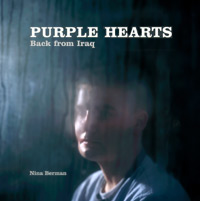
Every day we hear of soldiers killed, and more injured, in Iraq. Yet we see very little of them. Last spring, Nina Berman, a New York-based photographer, decided to take action. She scoured the country, from Prichard, Alabama to Santa Ana, California, interviewing and photographing soldiers, and documented the human costs of war. In her recently published book, Purple Hearts: Back from Iraq, Berman collects her portraits and interviews with soldiers to capture the ongoing war in Iraq in a simple, blunt — and shocking — language.
“I’ve been a photographer for many years and I did this book because I want people to see these pictures,” Berman explains. “As a journalist and as an American living here I feel like there’s something that I must be able to contribute that isn’t being done. I was too young to do anything during the Vietnam War but if I don’t do something during this war then I’ll just feel like I’m as bad as everybody else.”
Some of Berman’s photos appeared in the March/April issue of Mother Jones. Her photo essay, “The Damage Done”, drew an enormous response from readers. Headed to New Mexico for a book tour with wounded soldiers and their families, she talked with MotherJones.com about the war, yellow ribbons, America’s violent youth culture, and the “dirty little secrets” of the Iraq war.
MotherJones.com: Why did you decide to photograph wounded soldiers?
Nina Berman: In the summer of 2003, I kept hearing all these news reports about soldiers being wounded, but I never saw any images on television, or in newspapers, or in magazines. So I felt a responsibility to show a more realistic picture of the war. There are actual casualties, soldiers are being injured, and some of these injuries are really serious. The American public needs to see this.
MJ.com: How did you find returning soldiers?
NB: There are no lists of wounded soldiers that I know of, so I went on Google and just plugged in words — like “amputee,” “leg,” “arm,” “wounded,” “brain damage,” and “local hero comes home” — and I found local newspaper reports about wounded soldiers returning home. From there, I looked to see if they listed a name of either a politician or someone I could call to get the soldiers phone number.
I really wanted to get a number of soldiers from around the country. I didn’t concentrate on one geographic region. Some I photographed at Walter Reed hospital while on assignment for Time magazine and two from a military base in Fort Riley, Kansas. The rest, expect for one or two others, are photographed in their homes.
MJ.com: How have critics responded to Purple Hearts?
NB: Well, I get feedback on the website — www.purpleheartsbook.com — which gets a couple thousand hits a day. Of those, I have received only two negative responses. Most people, from a wide-range of the political spectrum, are glad to see these soldiers recognized. That was my intention and I wanted soldiers to tell their own stories so that someone could not dismiss Purple Hearts as an anti-war book or a pro-war book. It’s important to just let the soldiers speak for themselves.
MJ.com: Were you surprised by some of the soldier’s positive reactions, given the considerable physical and emotional damage they suffered, to the war and their experiences in Iraq?
NB: I expected bitter soldiers, but as I talked to more people and family members, I realized that wasn’t really the experience of a wounded soldier returning home. Most of the soldiers I photographed had literally just been released from the hospital. They’re still in shock. For them to turn around and say, “I’m blind” or “I don’t have any legs” and then think that it wasn’t worth it — that’s a very hard leap to make. So I expected more bitterness and the pictures reveal soldiers who look quite lonely and almost in a state of shock.
MJ.com: How did you conceive of the layout of the book? Why did you use the black and white statements alongside small and large pictures of each soldier?
NB: Well, I wanted the reading of the book to be a sobering process. The first soldier shown, Jose Martinez, says that he’s the “perfect picture of the Army” and then the picture shows him so horribly burned in the face and you cannot believe this is possible. The pull quotes kind of pit you down one road and, after flipping the page, you go down another road. The book is meant to be complicated and complex, and not just a simple quick look at war and its result.
MJ.com: When Jose Martinez says, “I’m this great picture of the Army,” what struck you about that statement?
NB: When he said it, near the end of the interview, I felt a great deal of denial in his voice. Earlier he had said that he was glad this happened to him, because he had previously relied on his physical appearance and other superficial things — whereas now he’s realized that what’s inside of him is what’s important. But, you know, Martinez is 20 years old, and I can’t believe that this lesson makes it all okay for him. I feel it’s his way of finding something good out of something horrible.
The perfect picture of the Army is something different. Martinez, like many soldiers I spoke with, really wants to stay in the Army. This is all they know and their short time in the Army is their first adult experience in the world. They had jobs, they had routines, and they were usually pretty good at their jobs. For a wounded soldier it’s all taken away from you. Not only are you wounded, and your life completely changed, but you also don’t have the Army structure and the so-called Army family that many soldiers become attached to.
MJ.com: Most of these soldiers are in their late-teens and early twenties. What expectations did they have joining the U.S. Military and what are their future expectations as wounded soldiers?
NB: Well that’s interesting because when you spend a long time with them, some bitterness comes out now and again. Almost all of them have had difficult experiences completing their discharges. This is a massive bureaucratic problem for soldiers, and it’s critical to make certain they’re compensated fairly. What happens is they get wounded and sent to a hospital, usually to either Walter Reed or Brook Army, and begin the process of trying to get discharged. If you’re really wounded — a quadriplegic, a double-amputee or totally blind — you’re not a deployable soldier and you should be discharged. But I just spoke with a soldier yesterday who’s waited a year to get medically discharged. This is a major difference for wounded soldiers. If you’re not medically discharged you still get paid a crappy substandard soldier pay, whereas once you’re medically discharged you become a disabled veteran and begin collecting some actual benefits. These guys are stuck in the system for months and months and months, and all of them are quite frustrated by this. If the military were smart they’d get their act together because it leaves a sour taste in soldier’s mouths.
I asked them all what expectations they had had about the war, and a lot of their answers were really shocking. One soldier said he thought it would be fun, that he would be jumping out of planes. A couple of soldiers said they watched Desert Storm on TV as kids and thought it looked really cool. One soldier watched war movies as a kid and said American soldiers were always treated “awesome” in the world. He’s saying this and he doesn’t have a leg. That’s how “awesome” he was treated.
I also started asking them how they defined freedom and democracy, and some couldn’t even answer the question. For Jose, freedom was about being able to play video games or go to the movies. It was striking how simple these responses were, for soldiers being told that they were going to Iraq to liberate the people and bring them freedom and democracy.
MJ.com: What do the soldiers think when Americans say that “I’m against the war but I support the troops”?
NB: Well, I would really side-step political questions about whether they were in favor of the war or not because when I asked that question most soldiers tended to give robotic responses, saying: “I’m a soldier and I have no political feelings.” One soldier, though, whom I met at Walter Reed, said to me, “Look, whatever the book does or whatever you do, just make sure you say that people support the troops.” So I’m not sure what they think it means. I think, for me, the banner “support the troops” is an almost meaningless expression. I saw that banner all over the Republican convention, but then you see Veterans Affairs (VA) benefits getting cut, or you talk to soldiers who don’t even have appropriate equipment. So I don’t really know what “support our troops” means. If you really want to learn about the war and support the troops, head to the local VA and learn about the war and support members of Congress who are going to fund the Veteran’s Administration — instead of just putting a banner in your window or wearing a yellow ribbon.
MJ.com: That reminds me of what Spc. Robert Acosta, a twenty year-old soldier from Santa Ana, California, said about how Americans “watch action movies and glorify all of this stuff.”
NB: Right, Robert Acosta was probably the most articulate in the book. He’s become quite an activist. He recently appeared in an ad working with this group called Operation Truth and this morning, we were on the radio together. Since I met him, he’s made quite a substantial leap in his thinking about the entire war.
MJ.com: What influenced that transformation?
NB: I asked Robert about it the other day, because he was a very rare unguarded soldier and he gave me a lot of hope when I met him. When I first spoke with him, and started talking about politics, he remembered being one of those military kids who was worshipped as a hero, one of those kids who just used to say, “I’m a soldier and I have no political feelings.” But I asked him what changed and basically, when he was injured, the military tried to screw with him. First they wanted to make him a hero, giving him a bronze star for his injury [a grenade was thrown into his Humvee near Baghdad International Airport and he lost his right hand and use of his left leg]. But then they turned around and decided that his injury was his fault. He felt incredibly betrayed. They tried to say he shouldn’t have been in the Humvee in the first place and he saw, first hand, the military hypocrisy at work and that started changing his thinking.
MJ.com: Do these soldiers feel their voices and situations are acknowledged in the mainstream press?
NB: All the soldiers wanted to participate in my book because they felt like their voices weren’t being heard. Some soldiers have been on TV. For example, Martinez is still living pretty much at Brook Army hospital so when they get a public relations request, they put Martinez out there. Jeremy Feldbusch, who is now brain-damaged and blind, works with the Wounded Warriors project and speaks on television shows. But, in comments on the website, people seem surprised by these images and that’s something I have a hard time understanding because, man, here we are 18 months into this war and these images should be commonplace by now. When you have almost 8,000 injured in combat and another 15,000 or so injured in combat support, you should be seeing these images all the time. You look at Time magazine, which funded part of this project, and they have really only produced one story on wounded soldiers.
MJ.com: How did the soldiers react when it become known there were never any weapons of mass destruction?
NB: It was interesting. Two soldiers that I talked to seemed to buy into the whole reason for war. Then I asked them about WMDs, and their entire thinking changed and you could see their brain flip. Lt. Jordan Johnson, the one woman in the book, said it was a major disappointment because she supposedly had a mission and that mission was based on something that did not exist. And one soldier, Corey McGee, who had a rough trip stationed in Fallujah, said he bought into the whole 9/11 and Iraq equation. But when I asked him about WMDs, he said it makes you wonder if everything else they say is even true or not. I felt that, in many ways, I was the first person who talked with these soldiers about the broader issues of the war. Their whole understanding of the war, and how they process their injuries, depends on how much information they have access to and whom they talk to.
MJ.com: Did any of the soldiers talk about the Vietnam War?
NB: One soldier, Sgt, Josh Olson, who’s an amputee up to the hip, had relatives in Vietnam. He had the view that U.S. hands were tied in Vietnam and that we should have finished the job. He was also very hard-core about the war in Iraq, saying we’re going to have to kill a lot of people and “if they want to go to Allah, I’m going to send them to Allah.”
What I found, though, is that Vietnam Veterans are very interested in these sorts of soldiers. Purple Hearts‘ afterword is written by Tim Origer, a Vietnam veteran who returned from Vietnam at 19 as an amputee, works with Veterans for Peace and is making contacts with these soldiers. Many Vietnam vets are super, super upset about this war. They identify with these wounded soldiers and basically see the whole nightmare unfolding for a second time.
MJ.com: I want to ask you about the book’s afterword. Tim Origer writes that books like Purple Hearts “can awaken [our contemporaries] from their comfortable and complacent dreams.” Do you think Purple Hearts can have this type of impact? What else needs to emerge to change the culture of war?
NB: Well, for me, it comes down to basically two things with this book. One is let’s start getting a real look at war. If you want to start sending your sons and daughters to war then don’t have this cartoon version of what is going to happen to them. You know, they are not going to be action heroes coming home in a blaze of glory. So let’s face up to that. That was a really important reason for me to do this book because to me we’re all kind of complicit in this experience here.
And the second thing is that I hope the text gives people a little bit of an understanding of the kind of youth culture that exists in America, and what these youths know, what they don’t know, and what they imagine about the rest of the world. A lot of these soldiers come from very poor communities and the Army was the only thing out there. The Army recruiters are in their school every week, while corporate recruiters never enter these schools. The only people that are showing up in these high schools are Army recruiters in snappy uniforms with smiling faces.
I just got an e-mail off my site from this couple in Hawaii saying what can I do, the recruiters are coming to the school all the time and taking away all these children. I also made a ten-minute movie — which records these soldiers in their own voices — and I hope to get this movie shown in public schools. That’s what I’m hoping to do, that’s the next round.
Basically, I’ve been a photographer for many years and I did this book because I want people to see these pictures. As a journalist and as an American living here I feel like there’s something that I must be able to contribute that isn’t being done. I was too young to do anything during the Vietnam War but if I don’t do something during this war then I’ll just feel like I’m as bad as everybody else.
MJ.com: Who’s the most compelling figure for you in the book?
NB: Well Acosta is amazing and so thoughtful because he is the only one who talked about the confusing emotions when the enemy gets hurt and what that does to you. Tyson Johnson is important because his situation is just so bad. I keep in touch with him and his mom. His house was destroyed in the hurricanes last month and he’s just been screwed over so badly. And Sam Ross, who is blind amputee living alone in a trailer.
MJ.com: What happened with Tyson Johnson and his National Guard $2999 bonus pay?
NB: Basically, he was in the National Guard and received a bonus for joining the regular Army. He then suffered massive internal injuries and became 100 percent disabled and, therefore, could not fulfill his three-year contact. His credit report shows he owes the government back all this money, so he was deemed a credit risk when he tried to rent an apartment. Supposedly this is being sorted out for him. ABC did something on Tyson last week and they interviewed some three-star General, who said they would fix it, but I talked with Tyson a couple of days ago and it still hasn’t been fixed. But you know the bottom line is that he lives in this crappy town, away from anyone to advocate for him. And these soldiers don’t know how to advocate for themselves. They’re taught to take orders and not challenge and question authority, and this makes it really hard for them, especially if they are in pain twenty-four hours a day, which many of them are.
MJ.com: What about the rhetoric around troops that politicians use in campaign rallies and commercials?
NB: They say, “support our troops” or they show up at a veteran’s parade and that’s it. Or, like Acosta says, they show the war and America changes the channel. For me, the best possible solution is to humiliate politicians publicly, because that’s the only way I can figure out how to make them move.
MJ.com: Are there any similar projects underway that attempt to document the considerable number of Iraqi casualties and injuries?
NB: The only one I know about, and maybe a little off subject, is a short movie about what happens to soldiers who’ve killed someone in combat. Because that’s the thing nobody wants to talk about. And if you want to find a soldier who has post-traumatic stress, it’s not so much the one who saw his buddy killed; it’s the one who did the killing himself. I don’t get into that too much in the book but it’s something as a country that we should start talking about. Because when you send 19 year-olds to Iraq and they kill a bunch of people, what are they supposed to do when you send them home?
That’s why I think matching up Vietnam vets with these Iraqi vets would be a really great thing. When soldiers say only other soldiers can understand, that’s what they’re talking about: what it means to kill. It’s not just the guys with the guns that are killing in Iraq, it’s the truck drivers who are coming back really messed up because their orders are to run over anything that doesn’t get out of the way. In a country with a big urban population, with lots of children, they are running over children. That’s the dark dirty little secret that people don’t want to talk about. Here are our wonderful innocent liberators over in Iraq killing people. Not just bad people, but all people.