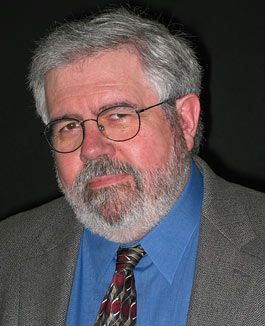
David Cay Johnston is one of the few people in the United States who’s exposing the American tax code for what it is: backwards socialism. As a Pulitzer Prize-winning tax reporter for the New York Times, Johnston has, over the past nine years, uncovered the inner workings of a system that coddles, aids, and abets the rich in their various attempts to get out of paying taxes, forcing the upper-middle, middle, and working classes to pay for government on their own.
As Johnston showed in his book, Perfectly Legal: The Covert Campaign to Rig Our Tax System to Benefit the Super Rich—And Cheat Everybody Else, few people have really closely examined the intricate loopholes, devices, dodges, and shelters that allow corporations and superrich individuals to pay shockingly little in taxes. Sometimes even the IRS can’t decipher the most complex tax-dodging schemes, and few journalists have the knowledge needed to cover the tax beat adequately.
As a result, most Americans remain unaware of the ways in which the wealthy cheat the system. And often, even when the public—and Congress—does become aware, nothing happens. Corporations and the superrich can continue to use tax dodges long after they’re made illegal because tax law enforcement is so badly underfunded. Congress routinely cuts funding for tax auditors to save money, although as Johnston explains, the result is that the government often loses more revenue in uncollected taxes than it saves by firing IRS employees.
Johnston’s book clearly shows that if Americans want a genuinely progressive tax system, one in which people pay what they can afford for the benefit of society, the current setup simply cannot continue. Johnston recently sat down with Mother Jones to explain why.
Mother Jones: You write in your book that we have what amounts to a flat tax in this country—that the rich pay the same percentage of their income in taxes as the poor do. People would be very surprised to hear that. How do you figure?
David Cay Johnston: Politicians like to talk about the income tax when they talk about overtaxing the rich, but the income tax is just one part of the total tax system. There are sales taxes, Medicare taxes, social security taxes, unemployment taxes, gasoline taxes, excise taxes—and when you add up all of those taxes [many of which are quite regressive], and then you look at how they affect the rich and the poor, you essentially end up with a system in which the best off 20 percent of Americans pay one percentage point more of their income than the worst off 20 percent of Americans.
MJ: Explain how people defer taxes. Your book shows that deferrals are one of the key ways in which the very wealthy avoid taxes.
DCJ: We have two tax systems in America. One is for wage earners. The government takes money from them out of each paycheck—so it knows exactly how much they make, and as a result, those workers can’t really cheat to any significant degree. But the other tax system is for capital. Those with capital get to tell the government what they want to tell the government. They may get audited, but if their tax returns are of any size or complexity the government doesn’t have enough of the smart auditors needed to figure out what’s really going on. And there are all these special rules that allow you to do things like take in money today and pay taxes on it thirty years from now. That’s a deferral and it’s very common.
MJ: You mention in the book that Congress has handcuffed the IRS to keep it from investigating tax loopholes used by what you call the “political donor class.” But you also mention that the IRS misappropriates its resources, frequently auditing people, often the poor, who try to stretch their tax deductions by some small amount.
DCJ: The bad actor here is Congress. Congress is supposed to fund the IRS, and it has been steadily reducing the number of auditors and tax collectors the IRS has at the very time that the tax system has become vastly more complicated. And of course the country continues to grow, so there’s an increasing number of tax returns coming in. The IRS responds by doing exactly what Congress expects of them. That shouldn’t surprise anyone. All bureaucracies do what they are told.
MJ: There are some pretty scandalous examples in your book of the IRS’ inability to go after tax cheats. For example, some people took out a full page newspaper ad broadcasting the fact that they didn’t believe in filing taxes, and hadn’t done so, and nothing happened.
DCJ: Eventually, after I wrote seventeen articles in the Times and sat in the IRS Commissioners office and had sharp words with him, they finally started indicting those people. They have tried eight people, so far, and they got convictions for all but one. But it took years of relentless coverage.
If someone ran an article on the front page of the morning newspaper saying, “Here are the addresses of the ten biggest drug dealers in city,” you can confidently know that the police are on their way to, at the minimum, roust these people. But the IRS did nothing in response to the initial report in which I gave them a roadmap to these people. And that’s because they pick almost all their investigative targets based on what the computer tells them. So if you don’t file a tax return, or you file one that appears to be normal—you say you made $90,000 and you have normal sorts of deductions, when in fact you made $50 million—the computer won’t identify you.
MJ: You mention many times in the book that the IRS was alerted to a tax shelter or a tax dodge by one of your articles. How much would you estimate you’ve cost potential tax cheats over the course of your career?
DCJ: A committee in Congress calculated the value of two of the tax dodges I exposed. They were valued at $262 billion over ten years. And that’s just two of them. But of course, after I expose a tax device in the Times and it gets stopped, there is a whole industry of incredibly smart, highly-paid people who immediately say, “Okay, let’s go find another one.”
MJ: Are there any members of Congress who have both the courage and knowledge to fight for fairer tax laws?
DCJ: Oh, sure. There are a lot of politicians who want to do this. But they run into this falsehood that has been inculcated into a lot of Americans—that a progressive income tax is some kind of lefty scandal. Progressive tax of any kind is the most conservative principle in western civilization. Indeed, it is the very principle upon which democracy began in Athens 2500 years ago: Those that get the greatest economic benefit from living in a civilization should bear the greatest burden of maintaining that civilization. Now that’s not to defend the current system we have. It is a complete and indefensible mess, and so there are people who want to fix it. But you can’t fix it if everyone sees these things through a lens that’s based on a lie.
When you say the tax system benefits the rich, there are a lot of people who respond, “That can’t be true, look at the rate of tax. The people who are rich pay a higher rate than you or I.” Well, yeah, but if you don’t have to pay taxes on a lot of your income, then your real tax rate is a lot lower. And if you’re allowed to pay your taxes thirty years from now instead of today then you’re a lot better off. People need to have a sophisticated understanding of how the system works to appreciate that the posted tax rate really has very little to do with the taxes people pay.
MJ: You write that the increased flow of capital and goods around the world creates opportunities for tax evasion, because, among other things, corporate profits can be transferred to off-shore subsidiaries that don’t pay American taxes. What are the implications of globalization on American tax policy?
DCJ: Let me give you some numbers. In 1990, about 1 percent of American corporate profits were taken in tax havens like the Cayman Islands. By 2002, it was up to 17 percent, and it’ll be up to 20-25 percent very quickly. It’s a major problem. Fundamentally, we have a tax system designed for a national, industrial, wage economy, which is what we had in the early 1900s. We now live in a global, asset-based, services world. And we need to have a tax system that follows the economic order or it’s going to interfere with economic growth, it’s going to reduce people’s incomes, and it’s going to damage our country.
MJ: For all your criticisms of the system, you don’t come across in the book as an opponent of taxes.
DCJ: I dislike paying taxes as much as anyone, but yes, taxes are the price of civilization. There is no America without taxes. The question isn’t, “Do we want to have taxes?” The question is, “How heavy is the burden, and who bears that burden?”
MJ: Large corporations seem the most adept at avoiding their share of the burden.
DCJ: That’s correct. Sixty-one percent of large corporations paid no federal income taxes for the five-year period from 1996 to 2000, according to the Government Accountability Office, the investigative arm of Congress. The companies that pay the least tend to be capital-intensive and multinational.
And the tax code is totally skewed toward multinationals. When researching this book I started talking to local businessmen in Rochester, New York, and they told me stories about their dealings with the tax code. And one of things that emerged from it was that the tax code would favor multinational competitors against them. Some of them started opening up factories overseas because their tax advisor said, “You’re going to get killed by the system.”
What do members of Congress talk about all the time? They talk about the family businesses and the small businessmen they are trying to help. They are screwing the small businessman. And they are helping the multinationals because guess what, that’s where the campaign money comes from. You don’t get that money from Joe Sixpack who works in a factory and you don’t get that money from the bourgeois businessman who is a fundamental force in stabilizing your local community. You get it from big corporations.
MJ: Explain how multinational corporations manipulate the system to pay little to no tax.
DJC: That’s easy. They do it simply by having rules in place that allow them to do some fundamental things. First, they get to reach forward. I’m talking about deferrals. You, as a wage earner have to pay your taxes every year on your income for that year. So if you have a one-time windfall that makes you a lot money you could end up in the top tax bracket. But if you’re a corporation you are allowed to reach forward with deferrals for years. Over a 45 to 50 year period, you can balance out the winning years and the losing years in such a way that you pay very little tax, especially considering the time-value of the money.
Another good example is that senior executives can, after a fashion, get a portion of their pay tax-free. You defer part of your income and not have to pay taxes on it, and then when you retire you have the company buy a life insurance policy on you using that money. The company can deduct that money because it is a business expense, and the money will get paid out to your children or grandchildren when you die, so you have effectively given them your money and it’s never been taxed.
The tax code is full of these devices and immense amounts of money are spent on figuring out how to use them. This is all unbelievably complicated. I was at my desk at the Times a number of years ago trying to figure out a tax shelter and I had a sheet out with letters on it and an editor came by and said “Are you doing Algebra? What are you doing algebra for?” I said, “I’m trying to figure out how this tax shelter works. And you need algebra to get the logic of it.” And he said, “We’re a newspaper, we don’t do algebra!” [laughs] And the truth is, if we’re going to understand this stuff, we need algebra. And I was doing very simple algebra to understand the principles of the deal. The inner workings of that deal involved hundreds of pages of complexity. So even if the IRS found out about this deal, I’m not sure they could understand it.
I broke the story that Enron did not pay taxes because of all the offshore devices they had. Afterwards, the Senate Finance Committee did an enormous investigation of Enron and published a 1600-page report on it. One of the key findings was that Enron’s tax shelters were so complicated, the IRS was not capable of understanding them.
MJ: What country has a tax code we could use as a model?
DCJ: The British use a system where the profits a corporation reports to shareholders is what they pay taxes on. Whereas in America we require corporations to keep two sets of books, one for shareholders and one for the IRS, and the IRS records are largely secret. For publicly-traded companies, the British system would tend to align the interests of the government with the interests of the company because the company wants to report the biggest possible profit. Fundamentally, though, all wealthy countries have high taxes because wealth requires lots of common goods, from clean water to public education to a justice system.
The important issues are the principles they figured out in [ancient] Athens–that the greater the economic gain that you derive from living in a society, the greater the burden of the taxes you should bear. Because if not for that society you could not become wealthy. We live in a society that is all I, I, I, I. That’s the culture of the CEO. I did this, I did that. I should get one-third of all the stock options in this company I lead with 37,000 workers because I got them to work so hard.
But the fact is you didn’t do it, 37,000 people did it and you steered the ship. We need to realize in our tax system is that we are a society. This libertarian idea that says, “I’m responsible for everything that happens to me”—no, you aren’t. Taxpayers educated you, taxpayers paid for the clean water that kept you from dying when you were a child, society created the peace that allowed your business to thrive. The tax system is how we distribute the burdens of maintaining that society.
What has happened is very, very wealthy people have looked at the system and decided that they can co-opt it. They figured out that ordinary Americans are so busy working to support themselves or paying attention to Paris Hilton and Jennifer Lopez and baseball that nobody will dig in to see how they made the system work for them. And I don’t fault them for that, there is nothing wrong with people advocating for what they want from their government. The problem is when nobody pushes back.