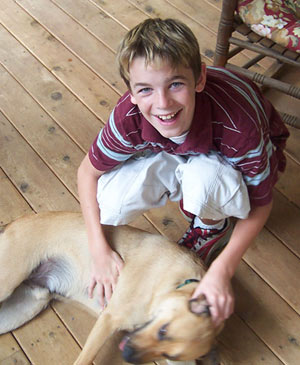
Photo of Joe Teater provided by the Teater family
Behind the wheel and busy on her cell phone, Holly Jo Smeckert didn’t slow down as she neared Knapp’s Corner, a busy intersection in Grand Rapids, Michigan.
It was January 19, 2004, and the 20-year-old nanny and Sunday-school teacher was taking her young charge to dance class in her employers’ Hummer. Smeckert was so absorbed in her call that she noticed neither the red light nor the line of cars stopped in the adjacent lane awaiting a signal change. Traffic flowed through the intersection in front of her, but that didn’t register either. Without even touching the brakes, she blasted through the light at 45 miles an hour, slamming into a Chevy Suburban and pushing it 120 feet—over a sidewalk and onto a patch of snow.
The other driver, Judy Teater, wasn’t badly hurt, but Joe, her 12-year-old son, bore the full impact. He was unconscious, his breathing wet and gurgling. Judy, a former nurse, struggled to clear an airway. An anesthesiologist pulled over and tried mouth-to-mouth, sucking blood from Joe’s lungs and spitting it onto the snow. A neighbor of the Teaters who had witnessed the crash called Judy’s husband Dave in near hysterics; he arrived in time to watch emergency crews extricate his son, and then rode with Joe in the ambulance.
The boy never regained consciousness. Doctors ran tests but found no sign of brain activity, so the Teaters gave their permission to take their son off life support and harvest his organs. Joe’s death was a big local story, and hundreds of people turned out for his funeral.
Dave Teater is tall and husky, a former small-college football player who, at 52, still looks fit. He was an early cell phone adopter himself, driving around in the late 1980s with a big, clunky one bolted to the console of his car. Back then, he ran an auto industry consulting firm and commuted about once a week between Grand Rapids and Southfield, near Detroit, a horrendous five-hour slog. His mobile filled the time and made him feel productive. Dead zones limited its utility at first, but as the network grew Dave found he could do conference calls while zipping along I-96. He’d hang up after a half hour, not knowing which side of Lansing he was on. A bit of foreshadowing, perhaps, but he didn’t give it much thought until…Joe. Dave would later take up the cause of preventing more such deaths, and join a company that has pioneered cell phone safety technology. But for a time, he was too overwhelmed to do much of anything.
Joe was the youngest of Dave’s three sons, and they were unusually close. Before he was born, Dave was preoccupied with his successful business. He also drank too much and, in his own eyes, fell short as a husband and father. Had he not joined AA and gone on the wagon, the Teaters would never have had their third child.
A cute kid with a million-candlepower smile, Joe had been counting down to his 13th birthday—and directing people not to call him “Joey.” The day before the crash, Dave took him to the Detroit Auto Show, and then Greektown for lunch. Joe told his dad he needed to learn to like Greek food, because he was going to be an archaeologist, and “Greece is a real important place for archaeology.” But Joe also struggled with attention deficit disorder. He was on the way to math tutoring when it happened.
In one unimaginable instant, the Teaters lost what they thought of as an almost perfect family life. Dave and Judy pretty much fell apart. Dave had never before wept from grief as an adult, but now tears came often. On the advice of a counselor, he kept a journal and poured out his despair. At times he felt envy for older people nearing the end of their lives. After a while, he became the volunteer director of a residential alcohol-treatment center. It helped to be involved with other people’s problems, yet when his thoughts strayed from the loss of his son, he felt twinges of guilt. Compelled to drive past the accident site regularly, the Teaters sold their home and moved to a nearby town.
The crash sequence seemed equally incomprehensible: Smeckert had clear skies and good visibility. She was sober. And yet she had failed to process a whole string of visual cues. To Dave Teater, this made no sense at all—so he began to do some research.
The volume of scientific literature on cell phones and driving surprised Teater. He found studies that described gabbing motorists as driving impaired. Researchers had even coined a term—”inattention blindness“—to describe how a phone conversation could seize the mind like a tractor beam, dulling reaction times and situational awareness, particularly when the topic was complex or emotionally fraught. Paul Green, an engineering professor at the University of Michigan’s Transportation Research Institute, likened the mental demands to those of circus jugglers spinning plates on the ends of sticks. “You’ve got so much information from the roadway, and so much information from the phone, that it’s just too much to deal with,” he said.
A pair of studies in Canada (pdf.) and Australia concluded that talking on cell phones quadrupled a driver’s risk of being in a crash. Researchers at the University of Utah tested 40 drivers in a simulator, monitoring responses to things like a car suddenly braking in front of them; the test subjects performed no better, and by some measures worse, while talking on a cell phone than they did with a blood alcohol level of .08 percent—legally drunk (pdf.).
Teater also learned that major corporations—including ExxonMobil, DuPont, and Shell—were so concerned about safety and liability that they banned on-road use of cell phones by their employees during work hours.
Why, he wondered, hadn’t he heard about these things? Was everyone this ignorant? The thought made him angry. Holly Smeckert didn’t seem like a bad person—her life was probably ruined, too. And had she been aware of the dangers, Teater thought, maybe she would have put down her phone.
Shortly before Joe’s death, federal highway safety officials were having similar thoughts. Back in 2003, the wireless industry was in the midst of a phenomenal growth spurt, with millions of customers chatting and texting behind the wheel. (The US market has exploded from 1.2 million subscribers in 1987 to more than 250 million today; by one government estimate, 1 in 10 US drivers are using their cell phones at any given moment.) Other electronic distractions were multiplying, too, like cutting-edge navigation and infotainment systems that hadn’t been independently evaluated for safety. It was time to take a stand, to tell motorists in no uncertain terms to hang up and drive. But then, abruptly, the federal officials backed off, leaving sobering cell phone safety data buried deep in the bureaucracy.
The shift played out at the National Highway Traffic Safety Administration (NHTSA), a unit of the Transportation Department that regulates the auto industry and aims to reduce the annual toll of some 42,000 deaths on US roadways. Long hobbled by stingy budgets and agonizing caution, the agency has kept a low profile on the issue of electronic distractions.
In 2003, that seemed about to change. Agency researchers had spent months examining scores of studies and preparing hundreds of pages of briefing papers, laying the groundwork for a public outreach campaign. Among these documents, which NHTSA has refused to release but which were obtained for this article through unofficial channels, was the first-ever government estimate of deaths from cell phone-related crashes: 955 in 2002.
NHTSA administrator Jeffrey Runge was eager to act. In June 2003, he held a briefing for senior Transportation officials. “I was delighted with the briefing,” he said in an email to his staff. “Mission accomplished so far.”
Agency officials then drafted a bluntly worded letter to the nation’s 50 governors on behalf of Transportation Secretary Norm Mineta. New York had become the first state to mandate use of hands-free devices, and other states were poised to follow. Officials at NHTSA feared such laws gave an imprimatur of safety to hands-free calling, perhaps encouraging drivers to spend more time on the phone. “Overwhelmingly, research worldwide indicates that both hand-held and hands-free cell phones increase the risk of a crash,” the letter warned. “We are convinced that legislation forbidding the use of hand-held cell phones…will not be effective” and “may erroneously imply that hands-free phones are safe to use.”
That letter was never sent—Mother Jones obtained it only after a persistent safety activist and lawyer named Aaron Wolff took the agency to court and pried loose a copy in 2007. The agency’s estimate of cell phone deaths went unpublished, and the highway safety researchers who hoped to condense their huge briefing document into a public report were instructed not to.
Runge, who left NHTSA in 2005 to become assistant secretary for health affairs at Homeland Security, said in a recent interview that the decision not to send the letter was made “above my pay grade.” He explained that “it was our responsibility to tell people what we knew,” but there was no support for the initiative within the DOT. “When things are not going to fly, you move on,” he said.
In the past, NHTSA has acted on safety issues that result in far fewer fatalities than cell phones; in 2001, for instance, it required automakers to install vehicle trunk latches to prevent people from being trapped inside. But targeting cell phones would have kindled a political firestorm, inviting angry attacks from the wireless industry and its congressional allies. At the time, the industry was hauling in more than $87 billion in wireless service revenues—a figure that soared to $139 billion in 2007—thanks in part to subscribers using about 40 percent of their minutes while driving, according to some estimates. Then, as now, the industry argued that drivers face all manner of distractions, from eating to shushing noisy kids. It would be unfair to single out cell phones.
There is no evidence that wireless companies interfered directly to crush NHTSA’s initiative, but the industry has nonetheless ensured itself plenty of clout in the corridors of power. Since 2000, the main trade group, known as CTIA, has spent $35 million lobbying Congress, and $2.4 million more donating to federal candidates and parties, according to data from the Center for Responsive Politics. Individual companies such as AT&T and Verizon have spent many millions more.
John Flaherty, Secretary Mineta’s chief of staff at the time, told me he opposed NHTSA’s warning to the governors because the agency didn’t have enough evidence to fend off attacks from the industry and Congress. “I said the letter shouldn’t go out at that point because we need to be more data driven on this,” he said. (For his part, Mineta told me he’d never seen the letter.)
During the 1990s, Flaherty briefly lobbied for CTIA on the issue of 911 calls, but he says this connection didn’t color his views. “I was aware of what [industry] could do to frustrate safety legislation,” he said. His basic argument, he recalled, was that “whatever we’re doing, we need to be certain of this. Otherwise, we’re going to get our lunch handed to us.” Both Runge and Flaherty, now a principal with the equity firm the Carlyle Group, said they weren’t lobbied by the industry.
Today, NHTSA’s policy regarding mobile phones is tucked into an obscure corner of its website. Using a cell phone, the site notes, “can pose a serious cognitive distraction and degrade driver performance,” although “the data are insufficient to quantify crashes caused by cell phone use specifically.”
Such language is “crafty” in light of the censored estimate of 955 deaths, remarks William H. Walsh Jr., a former high-level NHTSA official. It was merely an estimate, to be sure. (Because witnesses are rare and police agencies have different reporting standards, reliable data on cell phone wrecks do not exist.) It wasn’t even the largest estimate: A study by the Harvard School of Public Health put the annual death toll from cell-related wrecks at 2,600. But coming straight from the government, the 955-death figure “would have gotten a lot of notoriety,” Walsh said.
It’s one thing to generally advise people not to talk on the phone, and quite another “to attach a number to it—a big number,” Walsh added. “They don’t put the numbers out there because the numbers make it a lot harder to explain why you haven’t been more active.”
NHTSA’s website also features an eviscerated version of an annotated bibliography prepared by agency researchers. The original included summaries of key findings from more than 150 worldwide studies involving distractions posed by cell phones and other things. The bibliography contained no policy recommendations, and would have been a valuable resource for scientists, the public, and the press. But the summaries were removed from the Web version, reducing it to little more than a list of authors and titles. “How could you be afraid of an annotated bibliography?” asks Michael Goodman, who worked at NHTSA as a research psychologist prior to his retirement in 2005. “It is very clear that for political-economic reasons, this whole thing was put to rest.”
Goodman calls the episode “an embarrassment to the agency…To have it tossed out is not only, I think, unethical, but it’s also a waste of public funds.”
Proceeding without federal guidance, more concerned state officials began enacting hands-free laws as a political path of least resistance. Following New York’s lead, California, Connecticut, New Jersey, Washington, and the District of Columbia now require drivers to use a headset or other hands-free devices. (Motorola has promoted its headsets with the slogan “You have the right to keep talking… Know your rights. Talk it up.”) According to the National Conference of State Legislatures, 18 states and DC now restrict cell phone use by teens or novice drivers—laws that could save lives if enforced. More than 30 states also bar placement of on-board TV screens where drivers can watch them.
But other electronic distractions are proliferating without independent scrutiny. Portable GPS navigation systems, which are selling by the millions, typically feature spoken directions, an improvement over paper maps. But the devices include other bells and whistles that draw attention away from the road: Drivers can tap in requests for lists of restaurants, movies, and golf courses. Some models even include video games. News organizations and websites typically tout the coolest features in their gadget reviews, ignoring safety entirely. It’s up to individual drivers to set boundaries and manage their temptations—a fine arrangement if they weren’t sharing the road with everyone else.
Eager to share in the bonanza, automakers are building ever more advanced electronics directly into their offerings. In January 2007, the Center for Auto Safety, a consumer watchdog, petitioned NHTSA to require that interactive devices be made inoperable while the vehicle is moving, but the agency denied the request.
Instead, NHTSA has asked automakers to police themselves. The Alliance of Automobile Manufacturers, representing 10 US and foreign automakers, maintains a set of voluntary design standards to limit distractions from in-vehicle devices. Among its key provisions: Electronic tasks must be simple enough to perform with a series of two-second glances away from the road, for a total glance time of no more than 20 seconds. A panel of the Society of Automotive Engineers—which included many of the same industry members—came up with a similar guideline. “The number was, very candidly, a negotiated number,” admitted James P. Foley, who chaired the SAE panel and now works as a Toyota engineer. “It was the lowest number that the most people could live with.”
To comply, some automakers now include a lockout feature to keep drivers from performing complicated tasks—like entering destinations into a car’s navigation system—while the vehicle is moving. Even so, authorities such as Transport Canada, Canada’s highway safety agency, have complained that the “2/20” rule allows extraordinarily long glance times. “When you’re going 60 miles an hour, two seconds is 176 feet,” says Clarence Ditlow, who runs the Center for Auto Safety. “If your eyes are off the road for 176 feet, that’s not good.”
A recent announcement by Chrysler threatens to undermine that rule in any case; the automaker said in June that it will offer a new wireless network, “uconnect web,” to transform vehicles into Wi-Fi “hot spots.” This will enable the use of portable devices for everything from Web surfing to online games to TV and videos. But it won’t violate the industry’s voluntary guidelines, Chrysler argues, because those rules apply only to built-in equipment, not portables. “There already exist plenty of opportunities for people to do irresponsible things with personal communication devices in their vehicles,” said company spokesman Max Gates. “Of course, we’re hoping for responsible use of that Web access by owners of the vehicle.”
Holly Smeckert pleaded guilty to negligent homicide in May 2004. Drivers involved in a crash rarely acknowledge that they were on a cell phone—one reason for the lack of good data—but Smeckert admitted she was leaving a message at her church. “On the voicemail,” noted a police report, “Holly identified herself and began leaving the message when squealing can be heard and then silence.”
Smeckert might have received up to two years in jail, but the Teaters spoke up on her behalf. “As much as she has hurt us, our family does not support incarceration for Mrs. Smeckert,” Dave Teater said in a statement at her sentencing. “From what we have heard, she is a good person who made a terrible mistake, and we do not see how jail will benefit anyone….We do not think anything less than a ban on cell phone usage while driving will have an impact.” Smeckert was ordered to perform community service and lost her driver’s license for five years. Soon after, she and her husband moved out of state. She did not respond to interview requests for this story.
Dave and Judy Teater did, however, sue Smeckert’s employers, Philip and Roberta DeVries. The young nanny, it turned out, had racked up a string of speeding tickets, but the DeVrieses never checked her driving record before handing over the keys to their Hummer H2.
The case settled for $1.6 million. Dave and Judy used some of the money to establish a foundation, the Joe Teater Imagine Fund, which has underwritten camp scholarships and a water project in Honduras, and given to the National Safety Council. Dave, who had never taken part in social causes, threw himself into a cell phone safety crusade. His rebuttal to an article in USA Today appeared in the letters section. The paper had quoted an industry spokesman as saying that most crashes do not involve cell phones. “That’s as ridiculous an argument as saying the majority of accidents don’t involve alcohol,” Teater wrote.
Online, he found more chronicles of heartbreak. In Houston, a driver on a cell phone drifted onto the shoulder, striking and killing a young traffic officer. The driver was on a call to his insurance company, because earlier that day he was rear-ended at a stoplight by someone on a cell phone. In Massachusetts, an 18-year-old high school grad crashed and died during a cell phone chat with his parents. Shortly after the line went dead, police arrived to break the news to the father, who had previously operated a string of cell phone shops.
Teater also contacted David Strayer of the University of Utah, coauthor of the study that compared cell phones to alcohol, to offer his encouragement and thanks. The scientist put Teater in touch with a woman named Mandy Chan. She and her husband, John Geyer, were successful tech entrepreneurs who had sold their DVD publishing service to Amazon in 2005. At a picnic, some friends of theirs had described a news broadcast that showed teen drivers yapping on cell phones. Chan and Geyer were looking for their next venture, and it gave them an idea. If parents could disable their kids’ phones when the kids were driving, it could save lives and be a moneymaker, too. The couple ultimately launched a company called Aegis Mobility Inc. to develop and market the technology.
When they finally met the Teaters in late 2006, Chan and Geyer were impressed by Dave’s business credentials; they hired him on as an executive the following May. Three years after Joe’s death, and still trying to claw his way out of depression, Dave had finally gained a new sense of purpose. He and Judy used some of the settlement money to invest in Aegis, and drummed up other investors. One was Timothy Smith, author of Crashproof Your Kids, a how-to that covers cell phones. The book was inspired by a spate of teen fatalities near Smith’s Chicago suburb—and by his own jitters, knowing his own kids would soon be on the road. Smith, in turn, recruited friends to invest.
The Aegis software can detect when a phone is in a “driving state,” which lets target customers—mostly parents and company safety directors—monitor on-road calling activity or block calls while the car is in motion. The hard part has been finding partners among the big wireless companies, which would sell the blocking service for an extra monthly fee. In October, Nationwide Mutual Insurance Co. said it would offer discounts to customers using Aegis once wireless providers adopt the technology.
In the meantime, Teater has become a sought-after speaker at safety conferences. John Ulczycki, communications director for the National Safety Council, called the Teaters “fantastic spokespeople,” because they “don’t come across as people who feel sorry for themselves.”
Instead, Teater engages his audiences with research, statistics, facts. Rather than dwell on Joe’s death, he treats it almost as just another fact, which makes the power of his presentation that much greater. He was recently invited to speak at two conferences in Canada, whose organizer had attended another of his talks and thought he’d had a profound effect on the audience. And on the organizer as well: Following Teater’s presentation, she’d personally stopped answering her phone while driving.
“I love getting that stuff,” says Dave. “It kind of tells me I’m on the right track.”