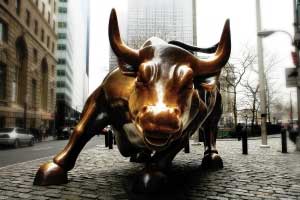
Bonus Bull

wallstbull.jpg

Think a few regs will stop Wall Streeters from receiving ridiculous payouts? Think again.

Tue Feb. 17, 2009 2:33 PM PST

P.T. Barnum may have coined the phrase "There's a sucker born every minute," but Wall Street titans have leveraged that principle and banked it in the Caymans. And don't think that the recent stimulus package provision aimed at reining in CEO compensation is going to stop them.

Recently, President Barack Obama, tapping into a source of public fury, decried the "shameful" excesses of Wall Street and proposed capping the cash component of executive compensation at $500,000 for those running firms set to receive money under the Treasury Department's Troubled Asset Relief Program (TARP) and other federal bailout initiatives. Treasury Secretary Timothy Geithner also blasted big bonuses when he introduced a light-on-details plan for the next phase of the Wall Street bailout. And Sen. Christopher Dodd (D-Conn.), chair of the Senate banking committee, tucked compensation constraints for the top 5 senior executives and 20 highest paid employees at firms receiving more than $500 million in TARP money into the stimulus package. (Meanwhile, though, he removed Obama's pay cap idea, opting instead to restrain bonus compensation until TARP funds are repaid.)

Advertisement

Advertisement

But all this is window dressing, for Wall Street will, in all likelihood, still find imaginative ways to hand its execs huge sums of money in the years to come.

Cash typically comprises only a small percentage of an executive's compensation package. Thus, it's no hardship for Wall Street execs worth millions to forgo a year or two of bonuses to get the government off their backs. Ask former Treasury Secretary Hank Paulson. In 2005, while serving as the CEO of Goldman Sachs, he received just $600,000 in cash—but $38 million in other forms of compensation, such as $30.1 million in restricted shares and 220,000 stock options. (His car and driver cost almost $154,000 that year, a bargain compared to Tom Daschle's limo expenses of $182,520.)

Currently, in the media and parts of the government, a twisted line of reasoning persists that warns against attaching too many strings—like compensation caps—to the TARP funds. The argument goes that doing so will reduce the talent pool available to the Street or make institutions too nervous to seek government assistance when they need it.

Whatever action the government takes on executive compensation, Wall Street is anticipating a weak bonus year for 2009, and probably for 2010 as well. First, anyone who can evaluate a decaying asset at all knows that the banking system will deteriorate further in the near term. Second, banks still owe money they borrowed using their inferior assets as collateral.

Yet once all that's out of the way, bonuses will rebound. They always do. Over the past three decades, there have been four periods of decreased bonuses, which were inevitably followed by increases that made up for the declines. During the savings and loan crisis of the 1980s and early 1990s, 747 banks were shuttered, the Federal Savings and Loan Insurance Corporation went bust, and the Resolution Trust Corporation swooped in to collect bad (mostly real estate) assets. Ultimately, this rescue cost the American public half a trillion dollars. Wall Street bonuses were down 21.3 percent in 1988 from 1987 levels. By 1991, though, bonuses doubled from the previous year. Similarly, in 1994, during the Mexican peso crisis, Wall Street bonuses were cut 15.7 percent, only to bounce back 26.8 percent the following year.

The pattern repeated in 1998 when, during the Russian debt crisis, the Federal Reserve bailed out the hedge fund Long Term Capital Management to the tune of $3.65 billion. Wall Street cut bonuses by 18.8 percent. They jumped 48.5 percent the next year.

In late 2001 and 2002 came the triple play of the Enron and WorldCom scandals, a recession caused by a spate of corporate bankruptcies, and a nervous post-9/11 stock market. Bonuses dropped 33.5 percent and 25 percent, respectively, during those two years. By 2004, they zoomed back to pre-recession levels.

Bonuses nearly doubled over the next two years as subprime assets, collateralized debt obligations, and credit derivatives fueled the market. In 2006, a record year for Wall Street profits, bonuses reached new highs. Goldman Sachs CEO Lloyd Blankfein, who led the group of supposedly contrite CEOs who testified before Rep. Barney Frank's banking committee last week, bagged more than $110 million for 2006 and 2007.

Last year, bonuses shrank by 44 percent, but fell only to 2004 levels—and Wall Street still managed to reward employees with $18.4 billion. This despite a complete Wall Street meltdown, the near-fatal condition of the country's largest bank (Citigroup), the collapse of two major investment banks (Lehman Brothers and Bear Stearns), and the immensely reckless merger of Merrill Lynch into a terminal Bank of America. In the Merrill Lynch-BoA deal, former Merrill CEO John Thain grabbed a $15 million signing bonus and other perks, and he paid $4 billion in year-end bonuses to Merrill Lynch employees before the merger went through.

Regardless of the strictures that might be placed on Wall Street bonuses in the future, there are multiple ways for corporate leaders to get around cash caps by using restricted shares, offshore companies, and other devices.

To ensure that executive compensation is in line with the public interest, it ought to be taxed or constrained in every possible form. And to stop the Wall Street bleeding from further infecting the entire economy, we ought to make banks disclose all their positions rather than talk about future transparency and "stress testing." The next step is to divide firms dealing with public deposits and loans from other financial institutions—and only give the traditional banks federal assistance (and make renegotiation of residential home loans mandatory). It would be like reinstituting the Glass-Steagall Act of 1933, which created a wall between banks that collect deposits and make loans and those institutions that engage in other, more speculative financial endeavors. That system worked pretty well until its bipartisan death in 1999. It could work once again.

Nomi Prins is an economist and frequent contributor for Mother Jones. Her most recent book is It Takes a Pillage: Behind the Bailouts, Bonuses, and Backroom Deals from Washington to Wall Street. To read more articles by Nomi Prins, click here.

Get Mother Jones by Email - Free. Like what you're reading? Get the best of MoJo three times a week.

Comments

Credit Cartel

As the credit cartel extorts trillion upon trillion to consolidate its stranglehold on Congress, the chief thief in the White House is preparing plans for starving Social Security and Medicare. By comparison, Reagan was a petty thief to Obama. If they stay on this track, I would not be surprised to see Oklahoma City reenacted in DC.

After reading the comment

After reading the comment left by "Anonymous" I am confused. What are you saying?

Wha?

Anonymous is saying that he doesn't have a clue.

Same, I'm not sure to

Same, I'm not sure to understand

Anonymous 2-18

Please get an education and learn something before you post again and embarrass yourself further.

Taxes? Oh my!

tagged as: 
I'm not sure this problems is all that difficult to solve. I'm answer your question first. "NO!" I never thought Wall St. execs would be willing to settle for less compensation. Worse, within a very few years, they'll be back engaging in the same chicanery that has brought the world's economic system to its knees. Here's the solution, a quaint notion called taxes. Tax _all_ income the same with no deductions, credits, or exemptions. Leave NO loopholes. BUT, have a fairly steeply progressive rate of taxation with the top marginal tax rate at about 70% or so. You'd nail: the professional athletes who make $10s of millions per year, as well as people like Howard Stern and the porcine Rush Limbaugh. Is it really too much to ask highly compensated people to pay a significant %-age of that compensation as taxes? Anonymous can safely be ignored. BTW, it doesn't seem productive to have CAPTCHA "words" that aren't words that even humans can't read.

Bull!

Someone needs to steal the bull in the picture! I'll get on it.

There are a few problems

tagged as: 
There are a few problems with the system. The first one is the unexplained expectation that we expect capitalism to be fair to everyone. It is a bit like communism expecting everyone to pull their weight. It just doesn't happen. Another one is. A rabbit eats grass an eagle eats meat and either one will die before it changes it habits. Why are we expecting these guys to show repentance or true humility? it is just not inside them. From a morel or ethical point of view I cannot understand why we let these guys call the shots so much. They are supposed to be some of the so called cleverest of the clever and look at where they put us. Cleaver they may be, with numbers and stuff but ask them to show a little bit of emotional intelligence or humane compassion for the less well of in society and they will give you 10 reasons why they are so clever and deserve more for themselves. This is not really a bad thing it is just the way their personality works. They are bound by their genetic makeup to behave a certain way. Therefore I cannot see why we reward an individual in our society who is only doing what comes naturally to them. Put any one of these CEOs in charge of a ten man operation and they cant stop themselves from turning it into 5000 man operation in 10 years. Put another in charge and they will turn it into a 10 man operation in 5years because they have a need inside them to touch their work intimately . Who is more valuable? Is it The CEO who never gets his hands dirty, The self promoting so called visionary? that tells everyone they cant do without him? Or the people who actually do the stuff? The stuff that makes the CEO Look like he is achieving "Goals" . I think we both need each other. And I think a good leader does deserve some compensation for leading. However when his or her reward for doing what comes naturally to them is disproportionately excessive I feel the rest of society has to remind these individuals of their own blind spots or personality holes. I have problems accepting the reasoning that the CEOs deserve more than 200 to 250 times the reward of the lowest in our society. Just because he or she finds it uninteresting to be hands on making, serving or day to day cleaning, does not mean he is more or less valuable to society. (Their personality type would secretly beg to differ) They are just part of our society. The trouble is the lawmakers seem to be beholden to these guys I think the problems start when they are left in groups by themselves without enough other personalities in the mix to compensate for their narrow mindedness. But quiet frankly 99 percent of the population don't give a damm what they do because we don't relate to what interests them. (POWER and subsequently MONEY) The rest of us just want the basics in life. A safe society, a roof over our heads with a warm bed, access to healthy food, basic health and dental care for our families, A bit of money left over to buy reliable transport and a few technological nick nacks. It sounds like heaven on earth. What more could you want? If you are a CEO enough is never enough.

We need to seriously

We need to seriously reconsider if we want a system that values competition over cooperation.

OMG

if the bull i like that, i don't think i could be a cowboy ^_^

Money World

For people who has control in money business will be rich. The best is to be your own fund manager and have control of all the money. You'll be fat by then and have to lose weight. Fat Loss 4 Idiots Review

Bail Out

All the overpaid pompous wags running our industry and financial institutions should have their mental skills reviewed on the TV program called "Are You Smarter Than A Fifth Grader?" We've all seen teachers with high degrees ask the kids for help and still lose. High school and college honor students have failed. This program should be made the national compulsory standard for all CEOs and the bankers of Wall St. Those who fail, and most will, should then be forced to resign and apply for a real job! Politicians will oppose my idea, because they will fear they may also have to take a "fifth grade" exam.

It is better to let

It is better to let proffesional to manage your money, but even they can not guarantee you will make a profit.

Anonymous is saying that he

Anonymous is saying that he doesn't have a clue.

my opinion

Nice airtical, i would like to tell all of my friends about it. By the way, i would like to introduce everyone of you a very nice website, it offers cheap air max trainers for men and women. Such as Air max 1, air max 2, air max 90, nike air max 2009+, air max 2010 new, nike air max TN, nike air ltd trainers, air max 95. Dunk SB shoes, nike shox shoes. You can find almost all the nike series there, in huge collection and varies colorways. They have Latest style and classic style. Though their price are low, don't worry about it's quality. They are realll ones!!! I have bought from them for so many times, and very satisfied with the their goods and service. Come on, you'll love it.

Post new comment

Alternately, you may login to or register an account
The content of this field is kept private and will not be shown publicly.
  • Web page addresses and e-mail addresses turn into links automatically.
  • Allowed HTML tags: <a> <ul> <ol> <li> <blockquote>
  • Lines and paragraphs break automatically.

More information about formatting options

MoJo Comments: Send Us Your Feedback

We changed our spam software to better filter comments. Should you encounter any issues, please let us know.

Photo Essays

The chaos and humanity of war.
The craftspeople and musicians of Appalachia.
A selection of '70s ads depicting African-Americans.
As climate change melts the permafrost, native villages slip into the sea, taking a way of life with them.