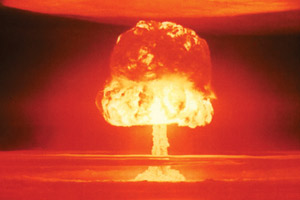
Delayed Nuclear Reaction

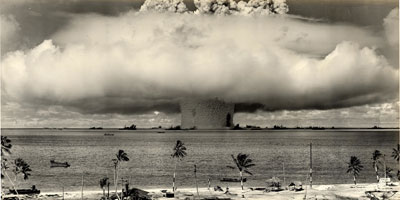
hbombmaster.jpg

Eight years after 9/11, a global effort to secure nuclear plants from terrorists has only just begun. MoJo interviews the man in charge.

Mon Jul. 20, 2009 3:00 AM PDT

The scenario is a Hollywood staple: Terrorists infiltrate a poorly guarded nuclear weapons facility, capture the bomb, and hold the world hostage to their diabolical demands. But that could only happen in the movies, right? Unfortunately, no. Nearly eight years after 9/11, nuclear specialists are only just starting to coordinate industry-wide practices to keep the materials used to make doomsday weapons from falling into terrorist hands.

The nuclear industry has long collaborated on safety issues, such as preventing reactors from exploding. But even as the threat of terrorism has grown, security has remained an ad hoc affair, with each individual facility or country left more or less to its own devices. It was only last September that a Vienna-based nongovernmental organization called the World Institute for Nuclear Security (WINS) began bringing nuclear security specialists together to formulate procedures to prevent violent extremists from obtaining the key ingredient in nuclear bombs. 

Advertisement

Advertisement

The group was the brainchild of former senator Sam Nunn, a longtime proponent of nuclear nonproliferation who, along with Ted Turner, cochairs the Washington-based Nuclear Threat Initiative. With initial funding of $6 million—half from Nunn's organization and most of the rest from the US Department of Energy—WINS focuses on securing fissile materials at facilities around the world. It's led by Roger Howsley, the former director of security, safeguards, and international affairs for British Nuclear Fuels, the UK's government-owned nuclear concern. Mother Jones talked to Howsley about the alarming gaps in security at nuclear plants around the world.

Mother Jones: There has been a lot of talk about the risk of terrorists obtaining nuclear weapons. Is the concern justified?

Roger Howsley: It's a matter of record that there are terrorist groups that have made plain that if they could access nuclear weapons or nuclear materials and use them for terrorist purposes, they would do so. If you look at some of the court cases related to terrorists, you find that there are people who have actively tried to get hold of nuclear or radioactive materials or have planned to try to get hold them with a view to using them. You have to presume that there is still interest in doing so.

MJ: How active is the black market for nuclear materials?

RH: The number of occasions where nuclear or radioactive materials have been smuggled or stolen is pretty small. The International Atomic Energy Agency keeps a trafficking database in which they have recorded upwards of 100 incidents a year, but I think a lot of those are very small, low-level things of no real significance. Of course the thing that governments most worry about is the possibility of someone stealing a nuclear weapon or enough nuclear material to produce an improvised nuclear device, which would be shocking. But we also need to understand that there would be a high level of public paranoia if it were just a small amount of radioactivity that was dispersed. I've heard people call dirty bombs "weapons of mass disruption" as opposed to destruction—psychologically, people don't respond proportionately to the scientifically calculated harm that might be caused from a radioactive release. You only need to look at the sarin attack on the underground in Tokyo to draw parallels. Quite understandably, people react in a very frightened way when these sorts of things happen. So we shouldn't underestimate the potential harm that a dirty bomb would do.

MJ: What is the most likely scenario under which terrorists might steal nuclear materials?

RH: I can remember once being contacted when I was a security officer at British Nuclear Fuels. It was a high security transport company calling. They said they'd been away for a couple days' brainstorming on how they could improve security and thought they'd like to benchmark (that is, compare) with other transporters that carry particularly sensitive materials. They wanted to compare the number of attacks they'd had on their facilities and their transport operations compared with us. And I said, "Well, you can come and talk to us about it, but we've actually never had an attack on our facilities or transport operations," whereas they regularly had their high security vehicles intercepted by bandits or whatever. The point of me saying this is that we don't have statistical data to justify what we think is most likely to happen.

MJ: What does WINS hope to achieve?

RH: There was enormous reaction across the world after Chernobyl. People began to take nuclear safety much more seriously. In 1989 there was a new organization formed called the World Association of Nuclear Operators. They had looked at the situation, realized the nuclear industry was politically on its knees after Chernobyl, and unless they took really serious action, it was possible that the entire nuclear industry would just grind to a halt. WANO has worked well over the last 20 years or so to improve nuclear safety standards but also to improve the efficiency of reactors. It is very much a model for what we are trying to do. Human nature being what it is, though, people are usually better at reacting to events than trying to prevent them from happening. We should think today what we would do tomorrow after an event, and not wait for it to happen.

MJ: How can the nuclear industry improve security, given that so much remains unknown about potential threats?

RH: One thing that we're trying to do is actually look at other industries, what their philosophies are. If you look at the diamond industry or the gold industry, they have a definite risk. People try to steal diamonds and gold all the time, so what are they doing in terms of insider threats? What I want is for WINS to think like that, think more imaginatively about how we can improve things. We're not always necessarily looking for people to spend a lot more money on what they're doing; it's much more of a management attitude.

MJ: What is the biggest challenge to improving the security of nuclear materials?

RH: The security problem we have is that if you're not attacked, you don't necessarily have data. So you report to your chief executive or your board of directors that in January, nothing happened. February, nothing happened. March, nothing happened. April, nothing happened. And people can very quickly become bored. People lose interest; they can become less focused in terms of the attention they give security, and that's the worry about complacency. Just because nothing happens, you can't differentiate whether nothing has happened because you're a really hard target or because nobody has tried.

MJ: Why hasn't the nuclear security community come together sooner to share best practices?

RH: One of the things that's characterized security generally over the years is that you can't talk about it…for security reasons! Whereas people in the nuclear safety community have really got to know one another—there's a stack of international groups that deal with nuclear safety and share best practices—the nuclear security community hasn't done that. For example, after 9/11, when I rang my counterparts in nuclear companies in Europe and elsewhere, I found myself quite often introducing myself for the first time to the security director, saying I'd like to come and talk to you about what you're doing in response to these terrorist attacks. There was just no infrastructure in place to do that. People keep to themselves. It's "need to know," and all of the things that have been criticized in various reports following 9/11.

MJ: Are there any legitimate security reasons for this?

RH: When you think about the risks we're worried about, actually getting a group of professional security people together to talk about best practice doesn't strike me as being a very great risk. We're talking about good management practices and how to get your guards properly recruited, trained, motivated, deployed…things that are generally transferable around the world. We're not talking about sharing the combination codes to one another's facilities.

Bruce Falconer is a former Mother Jones' Washington bureau reporter. For more of his stories, click here.

Get Mother Jones by Email - Free. Like what you're reading? Get the best of MoJo three times a week.

Comments

Nukes and weaknesses

I think that it's really a big challenge to secure transportation, storage and usage of active nuclear fuel or nuclear waste.

In my opinion a security breach could be more unlikely in western areas of the world, where instead an attack to the plants it's easier.

On the other side in Russia could be most likely exactly the opposite.

Nuclear fuel (both newly produced and exausted), in my opinion should be under government protection at all time, with plants treated as military bases.

Nuclear is a big and effective power source, which I wish will take more and more place, but needs specific and uncommon security rules (and cautions) to be followed, not only on operational side but also on security one.

Especially in these troubled times.

This comment also as a post at http://ictheworld.wordpress.com

How can it be...

Hotrao's response is a perfect example of the power of splitting, projection and denial in causing the problems of the world. How can you want more of something that you simultaneously realize is a dire danger and needs special security arrangements which can never be even remotely 100% effective and which will inevitably cause loss of human rights and humanity even in their inadequate form?

Most people who favor nukes are conservatives. How can they hate and mistrust government so much and yet have utter faith in the government's perfection when it comes to running the most harmful things of all--nuclear power, nuclear weapons, armies and police (secret and non-)?

How can the most obvious and potentially catastrophic targets of terrorism be the favored energy source of security-obsessed people like Dick Cheney (and Hotrao?) and how can it be acceptable that the people in charge waited so long to start thinking about making them safer, while making damn sure habeas corpus was ripped up, the army was allowed on this side of the Rubicon and dangerous insurrectionists like Quaker Peace Groups were fully infiltrated and spied on?

I think the cart is supposed be--now how does it go, again?...oh yeah--AFTER the horse!

Unsafe at any cost

tagged as: 

Nuclear power plants will never be safe, and in fact contribute to the short and long term problems of our world. The various radioactive isotopes in the wastes are deadly poisonous... some for up to 240,000 years. Our governments and the energy companies assure us that some day we will have protected and guarded storage facilities for nuclear wastes. However, every proposed solution has associated problems. This article clearly shows the difficulties managing nuclear materials today, but we must think beyond today and imagine the implications of our activities on future generations… people who may have no need or desire for nuclear options.

Our leaders and capitalists today assure us that the toxic wastes from our current activities will be safe and guarded in the future long after we are dead and gone… for a period more than 20 times greater than the entire history of human civilization! Yet, throughout this ‘civilized’ history we have fought wars and destroyed each other continually. Our leaders have no idea how we can live in peace today, yet they guarantee that our radioactive waste will not harm anyone for a quarter of a million years. Judging by our history, it is clear that our nuclear waste will dominate the health, economics and politics of humans for millennia, as a succession of groups seeking power will fight endlessly over their control.

Nuclear power is not the answer to our energy problems. Nuclear weapons are not the answer to our power struggles. The sooner we come to this understanding globally the brighter the long-term future of the human race.

Please check out www.changing-history.com for further philosophical considerations.

Underground Bases

Underground bases which are not yet under the control of the US goverment are tied together in a privately held communications network. The nuclear weapons and or power plants are an excuse for government guarding of these facilities worldwide. The activities there are not all "nuclear" related and the same companies, aligned together for these also control the oil and gas industry, water, road building, and other worldwide infrastructure.

It is a militia outside of Government control with its own agents inside of the Government. The layers of secrecy are increasingly more about hiding past crimes, mind control objectives and a fascist form of enslavement, using unreported taxpayer black ops money for their assets.

Now these same companies are trying to control the new renewable energy initiatives. At its core, it is pro big business and anti-democracy, with the New World Order now moving into the minds of mankind for control. Nuclear materials make a good excuse and any government initiative toward government control of these facilities has failed on both sides of the political spectrum.

Doublespeak campaigning is in full swing and so is the Big Brother initiative, long in the planning prior to WWI. Look for a book by myself and Dr. Robert M. Bowman who ran the programs under Ford and Carter which later became known of as Star Wars about these subjects next year.

Unfortunately for all of us... the wrongfulness of fake division between right and left in this country falls right into the hands of a well funded, well organized, State controlled, Chinese covert attacks on multiple fronts. In the end, because of wrong objectives, the ones they originally sought to defend our freedoms from, the Communists, become the new world dictators by reaping the harvest stored in these locations... just because they are greedy.

Robin L. Ore
http://femtobeam.com

****** The New Amerika ******

Interesting post by Robin Ore .... But here is my take on "Delayed Nuclear Reaction"

I have read somewhere that the Vatican tried to outlaw gunpowder. I did a search [cia/google] to enable me to provide a few more details of what the Vatican contended to justify a ban on gunpowder... but..alas..nothing..

Gunpowder, as i recall [in the Vatican's mind] threatened to upset the established order..... At the time Knights were the warriors. They were athletic and owned expensive armaments, trained horses and they spent their lives fighting.. BUT Gunpowder enabled a serf with a few days training to shoot the Knight with the lifetime of preparation, right off his [high!] horse.

This is how I see all the nonproliferation schemes.... Not only do the [powerful] States that profess nonproliferation....continue to build more weapons...and deadlier ones, They let their "friends" slip past the restrictions of the treaty regime... E.G. Israel and India...

AND these powerful [nuclear] states [U.S. & Israel] almost daily, usually weekly and never fail to monthly- Threaten the weak [non-nuclear] NPT compliant states WITH ....NUCLEAR ATTACK.. which is explicitly proscribed by the very treaty they [claim to] enforce...'We are taking NO options off the table" [No options 9off the table) means just that, that the nuclear State saying this includes infanticide, genocide, extermination!!] if they do not keep their technology in the eighteenth century... "To make us all safer"..... The safety the powerful [nuclear] States seek, is the safety to attack the weak [non-nuclear] states on ANY provocation [real or manufactured] to expropriate their resources, their land or for any other reason [or whim] [think Panama] that suits the powerful.... You get the Idea.... God forbid [in the mind of the powerful states] that some small state like say Cuba or Syria would be able to tell a [nuclear] monopoly State.... No. you CANNOT STEAL any more of our land, resources....or "all options are on the table" Yaa, it's O.K. for the U.S.~~~ But not for most places.

also, when India exploded their bomb...Pakistani's "ate grass" to get the bomb too... Because... Duh.. how could they negotiate with India on ...say Kashmir.. or any bi-lateral issues...if they are in the "weak" [I.E. non-nuclear] position? The NPT is controlled by the exploiters!!

Now look at the Israel, Egypt, Iran, Syria, Saudi situation... Not only does Israel GET the bomb,...they threaten and attack their neighbors several times each year... None of their neighbors are safe until they get parity...or at least deterrence [having enough throw-weight to be able to make an attack too costly in Israeli lives and infrastructure] to raise the costs to unacceptable.

All these non-proliferation schemes are making proliferation accelerate due to [all] the [nuclear] threats..and the increasing sensitivity of proliferation detection regimes-- "We better get it soon or we will be frozen OUT!!!"

The WORST violator, the U.S., when it decided to use their bombs~~ Which MILITARY target did they chose?? None!! They chose cities full of non-combatants and incinerated hundreds of thousands of [nearly all] women and children... And THEY are the loudest voice to keep these weapons away from their victims, the weak.

What would you have done?

If the government REALLY believed 9/11 was caused by terrorists, instead of home-grown "false flag" terror, wouldn't you expect different results? Like surrounding nuclear installations with military zones, closing off the border with either soldiers or "patriotic" volunteers? Shouldn't they have created immediate bans on container shipping until each and every container large enough to smuggle either nukes, or bioweapons, or drugs was stopped? But that's not what happened at all, is it, nor is it what continues to happen, is it? You certainly wouldn't have tried to sell our ports to arab private investors. It's like the Sherlock Holmes case and the dog that didn't bark. It's the uncharacteristic responses, the one's you'd NEVER do, if the story they want you to believe were indeed true...
And here is yet another perfect example...

The only reason "terrorists"

The only reason "terrorists" would hijack a nuke plant is to blow it up. Can you imagine 19 terrorists with box cutters hauling off nuclear material enough to make a dirty bomb? They'd be pretty easy to find, glowing in the dark. The previous comment about the government securing nuke plants and cargo containers if the post-911 "terrorist threat" was legitimate was right-on. They didn't; it's not. Complete and utter bullshit. Mother Jones time might be better spent exposing the fraud of the War of Terror rather than providing a venue for government propaganda. If (?) 911 was an inside job (!), we have more in common with "terrorists" than our own government. Crazy world. Time is short. Plant seed. Get some chickens. Hug your kids. We're in biiiiiig troube and not everyone's going to make it.

In our crazy world indeed

In our crazy world indeed first of all we must pay attention to safety. I agree that each state must provide maximum protection to materials which can be used like mass weapon (nuclear-, bio-, chemical- weapon) Total and permanent monitoring of all potential threats is right but it is important that it didn't turn in paranoia.

The great thing about home-grown power is...

....that if terrorizers try to take over your electrical production, they only get one house. You move out, they wave their flag, they leave...you move back in...make dinner...call the window glass guy...and it's back to worrying about what color to paint the garden trellis. Ok, you'll probably have to replace some pieces or buy a battery, or something...also great at the end of the month when you're not being terrorizerated by energy traders and crooked electric companies!

Klaatu marachas necktie

nice post

I think that it's really a big challenge for world to destroy fuel or nuclear waste.

Acne Treatment

Post new comment

Alternately, you may login to or register an account
The content of this field is kept private and will not be shown publicly.
  • Web page addresses and e-mail addresses turn into links automatically.
  • Allowed HTML tags: <a> <ul> <ol> <li> <blockquote>
  • Lines and paragraphs break automatically.

More information about formatting options

MoJo Comments: Send Us Your Feedback

We changed our spam software to better filter comments. Should you encounter any issues, please let us know.

Photo Essays

The chaos and humanity of war.
The craftspeople and musicians of Appalachia.
A selection of '70s ads depicting African-Americans.
As climate change melts the permafrost, native villages slip into the sea, taking a way of life with them.