This story first appeared on the TomDispatch website.
Celebrating its 60th birthday this year, NATO is looking peaked and significantly worse for wear. Aggressive and ineffectual, the organization shows signs of premature senility. Despite the smiles and reassuring rhetoric at its annual summits, its internal politics have become fractious to the point of dysfunction. Perhaps like any sexagenarian in this age of health-care crises and economic malaise, the transatlantic alliance is simply anxious about its future.
Frankly, it should be.
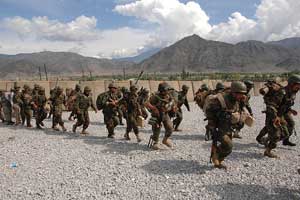
The painful truth is that NATO may be suffering from a terminal illness. Its current mission in Afghanistan, the alliance’s most significant and far-flung muscle-flexing to date, might be its last. Afghanistan has been the graveyard of many an imperial power from the ancient Macedonians to the Soviets. It now seems to be eyeing its next victim.
For NATO, this year should have been a celebration, not a dirge. After suffering a transatlantic rift of epic proportions during the Bush years, the alliance thrilled to the election of Barack Obama and his politics of conciliation. The new American administration swore it would shift troops from Iraq to Afghanistan to give NATO more of what it wanted to fight “the right war.” Vice President Joe Biden and Secretary of State Hillary Clinton both promised to push the “reset button” on U.S.-Russian relations, potentially removing one of the greatest obstacles to NATO’s health and well-being. And in a final flourish for the alliance’s diamond jubilee, France agreed to return to the fold, reintegrating into NATO after 43 years of standoffishness.
But hold those celebrations. Afghanistan has an uncanny ability to spoil anybody’s best-laid plans. At the April 2009 NATO summit in Strasbourg, Obama failed to get the troop reinforcements he wanted from his European allies. The NATO powers, in any case, have attached so many strings and caveats to the troops they are supplying — Germany has kept its soldiers away from the conflict-ridden south, most contingents have complex rules limiting combat operations, Canada will be pulling out in 2011 — that NATO’s mission resembles Gulliver tied down by the Lilliputians.
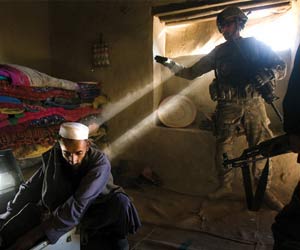
The real nail in NATO’s coffin, however, has been its stunning lack of success on the ground. The Taliban has, in fact, not only increased its hold over large parts of southern Afghanistan, but spread north as well. Most embarrassingly for NATO, a recent surge of alliance troops seems only to have made the Taliban stronger. Nearly eight years of alternating destruction (air bombardment, over 100,000 troops on the ground) and reconstruction ($38 billion in economic assistance appropriated by the U.S. Congress since 2001) have all come up desperately short. A new counterinsurgency campaign doesn’t look any more promising. What was once billed as the most powerful military alliance in history has been thwarted by an irregular set of militias and guerrilla groups without the backing of a major power in one of the poorest countries on Earth.
Worse yet, the Afghan operation has become a serious political liability for many NATO members. European politicians fear the kind of electoral backlash that ousted Britain’s Tony Blair and Spain’s Jose Maria Aznar when the Iraq War went south. Despite enthusiasm for Obama, European public opinion is, by increasingly large margins, in favor of reducing or withdrawing troops from Afghanistan (55% of West Europeans and 69% of East Europeans according to a recent German Marshall Fund poll). Mounting combat fatalities, a rising civilian casualty count, and devastating snafus like the recent bombing of two fuel trucks stolen by the Taliban in Kunduz Province that killed many civilians have only strengthened anti-war feeling.
Meanwhile, in the United States, both elite and public opinion is turning against the war. With the American economy still reeling from recession, President Obama faces a guns-vs-butter dilemma that threatens to wreck his domestic agenda as surely as the Vietnam War deep-sixed Lyndon Johnson’s Great Society reforms of the 1960s. No surprise then that the president is ambivalent about following his top general’s request to send yet more U.S. troops to fight in what the press now calls “Obama’s War.”
Not so long ago, pundits were calling for a global NATO that would expand its power and membership to include U.S. partners in Asia and elsewhere. This hubris has given way to despair and discord. Although the United States still holds out hope for a NATO that focuses on global threats like terrorism and nuclear proliferation, other alliance members would prefer to refocus on the traditional mission of defending Europe. Add in disagreements between the United States and its allies over how to approach the Afghan situation and NATO begins to look more like a rugby scrum than a military alliance.
NATO officials are now scrambling to sort things out, in part by calling the allies together to debate a new Afghan strategy before the year ends. Meanwhile, NATO’s Secretary General Anders Fogh Rasmussen is preparing a new “strategic concept” that would recode the organization’s operating system for the next summit in Lisbon in 2010.
It might be too little, too late. Some U.S. officials are fed up with what they consider European dilly-dallying about Afghanistan. “We have been very much disappointed by the performance of many if not most of our allies,” Robert E. Hunter, the U.S. ambassador to NATO during the Clinton administration, recently said in testimony before Congress. “Indeed, there are elements within the U.S. government that are beginning to wonder about the continued value of the NATO Alliance.”
As for the Europeans, they are building up their own independent military capabilities — and will continue to do so whether or not NATO gets its act together. The question is: Will the Afghan War eventually push the United States and Europe toward an amicable divorce? If so, the military campaign that was to give NATO a new lease on life and turn it into a global military force will have proven to be its ultimate undoing.
Near-Death Experiences
This is NATO’s second brush with death since the collective security organization was founded in 1949 to counter the Soviet Union. Although it didn’t fire a shot during its entire Cold War existence, NATO did fulfill its mission: to keep the Americans in, the Russians out, and the Germans down, according to the infamous catechism of Lord Ismay, NATO’s first secretary general.
When the Cold War ended and the Warsaw Pact vanished, NATO was suddenly an organization without a mission. During the early 1990s, it cast around for new portfolios — environmental work, humanitarian missions, anything. It needed a raison d’être fast. After all, the conflict-prevention mission of the Organization for Security and Co-operation in Europe spoke more directly to the post-Cold War temperament, and transatlantic publics were eager for their peace dividends. NATO was seen as a pillar of the old world order at a time when even President George H.W. Bush seemed prepared to accept something radically new (though he settled, of course, for a rough approximation of the status quo ante).
 Tragedy proved NATO’s salvation. The organization got a second wind when Yugoslavia disintegrated into warring states and European governments did little to prevent the bloodletting in the Balkans. The United States belatedly turned to NATO in 1995 to fly a few bombing missions against Serbian forces during the Bosnian conflict. Then, in 1999, responding to fears of Serbian escalation in Kosovo, NATO engaged in its first-ever war. During the 77-day conflict, the alliance conducted 38,000 air sorties against Serbian targets that resulted in considerable “collateral” damage including Serbian civilians, Albanian refugees, and, famously, the Chinese embassy in Belgrade. Although no NATO personnel died during these combat operations, the alliance acquired a reputation as the gang that couldn’t shoot straight.
As if the Balkans weren’t rationale enough, NATO also fell back on an old directive: to keep Russia out. Eastern Europe’s persistent fear of its former overlord injected new purpose into the organization. Although Russia’s leaders believed that Washington had promised not to expand NATO into Eastern Europe, the alliance did just that — and with gusto. First, it established a kind of alliance halfway house in 1994 that it dubbed the Partnership for Peace; then, in 1999, NATO accepted the Czech Republic, Hungary, and Poland as members; and five years after that, it expanded into the former Soviet Union by absorbing the Baltic states of Latvia, Lithuania, and Estonia along with Bulgaria, Romania, Slovakia, and Slovenia. Russia has, to put it mildly, been less than thrilled by NATO’s eastward leap and then creep. Meanwhile, wary of Russia’s military campaigns in Chechnya, Georgia, and Moldova as well as its energy power plays against countries to its west, the Eastern Europeans have eagerly huddled beneath the NATO “umbrella.”
As it happens, neither the Balkan tragedies nor the putative Russian threat proved to be unalloyed blessings for the alliance. The Balkan campaigns created enormous stress for its military command, and only the brevity of the air war over Kosovo saved it from popular repudiation across Europe. The expansion of NATO into Eastern Europe, meanwhile, made consensus within an already unwieldy institution more difficult.
The once central focus of NATO — a commitment to the collective defense of any member under attack — was, by now, looking ever less workable. Western European countries appeared anything but enthusiastic about the idea of defending the former Soviet bloc states against a prospective Russian attack. And despite promises to station troops in Central and Eastern Europe, the United States left its new NATO allies in the lurch. “While they are loath to say it publicly, [Central and Eastern European] leaders have told me that they are no longer certain NATO is capable of coming to their rescue if there were a crisis involving Russia,” wrote Ronald Asmus, former deputy assistant secretary of state in the Clinton administration. “They no longer believe that the political solidarity exists or that NATO’s creaky machinery would take the needed steps.”
On the eve of September 11th, a decade after the end of the Cold War, NATO had become an overstretched alliance with an ill-defined but expansive mission and a collection of member states increasingly at odds with each other. When the United States prepared to attack Afghanistan and then Iraq, the Bush administration simply bypassed NATO, constructing its own ad hoc coalitions “of the willing.” (Only in 2003 did the Bush administration turn to NATO to shoulder some of the local burden.) There could have been no greater vote of no-confidence in the institution.
The Afghan Test Case
Since the end of the Cold War, the U.S. troop presence in Europe has been plummeting. From a Cold War peak of several hundred thousand, it had dropped to around 44,000 by 2007. Reductions to the 30,000-level or even lower have been discussed. With U.S. forces stretched to the limit elsewhere in the world and U.S. strategists fixated on the energy heartlands of the Middle East and Central Asia, the European theater of operations has been (and remains) the obvious place for force reductions.
Washington will certainly continue to maintain key military bases in the United Kingdom, Italy, and Germany and has been setting up new ones in Bulgaria, Romania, and Kosovo (that just happen to be closer to the energy resources of Eurasia and the Middle East). Turkey and possibly the Balkans are slated to become important locations for a more advanced version of the missile defense system that President Obama recently canceled for Poland and the Czech Republic, bases which once figured prominently in the Bush administration’s plans for Europe. In sum, U.S. forces and resources once available to NATO’s European operations have been rapidly dwindling.
At the same time, in the Bush years Washington chose to push the alliance to expand beyond its traditional focus on Europe and think global, focusing on terrorism, piracy, nuclear proliferation, and other international threats. In this way, the United States imagined that it might be able to place some of the financial burden for its own self-appointed global mission on its European allies. The Afghan War and reconstruction effort, an out-of-area operation with global significance, was clearly to be the test case for Washington’s version of a new and improved NATO.
On the other hand, the newest members of the alliance from Eastern and Central Europe wanted the focus to remain on threats to Europe itself (that is, to them). They continued to be purely Russia-focused. The leadership in Poland and the Czech Republic, in particular, were eager for the recently canceled missile defense bases not because they particularly believed in, or cared about, missile defense per se, or feared a future Iranian first strike, but because they were eager for proof of Washington’s willingness to counter Moscow. For these Europe Firsters, Afghanistan has been nothing but a distraction from the essential mission of keeping the Russian bear at arm’s length.
This, then, is the tug of war within NATO: between the Europe First faction and the Go Global faction. Oddly, both sides appear on the verge of falling into the mud. Now that the Obama administration is making nice with Russia, the Europe Firsters don’t have a threat to stand on. For the Go Global faction, meanwhile, victory within NATO requires victory within Afghanistan, which is why, in 2007, future AfPak czar Richard Holbrooke declared that “Afghanistan represents the ultimate test for NATO.”
If Afghanistan is the test, then NATO is flunking. The Taliban has made a steady comeback since its rout in 2001. More American soldiers, as well as more soldiers from the other coalition partners, have already died in 2009 than in any of the previous eight years. The number of civilian casualties — 2008 was a record year and 2009 will likely break that record — fly in the face of NATO’s “responsibility to protect” guidelines. There aren’t anywhere near the number of troops necessary for an effective counterinsurgency campaign, if such a thing were even possible in distant Afghanistan, and what troops are there have proven ill-trained for “hearts and minds” work. Nor are there sufficient Afghan troops trained, almost eight years after the initial invasion of that country, to “Afghanize” the NATO side of the conflict. As for the grander projects of democracy promotion and nation-building, Afghanistan’s rudimentary economy remains heavily dependent on opium poppy production and its political system suffers from rampant corruption of which the irregularities of the most recent presidential election represent only the tip of the malfeasance.
No wonder, then, that the Europeans are thinking seriously about how to get out. After a suicide attack in Kabul killed six Italian paratroopers in mid-September, for instance, Prime Minister Silvio Berlusconi announced that “we must bring our boys home as soon as possible.” The war also suddenly became a major issue in Germany on the eve of national elections when a German commander called in U.S. air strikes on those two stolen fuel trucks in Kunduz. The attack, which killed an unknown number of Afghan civilians, has driven home to the German public that its mission in Afghanistan qualifies as neither a humanitarian nor a stabilization effort, and anti-war sentiment is rising accordingly. Moreover, the bombing has caused an unusual upsurge in bickering between Germany and the United States over responsibility for the incident and overall strategy. Just over the summer, the British lost 40 soldiers in the conflict, and a majority of Britons now want their troops withdrawn right away, which is likely to mean that the government’s reported decision to send yet another 1,000 troops to Afghanistan will go down very poorly indeed with the voters.
How can NATO go global when it can’t even pass its first major test in Afghanistan? “It is of course possible that NATO can survive Afghanistan even in the absence of total success: it depends on the extent of its failure,” Danish security analysts Jens Ringsmose and Sten Rynning have written. “What seems certain is that failure in the Hindu Kush will constitute a serious blow to global NATO.”
With NATO having to downscale, like the rest of us in these recessionary times, forget the notion that the alliance should mount out-of-area operations, argues former U.S. diplomat David T. Jones for the conservative think tank Foreign Policy Research Institute. “Aggression, terrorism, piracy, and human rights debacles need be addressed, but NATO is not the hammer for these nails. The United States needs to be more discerning about using this stiletto to chop wood. A ‘coalition of the willing’ is a tarnished term, but NATO is verging on becoming a coalition of the unwilling.”
“NATO often seems to be an organization that is permanently in crisis, but it always seems to bounce back,” argues Ian Davis of NATO Watch. “This is partly because collective defense/security solutions continue to make sense, not least to: prevent a renationalization of defense in Europe; to lock-in U.S. administrations (as far as possible) to multilateral and law-based approaches; and to provide sufficient security guarantees to enable nuclear disarmament to proceed, and for likely recessionary conventional disarmament to take place without causing instability.” But will these workaday goals be enough to keep the institution afloat?
Fine-Tuning the Prime Directive
In 2010, NATO will update its prime directive for the first time in a decade, and the Go Global faction will battle with the Europe Firsters for the driver’s seat. Neither group is likely to gain enough power within the organization to steer it alone. Undoubtedly, a compromise will emerge. For instance, Zbigniew Brzezinski, the former U.S. national security adviser and consummate geopolitician, argues in a recent Foreign Affairs essay that NATO should focus on building security relationships with the world. In this scenario, NATO emerges as more of a grand facilitator than a robust fighting force. If, on the other hand, Afghanistan truly takes the fight out of NATO, the more radical proposals of the Citizens Declaration of Alliance Security, which calls for a more defensive military posture at lower levels of spending, while restricting out-of-area operations to U.N.-authorized missions, might come into play.
All institutions have a strong survival instinct, if only to continue providing salaries to their employees. NATO will surely outlive its strategic planning process, its failures in Afghanistan, and its adjustment to new global threats. But it may survive in name only. If it shrinks to the role of grand facilitator or U.N. handmaiden, it will have effectively ceased to be a transatlantic collective security organization. The United States will then lean toward ad hoc coalitions to achieve its military objectives, while Europe build ups its independent military power.
Initially, Europe began to beef up its collective military capabilities to acquire a voice in the international community commensurate with its economic power, as well as to send a not-so-subtle message to the unilateralist Bush administration. Today, the European Union maintains two rapid-deployment battle groups of 1,500 soldiers each and expects, in the near future, to pull together another 10 or so battle groups from existing national armies. These forces have already conducted missions in more than 20 countries. Europe’s military-industrial complex, meanwhile, is trying to push up military budgets and aggressively market European arms in overseas markets. All of this still represents a far cry from what NATO commands, but a signal is certainly being sent: if the United States thinks it can go it alone — or simply dragoon the alliance into its own version of a global mission — Europe will have options.
Even at 60, NATO hasn’t quite proven that it can live on its own in a sustainable and responsible manner. Indeed, it is still struggling with a Hamlet-like identity crisis: to attack or not to attack. The Afghan war has only underscored this central paradox. If the alliance doesn’t engage in military operations, everyone questions its ultimate purpose. But if it does go to war — and the war is unsuccessful — everyone questions its ultimate efficacy.
Damned if it does and damned if it doesn’t, NATO will limp along much as the British and Soviet empires did after their misadventures in Central Asia. These were, after all, dead empires walking. NATO may be in this category as well. It just doesn’t know it yet.