Hollaback: How to Confront Catcallers

Last week, Jen Phillips discussed five ways to respond to jokes about rape. She chose option #5, wherein you disarm the joke-teller by pointing out just how un-funny these jokes are by reversing the target of the joke. Below, a few options for dealing with that ubiquitous troll of the city sidewalk—the catcaller:
1. Ignore it and keep walking.
2. Use non-verbal cues (involving the middle finger) to indicate your disgust.
3. Attempt to educate harasser through dialogue or a handy business card.
4. Share this gem of human interaction with others online via photo or tweet.
5. Organize a city-wide summit to address gender-based harrassment and assault in public spaces, complete with a gallery exhibition of photographs of area cat-callers caught in the act.
I tend to go with #1, since I prefer not to let the catcaller get the satisfaction of a reaction, though sometimes option #2 happens as a knee-jerk response. Unfortunately, directly responding to, and even ignoring, catcallers is not always a safe option. In April, a woman was left partially blind, and her friend suffered a fractured jaw, after telling someone to leave them alone in a NYC pizzeria. In March, a 29-year-old pregnant woman was run over and killed when she ignored a catcaller.
To bring attention to the prevalence of public harassment, a number of websites have been created under the title Hollaback. These sites offer a space for people who are the target of gender-based harassment to share their experience in specific cities, regions, and countries with a sympathetic community, while publicly shaming the perpetrators. You can also tweet sidewalk utterances to @catcalled so long as it's under 140 characters. Which it probably is, since as any city-dweller knows, these are not eloquent treatises.
However, these sites are not just chronicles of the harassers that make your walk to work less than pleasant. HollabackDC seeks to make public not just catcallers, but all forms of street harrassment and misogyny:
"Gender based sexual harassment is any sexual harassment that occurs in a public space when one or more individuals (man or woman) accost another individual, based on their gender, as they go about their daily life. This can include vulgar remarks, heckling, insults, innuendo, stalking, leering, fondling, indecent exposure and other forms of public humiliation. Gender based public sexual harassment occurs on a continuum starting with words, stalking, and unwanted touching which can lead to more violent crimes like rape, assault, and murder."
That is why they are moving beyond the web and joining other DC-based community activists to stage a summit that will address strategies for responding to—and ending—street harassment. The summit's opening reception will include a photography exhibit of street harassers in the act. If you live in DC and snap a catcaller in the act, you can submit your own photo.

Advertisement
Advertisement
Comments
More suggestions
Thanks for addressing this topic. I'd like to add a few more suggestions to the list (taken from my website http://stopstreetharassment.com/strategies/index.htm):
1. If the harassers work for an identifiable company, call or write the company to let them know that their employees are harassing women and why that is unacceptable.
2. Take actions that will create real consequences for the harasser, such as reporting the person to a police officer or other person of authority, like a bus driver or subway employee.
3. Talk about your street harassment experiences with family, friends, coworkers, and acquaintances. A lot of people don't realize how often it happens and how upsetting it is. Maybe if more people knew, it would happen less.
4. Put up anti-street harassment fliers, posters or signs or hand out anti-street harassment fliers.
5. Write and submit an article or op-ed about street harassment to a magazine or newspaper.
6. Not only can you share what happened to you online with a photo or tweet, but sharing the location & what happened can help show visually where this occurs and can possibly help show if there are areas where it is really bad and we can ask for police support in those areas or hang up anti-harassment posters, etc. I recently started mapping the stories submitted to my blog http://stopstreetharassment.com/map/index.htm and HollaBack DC also has a map for harassment stories in Washington, DC. http://hollabackdc.wordpress.com/submit-your-story/view-the-street-haras...
7. Conduct a survey in your area to measure street harassment. Organizations in Egypt, NYC, and Chicago have all done so within the last two years and their results prompted change, be it the introduction of new legislation to changes to how public transportation officials have to respond to harassment situations.
Lastly, I am writing a book on street harassment and I invite people to send me their stories for inclusion to stopstreetharassmentATyahooDOTcom
Harassment
Need to remember that not all harassment is directing at young women. Often when it is directed at middle-aged or older women, it is very crude and it makes clear that ANY attention you get would be doing you a favor. Bad is bad. Take it seriously and follow the sage advice above.
Leering? Really? How does
Leering? Really? How does one know when one is leering? How does one know when one is being leered at? I realize that Americans hate making eye contact, but are we all supposed to go about with our gazes cast permanently at our feet?
I prefer a polite
I prefer a polite response:
"Thank you. I know I'm hot. But you aren't. Good luck though"
After all, it is a form of complement, albeit a crude one.
So a "thank you" is in order. The second part makes it very clear the interest isn't mutual.
Harassment can go both ways
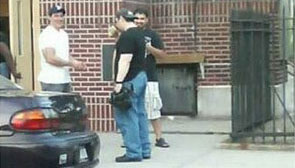
What's to ensure the pictures that end up on these websites are actually of catcallers? The photo included with this article only has context because of the caption, "Catcallers caught..." Alternate caption, "Three men on the sidewalk." How is the viewer supposed to know?
Pictures don't meet the test of truth and invite false accusations.
It is not a compliment. It
It is not a compliment. It is really degrading. Rather than get defensive, you men can become allies and educate your brothers to stop. I tried to count for a while how many times I get harassed while coming and going from work, running errands, meeting friends, and the average is about ten times per day. And then there are all the times that men have exposed themselves to me, grabbed me, lunged at me on the sidewalk so that I have to jump into traffic. These things are all part of a continuum. My little sister has been assaulted several times. This shit happens to every woman I know. It is a serious quality of life issue, there are whole streets I won´t walk or even bike down where it´s particularly bad. I have tried everything from engaging with the offenders to contacting law enforcement, only to feel like I am wasting time paddling upstream. If I tried to address every single incident, it would be a full time job I sure as hell didn´t ask for.
grabbing justifies direct use of force
Remember when you were a kid, and your sibling teased you until you hit them, but you got in trouble because, like your mom said "they're just words"?
Cat-calls, no matter how deeply annoying they are, are not the same as assault.
If anyone is actually being lunged at or grabbed on a regular basis (or more often than never), that calls for a healthy dose of pepper spray to the face.
I recommend Fox brand spray, it is the most powerful available to civilians.
Gray area
I recently met a new client who is one of the most attractive people I have met.
Due partially to shyness and mainly to professionalism, I did not say anything.
On our next meeting, as we got to talking, something came up in conversation which had me half deliberately mention it.
I quickly apologized for the lack of professionalism, though she assured me she found it to be positive and didn't mind.
I do not know if it would have been taken as well before we had got to know each other (slightly) through conversation, or at our first meeting, or if we were strangers passing by on the street.
Sometimes when it is very hot I take my shirt off. I do not do this to show off. Occasionally I get comments. These are invariably made by either men, or women I am not at all attractive to me. This makes me rather uncomfortable. I never-the-less am aware that they are made with positive intentions.
A close friend of mine is a runner. She often wears running shorts which could pass for underwear. She does not do this for attention, she is just oblivious to that sort of thing. Once a guy called out "nice legs". Nothing crude, nothing overtly sexual, he wasn't asking her contact information or condescending her. To be fair to the guy, she does have nice legs (because of all the running) and she was wearing something which, relative to the norm, could certainly have been seen as showing them off. She was very offended by the remark.
What I am trying to demonstrate is that there is a gray area.
Rape, sexual assault, and sexism are rampant and terrible in our society.
I feel it is disingenuous, perhaps even counter-productive, to pretend there is no difference between "harassment" and actual assault, or to pretend there is no gray area when clearly there is.
Despite the examples cited in the article, the vast majority of cat-callers do not attack women, and (as far as I know) no evidence exists to suggest that any correlation exists between cat-callers and rapists or perpetrators of violent crime.
This is not to say that harassment isn't an issue that needs to be addressed, but that we should be honest about it, and not simply promote reactionary outrage.
Post new comment
MoJo Comments: Send Us Your Feedback
We changed our spam software to better filter comments. Should you encounter any issues, please let us know.