• No Liberal Equivalent of the Federalist Society? Please.

    Over at Politico, Evan Mandery wonders why there’s no liberal equivalent to the Federalist Society, the right-wing legal organization that’s become the guiding light of conservative thought about the law:

    Over the past three decades, the Federalist Society has ascended from modest origins to become one of the most influential legal organizations in American history, with intellectual reach and political clout that no other legal group can match. As a presidential candidate in 2016, Trump effectively outsourced his Supreme Court picks to Federalist Executive Vice President Leonard Leo, and the group has enjoyed a near-lockdown on new appointments to the federal bench under Trump, most notably on the Supreme Court, where Justices Brett Kavanaugh and Neil Gorsuch each had long-standing Federalist ties prior to their nominations.

    So where’s the response from the left?

    ….There actually is one liberal analog to the Federalist Society, but chances are you haven’t heard of it: the American Constitution Society, founded in 2001, after the Supreme Court decision that effectively handed the presidency to George W. Bush….But the playing field is decidedly not level. The Federalist Society has more student chapters, more than twice as many lawyer chapters and a huge fundraising edge.

    This is wrong on a fundamental level. Liberals do have an equivalent to the Federalist Society, and yes, you have heard of it. In fact, conservatives studied it very carefully when they created the Federalist Society back in 1982.

    If you’re shaking your head here, I don’t blame you. What is this thing that I say you’ve heard of, but Mandery says doesn’t even exist? The answer is simple: it’s not one single organization. It’s a vast, well-funded movement that’s far older and far more influential than the Federalist Society. Its only problem is that it doesn’t have a name.

    It started in the 50s, when groups like the NAACP and ACLU began aggressively fighting for liberal causes in the Supreme Court. It continued as New Deal liberals took over law schools, professionalized them, and started churning out thousands of young lawyers steeped in a liberal understanding of the law. The Ford Foundation began funding legal aid groups in 1959, and later Congress created the Legal Services Corporation. In the 60s, powered by the legal sea change going on around it, the Warren Court revolutionized American constitutional law. At the same time, public interest law exploded, and in 1971 Ralph Nader started Public Citizen. And there were dozens of others: The Center for Law in the Public Interest, Public Advocates, the Natural Resources Defense Council, the Sierra Club Legal Defense Fund, the Leage of Women Voters Education Fund, and on and on and on. There were (and are) literally hundreds of these groups.

    This is what conservatives were up against in the 70s, and it’s why they started the Federalist Society. They weren’t politicizing the law out of the blue. They were responding to an explosive surge in the liberal legal network that, in their view, threatened to overwhelm conservative legal thought completely.

    So: do liberals have anything similar to the Federalist Society? Sure. But it’s not one single group that you can hang a name on. It’s an enormous network of liberal legal groups, some of them big and famous and some of them small and unknown. As usual with liberals, these groups are more focused on doing good than they are on pushing ideology, but there’s plenty of ideology involved too.

    Do we progressives need our own version of the Federalist Society? Maybe, but it’s really not the way we normally operate. Conservatives tend to be comfortable building big organizations that represents their interests. Building big umbrella organizations for liberals, by contrast, tends to be like herding cats. Over and over, no matter who tries or how much money is put into it, it just doesn’t work. We don’t want to be herded.

    So don’t complain that we don’t have a Federalist Society of our own. We do. The thing is, it’s a sprawling mishmash of groups with different focuses and different ideas. Why? Because that’s the way we like things.
  • Without Fox News, Republicans Would Be Toast

    How much effect does Fox News have on presidential voting? Here’s a trip down memory lane:

    2007: Stefano DellaVigna and Ethan Kaplan investigate the period between 1996 and 2000, when Fox News was being introduced. By 2000, some cities had it and some didn’t. The distribution was fairly random, and the researchers concluded that Republicans gained 0.4 to 0.7 percentage points in the places that carried Fox.

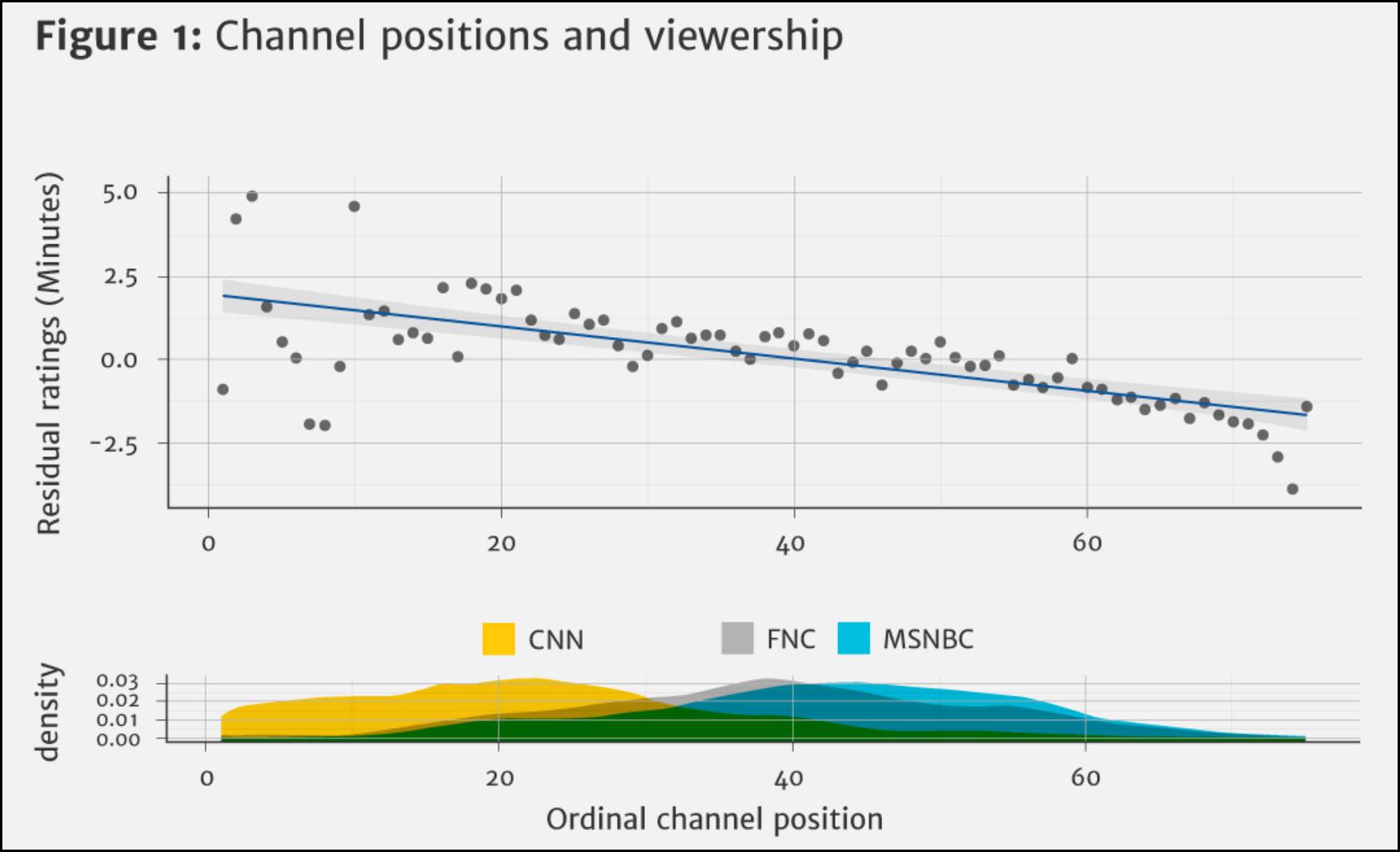
    2014: Gregory Martin and Ali Yurukoglu investigate the power of Fox News by exploiting the well known fact that channels with lower numbers on cable systems get more viewers than channels with higher numbers. The assignment of numbers is, again, fairly random, and they conclude that Republicans gained about 1.6 percentage points overall in 2000 thanks to the existence of Fox News.

    2017: Martin and Yurukoglu are back with a final version of their paper. This one reduces its estimate of the effect of Fox News to 0.46 percentage points in 2000.¹

    2019: Martin and Yurukoglu are back yet again with a summary of their 2017 paper. This time they highlight one of their snazzy charts:

    The top panel demonstrates how lazy we TV viewers are. By examining the same channels in different cities, M&Y find that, for example, Channel 40 gets about two minutes less viewership than Channel 20. The bottom panel of the chart shows the average position of the three big news channels. Fox News is around 38 while MSNBC is around 45:

    Given the position-related changes in Fox News viewership, this implies that every additional minute per week of average viewership in a zip code produced about a 0.15 percentage points increase in the Republican presidential vote share in that zip code.

    If I’m reading everything correctly, they estimate that the influence of Fox News on people who aren’t already Republicans is lower now than it was in 2000. However, Fox News is far more widespread than it was in 2000, so its net influence is up from 0.46 percentage points in 2000 to 6.3 percentage points in 2008. That is, if Fox News hadn’t existed, John McCain would have received 6.3 percentage points less of the popular vote. I didn’t buy that when I first reported on this paper, and neither does statistician Andrew Gelman.

    The problem is that these numbers depend on extrapolating from a few minutes of watching Fox to an hour of watching Fox, and it’s unlikely that this is a linear effect. So I’d guess that the real effect of Fox News is more likely something in the ballpark of one or two percentage points.

    Which is still a lot! Even a one percentage point influence would have been enough to swing both the 2000 and 2016 elections. I think it’s safe to say that the precise quantitative effect is hard to estimate precisely, but it’s still pretty clear that without Fox News the Republican Party would be in a world of hurt. Who knows? It’s even possible that they wouldn’t have won a presidential election since 1992.

    ¹They also estimate the effect of our leading liberal news channel:  “The corresponding effect of watching MSNBC for 2.5 additional minutes per week is an imprecise zero.

  • Senior Fraud Has Skyrocketed Since 2013

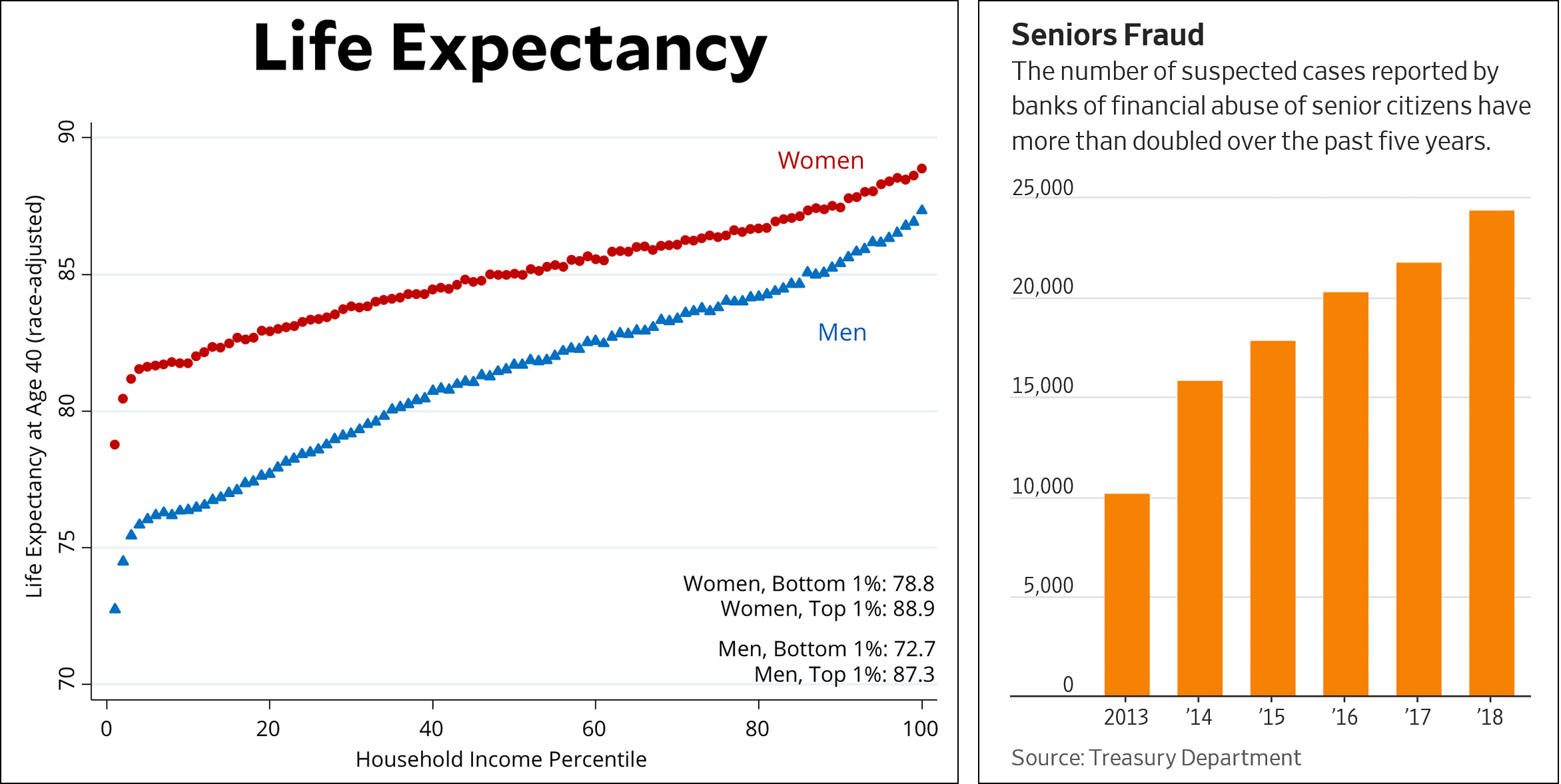
    We are living longer and longer, and that’s especially true of those with higher incomes. It turns out there’s a big downside to that:

    As we get older, the likelihood of dementia increases, and that makes us perfect prey for financial scammers. The Wall Street Journal reports today that financial scams against the elderly have more than doubled just since 2013:

    The increase occurred as new federal and state laws are prompting banks to take a more active role in trying to address frauds and scams that target older customers. For their part, banks are beefing up training programs for employees on how to detect, stop and report issues without violating a customer’s privacy. Employees are even learning to recognize early signs of cognitive decline.

    ….Last February, a customer in her late 70s walked into a New Canaan, Conn. branch of People’s United Bank, asking to wire $30,000 to her grandson. The customer said he had been in a car accident while vacationing in Mexico. Suspecting what is known as a “grandchild scam,” Rebecca Reed, an assistant manager, instead suggested the customer call her grandson. It turned out he had been at school all day—not in Mexico.

    “We can see it when something is not right,” said Ms. Reed, who has received a Fraud Fighter award from the bank.

    Keep your eyes open for this. Your aunts, uncles, grandparents, and parents will thank you.

  • Lead Exposure Creates Mean(er) Mockingbirds

    As we all know, there is considerable evidence that exposure to lead as an infant interferes with brain development, producing teenagers and adults who are more impulsive, more aggressive, and less intelligent. But suppose you want to really prove this. Ideally, what you’d want is a randomized controlled trial in which a group of infants is split randomly in two, with one half exposed to lead while the other half isn’t. Then you wait 20 years and see what happens.

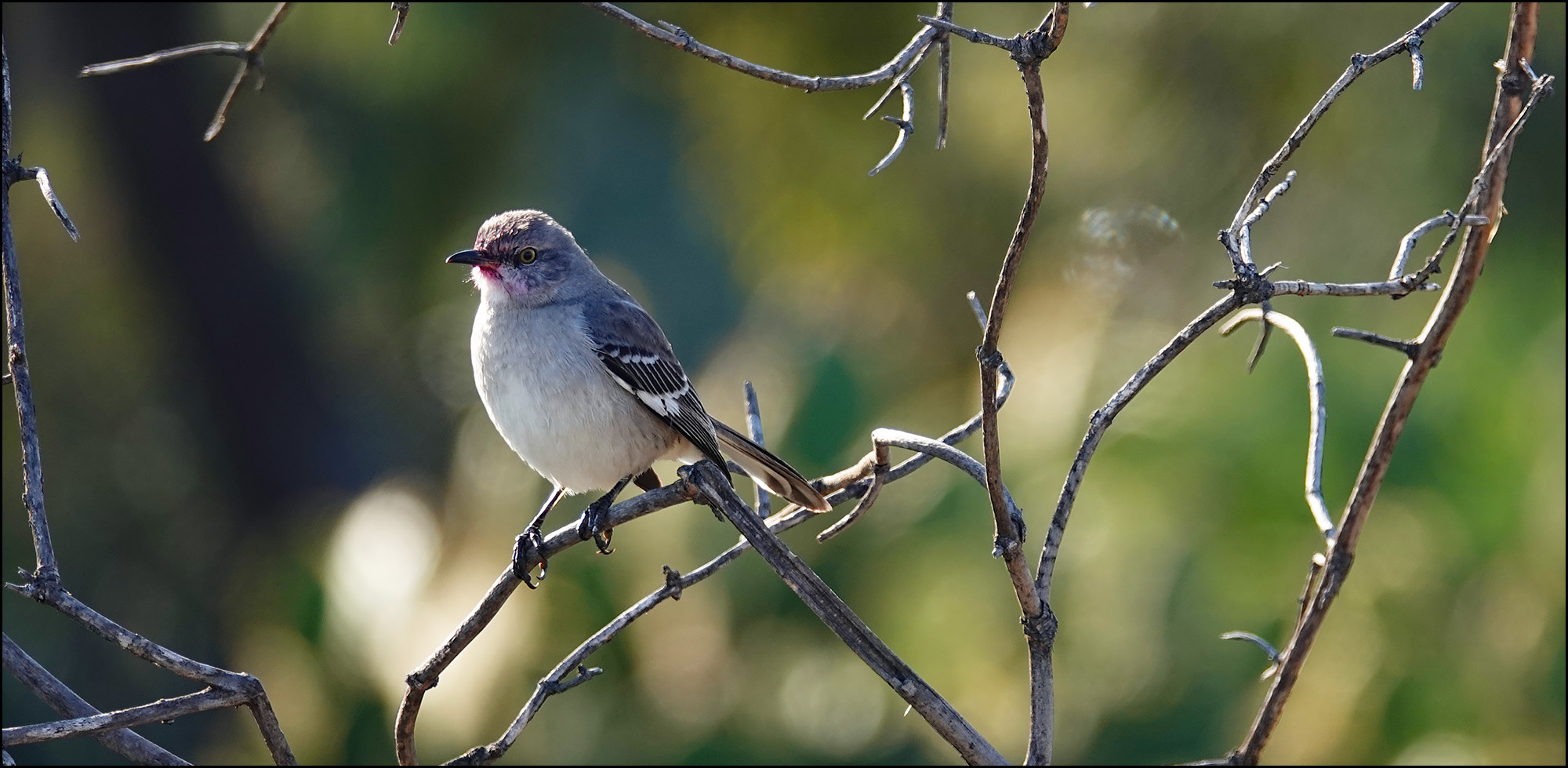
    Needless to say, this presents some wee ethical problems, so we can’t do it. And who wants to wait 20 years anyway? Instead, how about if we try this on some other animal? What we’d want is a species that tends to be sort of obnoxious already. For example, the northern mockingbird, which I just happen to have an excellent picture of:

    So when are northern mockingbirds even more obnoxious than usual? When they’re building their nests. And how do you bait them into aggressive acts? Like this:

    Researchers placed a taxidermized mockingbird on a tripod, 25 feet away from nests that pairs of mockingbirds were constructing, a situation in which the birds act most territorial. The researchers also played recorded songs of singing males to alert the mockingbirds and make the intrusions more realistic.

    So you make the mockingbirds think they’re under attack and then observe their behavior. Here’s what happened:

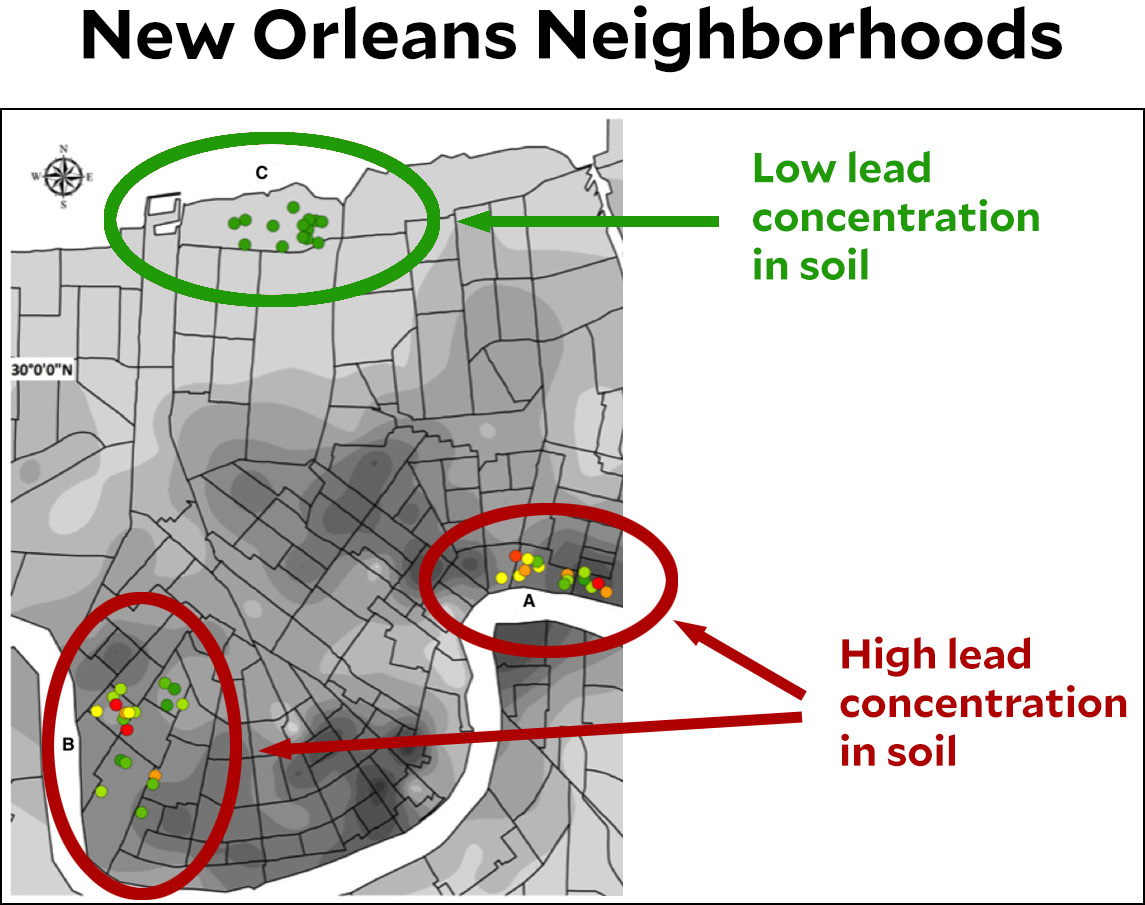
    In the neighborhoods with low lead levels, the mockingbirds responded to the threat somewhat conservatively, with scolding call vocalizations, raised-wing displays or fly-bys. In high-lead neighborhoods, though, the mockingbirds responded far more aggressively, attacking the perceived intruder and even ripping out its feathers. Researchers learned quickly they had to place the fake bird in a cage to continue the study and protect it from damage.

    This study was done at Tulane University in New Orleans, where Howard Mielke has done considerable research into lead and already has detailed maps showing the lead content in various neighborhoods:

    In the Lakeshore neighborhood, at the top of the map, the mockingbirds had an average aggressiveness score of about -1.0. In the Marigny and Uptown neighborhoods the birds scored 0 and 1.2.

    So there you have it. Lead is bad for human infants, and apparently it’s bad for mockingbirds as well. In both cases, the problem is lead in soil: human babies crawl around outside and then stick their hands in their mouths, while mockingbirds eat worms that have ingested lead particles. Either way, it’s bad news.

  • BREAKING: Davos Billionaires Hate High Taxes

    Here is today’s least surprising headline:

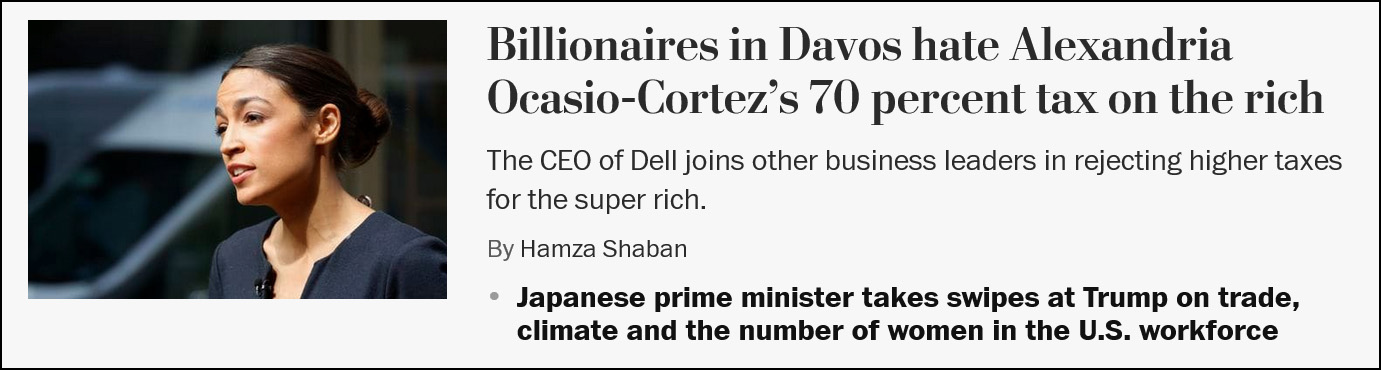
    According to the Washington Post, Michael Dell was asked if he supported a 70 percent tax rate on income over $10 million. However, the audience “burst into laughter” before he could answer.

    Eventually the answer turned out to be—wait for it—no! And all the other billionaires hated the idea too! Imagine that. However, this was not—not not not—because they are  greedy and want to keep all their money. Heavens no. Scott Minerd, chief investment officer of Guggenheim Partners, explained: “It affects the people that have the most money, and they will start allocating capital in a way that is less efficient and will bring down productivity.”

    So you see, low tax rates on the rich benefit us all.

  • Lunchtime Photo

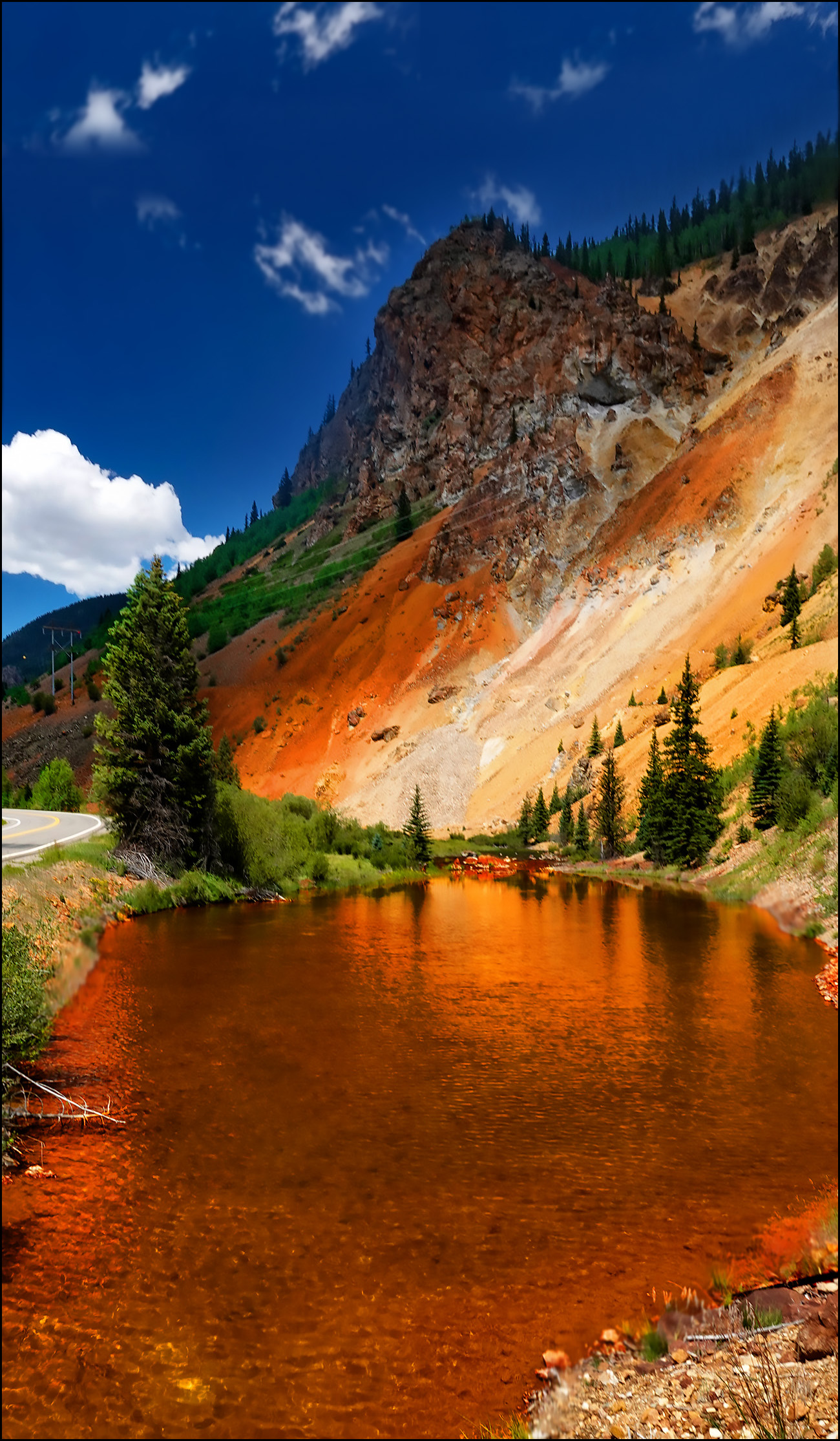
    This iron-colored pond is just north of Silverton, Colorado. It doesn’t appear to be fed by anything, so I suppose it’s filled by rainwater or runoff of some kind.

    For some reason this picture doesn’t really do much for me. It seems like it has most of the elements that make up a decent photo, but the whole is less than the sum of its parts, or something. I’m curious to find out if this is just me, or if others find it kind of pedestrian too.

    August 11, 2018 — Near Silverton, Colorado
  • The Rich Are Different From You and Me

    From the Wall Street Journal:

    Billionaire Ken Griffin, who is becoming almost as known for his prodigious purchases as he is for his investment acumen, has closed on a New York penthouse for roughly $238 million. The deal sets a record for the highest-priced home ever sold in the U.S.

    Huh. Griffin already owns mega-homes in Chicago, London, and Miami Beach, and has one under construction in Palm Beach. So why does he need a gargantuan New York penthouse?

    A spokeswoman for Mr. Griffin confirmed the purchase. She said Citadel is expanding its presence in New York with its new office at 425 Park Avenue, and Mr. Griffin was looking for a place to stay when he’s in town.

    Um, OK. I guess that makes sense. But only if this place has a helipad on the roof.

  • Build a Fence and Crime Will … Do Nothing

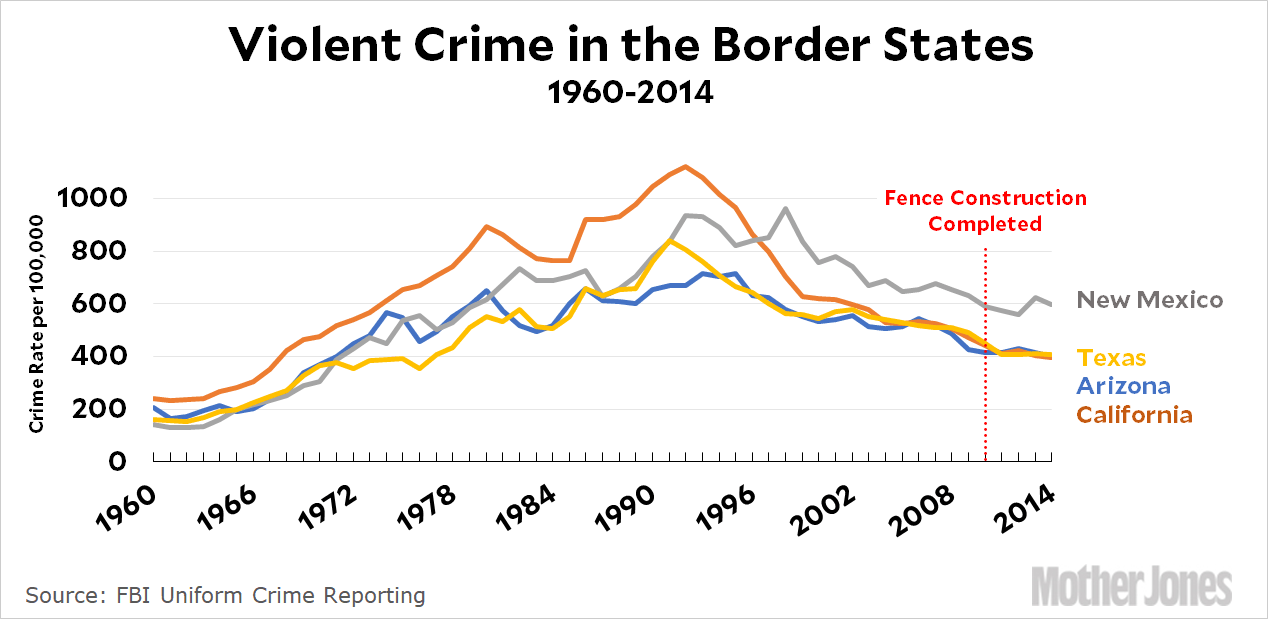
    Apparently President Trump has decreed that the new Republican slogan is “Build a wall and crime will fall.” As we all know, what he really means by “wall” is a steel bollard fence, just like the one we finished building in 2010 over about 600 miles of the southern border. So how did that turn out? Did crime fall after the fence went up?

    It looks to me like violent crime was falling in the border states pretty nicely, but then then it stopped falling when the fence went up. So much for that theory.

  • Obamacare Remains Pretty Popular in 2019

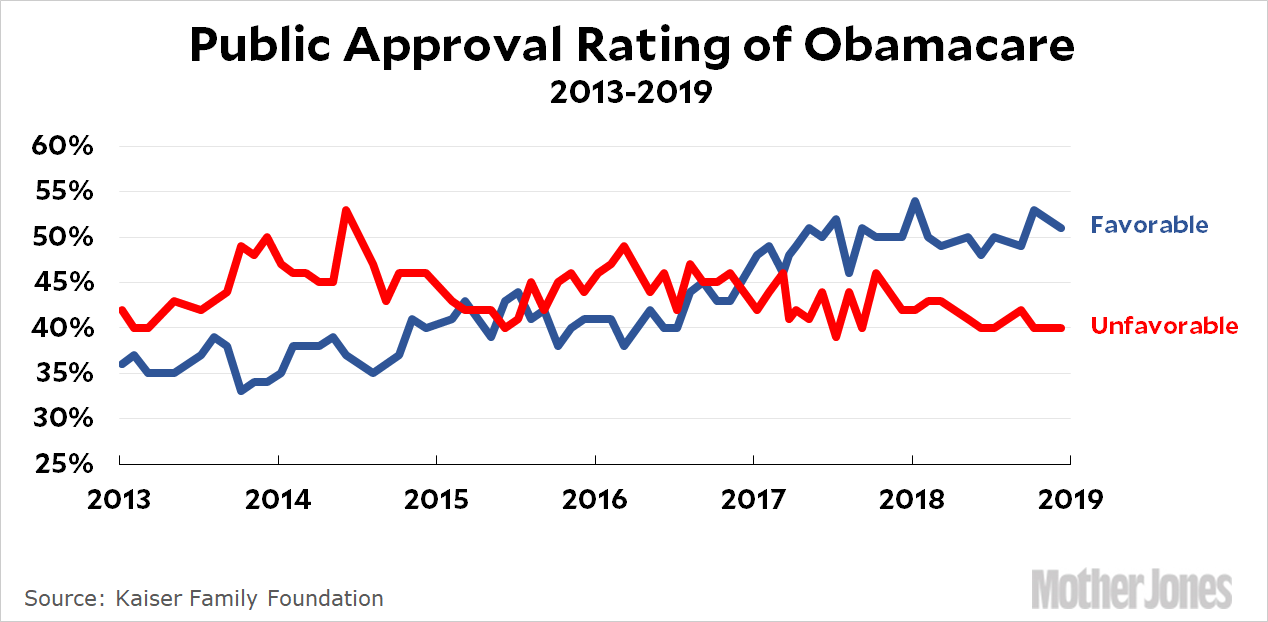
    As long as we’re on the subject of Obamacare, here’s the latest Kaiser tracking poll on its favorability rating:

    Nothing much has changed. Obamacare opened up a big favorability gap around the time Republicans tried to take it away, and that gap is now hovering around ten percentage points on a pretty consistent basis. This is mostly due to more favorable responses from Democrats (80 percent favorable) and Independents (50 percent favorable). Republicans have stayed at a dismal 18 percent favorable the whole time.

  • The Uninsured Rate Has Soared Under Trump — Maybe

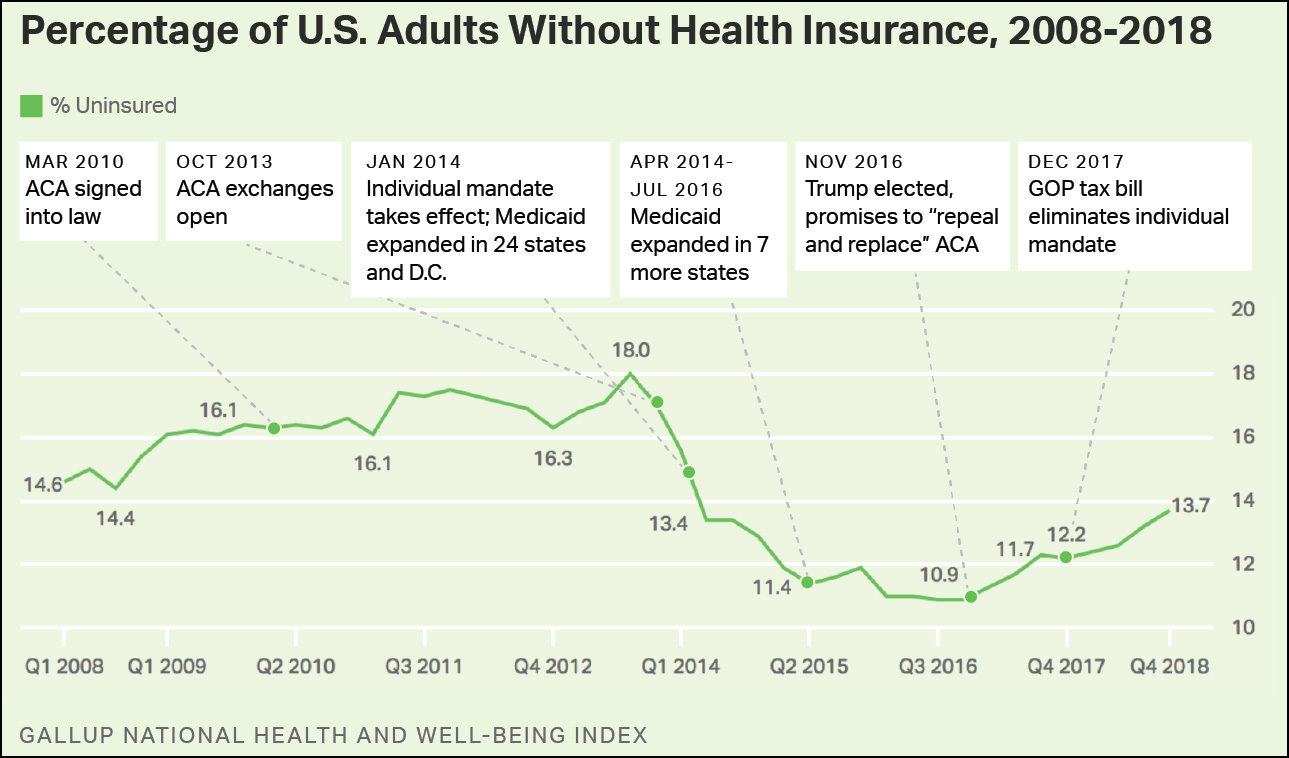
    Today Gallup announced that the uninsured rate for all adults had reached 13.7 percent, a rise of nearly three percentage points since Donald Trump was elected:

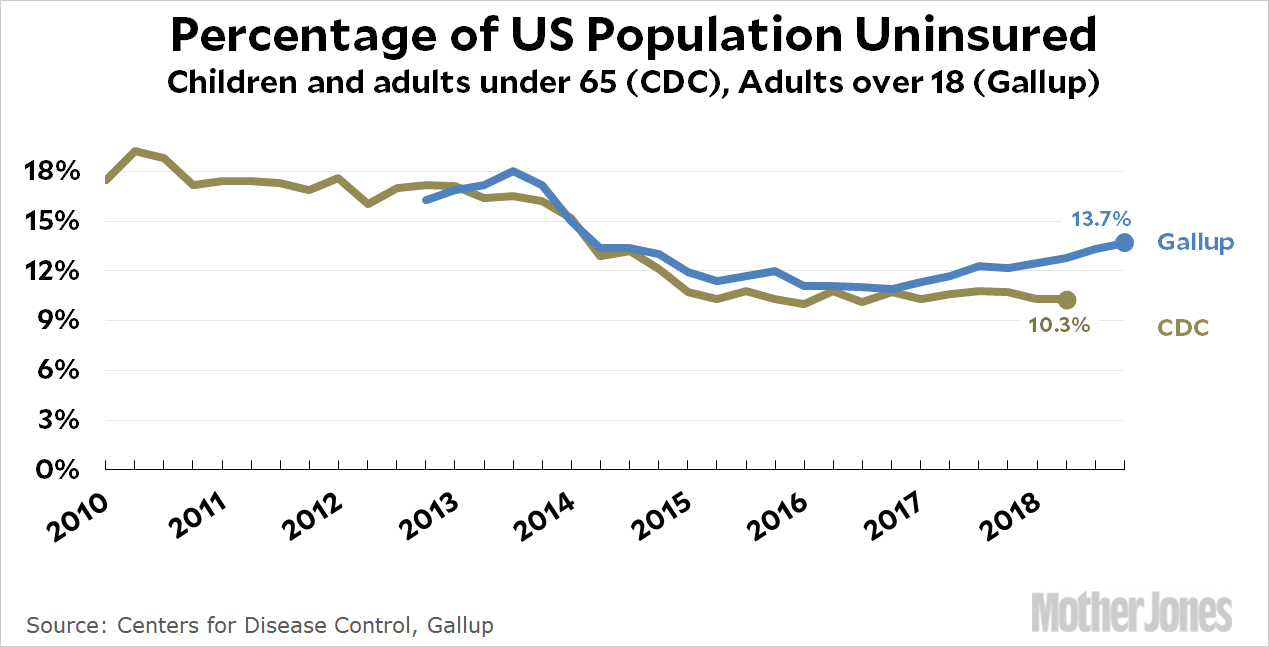
    I’m not quite sure how seriously to take this. There are various surveys of the uninsured rate, and I generally consider the CDC survey to be most accurate. However, it’s also the most out-of-date: the most recent CDC survey is from the second quarter of 2018, nearly a full year ago. The CDC and Gallup survey also measure slightly different things. That said, they produced pretty similar estimates all the way through 2016. Then they started to diverge:

    So who’s right? For now, I’d put my money on the CDC, and suggest that there’s no reason to panic over Gallup’s surprisingly high number. But that’s not a sure thing. We’ll just have to wait and see if the CDC number stays flat, or if it starts to catch up to Gallup later in the year.