Bruce Bartlett writes today that the federal tax code violates principles of both horizontal and vertical equity. The table below illustrates his point:
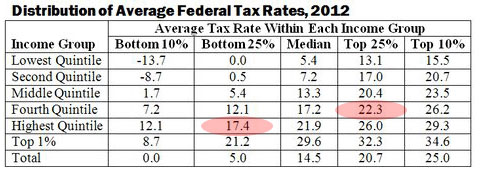
Reading across the chart, people who make roughly the same amount of money can pay wildly different tax rates. In the middle quintile, tax rates vary from 1.7% to 23.5%. In the richest quintile, tax rates vary from 12.1% to 29.3%. That’s a violation of horizontal equity, the principle that people who make similar amounts of money ought to pay roughly similar taxes.
The red ovals illustrate the violation of vertical equity, the principle that people who make more money ought to pay higher tax rates. Although the federal tax system is generally progressive, there are startling exceptions. The most heavily taxed segment of fourth quintile, which represents incomes of around $80-100 thousand, pays higher rates than the most lightly-taxed segment of the fifth quintile, which represents incomes of $100+ thousand.
The reason for this is partly because we tax different kinds of income very differently, and partly because the tax code is littered with targeted deductions and tax credits that some people can claim but not others. If you make a lot of money from dividends and capital gains, you pay a much lower rate than someone who makes a similar amount from wages. If you own a big home, you get to take a mortgage interest deduction not available to someone who doesn’t.
In theory, tax rates are lower on capital gains and dividends because this raises the stock of capital, which is good for the economy. But as Bruce dryly points out, “The empirical question of whether sharply lower taxes on capital, and hence the wealthy, has actually raised saving, investment and productivity is one I will revisit. Suffice it to say that since 2003, when the current tax rates on capital gains and dividends were instituted, the economy offers little, if any, evidence on this score.” He has more at the link.